
Analysis: You may never have heard of AirNav Ireland but its multi-million windfall is a useful reminder about Ireland’s aviation influence
Most people have never heard of AirNav Ireland, and fewer still know it owns a slice of a satellite company. That’s about to change, at least for the accounts department. The semi-state company is set for a multimillion-euro windfall as US satellite operator Iridium buys out the stake it holds in Aireon, the company that tracks aircraft from space, in a deal worth roughly €321 million.
What exactly is being sold?
Aireon runs the world’s only space-based air traffic surveillance system, flying as a payload on Iridium’s satellite constellation since 2019. Rather than relying on ground radar, which has gaps over oceans and remote regions, Aireon tracks aircraft everywhere on the planet using onboard transponder signals picked up from orbit.
Iridium is buying the remaining 61% of Aireon it doesn’t already own, for around $367 million, from NAV Canada, AirNav Ireland, Italy’s ENAV, the UK’s NATS and Denmark’s Naviair. Half of this is paid on closing, the rest a year later and Iridium is also taking on roughly $155 million of Aireon’s debt.
We need your consent to load this rte-player contentWe use rte-player to manage extra content that can set cookies on your device and collect data about your activity. Please review their details and accept them to load the content.Manage Preferences
From RTÉ Radio 1’s Drivetime in 2015, then IAA chief executive Eamonn Brennan talks about the Aireon global aircraft emergency tracking centre to be set up in Ballygirreen, Co. Clare
Why does Ireland own a piece of a satellite company?
Back in 2013, Ireland’s air navigation body – then the Irish Aviation Authority, now AirNav Ireland – bought in as one of Aireon’s founding investors back , alongside ENAV and Naviair, in a $120 million tranche that ran through 2017. NAV Canada put in a further $150 million on its own.
The logic at the time was straightforward: Ireland controls a chunk of the North Atlantic Tracks, the busiest oceanic airspace on the planet, and radar simply doesn’t reach that far out to sea. Then IAA chief executive Eamonn Brennan said the technology would bring “significant benefits to airlines flying in remote and oceanic airspace”. More than a decade on, that’s exactly the position Ireland finds itself cashing in from.
What does the payout mean for AirNav Ireland?
In pure accounting terms, this is a good outcome: a small state-owned body turning an early bet on unproven space technology into a real cash return more than ten years later. What isn’t yet clear is how AirNav Ireland plans to use its share.
We need your consent to load this rte-player contentWe use rte-player to manage extra content that can set cookies on your device and collect data about your activity. Please review their details and accept them to load the content.Manage Preferences
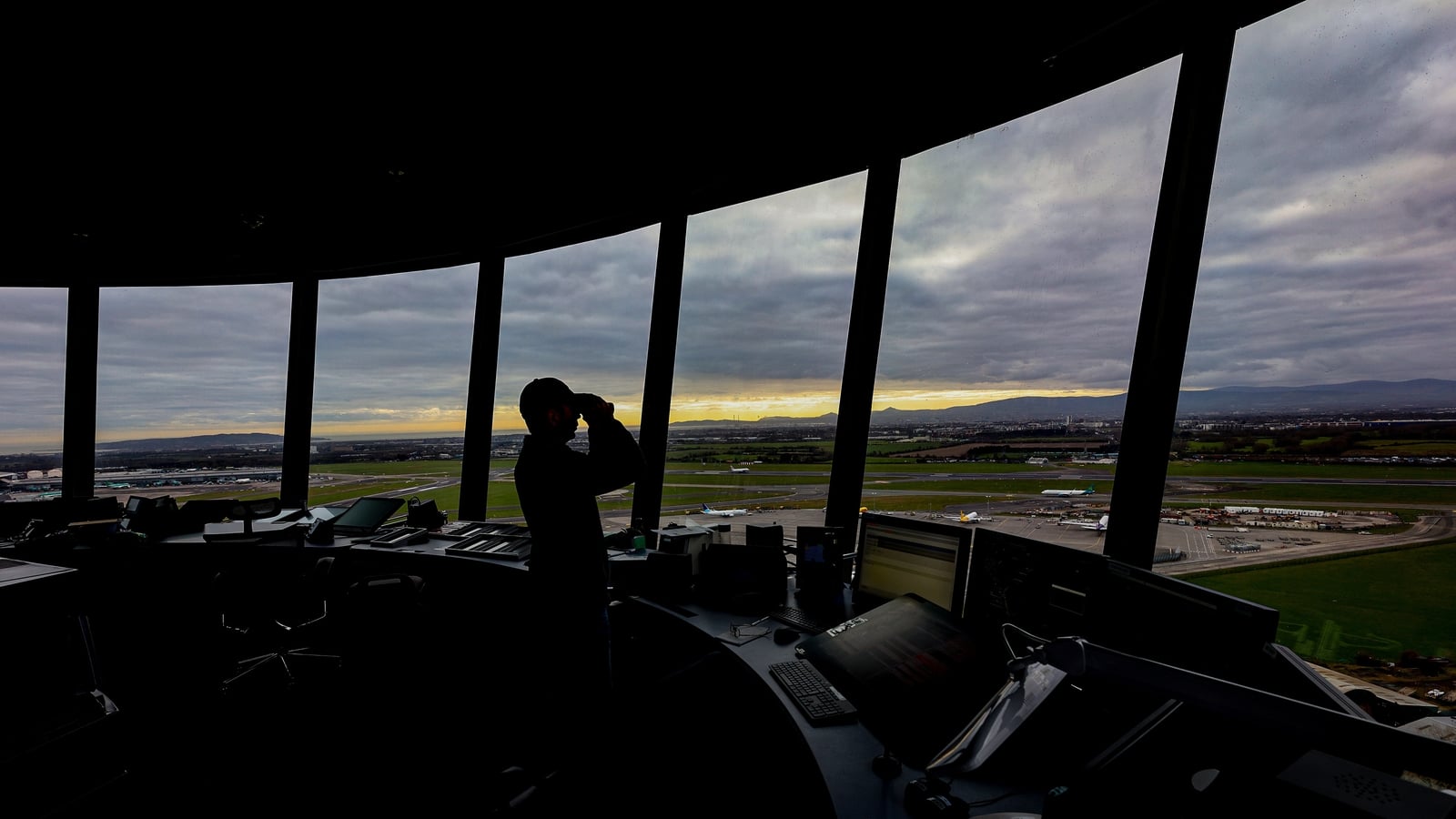
From RTÉ Radio 1’s Oliver Callan, what’s it like to work as an air traffic controller?
Iridium’s own framing of the deal is about consolidating space-based surveillance, satellite communications and aviation data services under one roof. Their chief executive Matt Desch points to “growing air traffic, denser airspace, autonomous aircraft” as the reason why the deal makes sense now. That last phrase is worth sitting with, because it’s not just about airliners anymore.
How does this connect to Ireland’s drone and air-taxi plans?
Space-based surveillance exists to solve one problem: tracking aircraft where ground infrastructure can’t reach. That’s precisely the problem facing drones and air taxis flying beyond visual line of sight, and Ireland already has a live test case for it.
At Shannon, Future Mobility Campus Ireland has been running the ÉALÚ-AER project, an EU-funded U-space demonstrator that trialled exactly this kind of surveillance gap-filling for drone and eVTOL traffic, using radar and third-party surveillance feeds to track aircraft with no cooperative transponder signal. Two of its three technology strands have already reached Technology Readiness Level 8, and FMCI secured planning permission for a permanent vertiport at Shannon Airport in October 2025.
We need your consent to load this rte-player contentWe use rte-player to manage extra content that can set cookies on your device and collect data about your activity. Please review their details and accept them to load the content.Manage Preferences
From RTÉ Brainstorm, from toys to wars, where will you encounter drones next?
While none of that runs through Aireon directly, it’s built on the same underlying premise Ireland backed in 2013: that low-altitude and remote airspace can’t be managed by ground radar alone, and whoever builds the surveillance layer for it gets to shape how that traffic grows. Ireland has now been on both sides of that bet – as an equity holder in the system that solved it for oceanic airliners, and as a live proving ground doing much the same for drones and air taxis. Whether AirNav Ireland or the Government sees a case for reinvesting any of this windfall into that second effort is, at this point, an open question rather than an announced plan.
Is this actually significant or just a tidy accounting story?
It’s fair to ask whether this is more than a footnote. A sum of €321 million split across five shareholders isn’t going to transform Irish aviation policy on its own, but it’s a useful reminder that Ireland’s aviation influence has never been about size. This is a small state body that put money behind an unproven idea more than a decade ago because it understood a genuine gap in its own airspace – and it’s now being rewarded for getting there early.
The real test is what happens next. Ireland is simultaneously collecting a payout from yesterday’s surveillance gap and building the infrastructure for tomorrow’s out at Shannon. Whether those two things end up connected, or whether the windfall just quietly disappears into the exchequer, will say a good deal about how seriously Ireland takes its own ambitions in advanced air mobility.
Follow RTÉ Brainstorm on WhatsApp and Instagram for more stories and updates
The views expressed here are those of the author and do not represent or reflect the views of RTÉ