
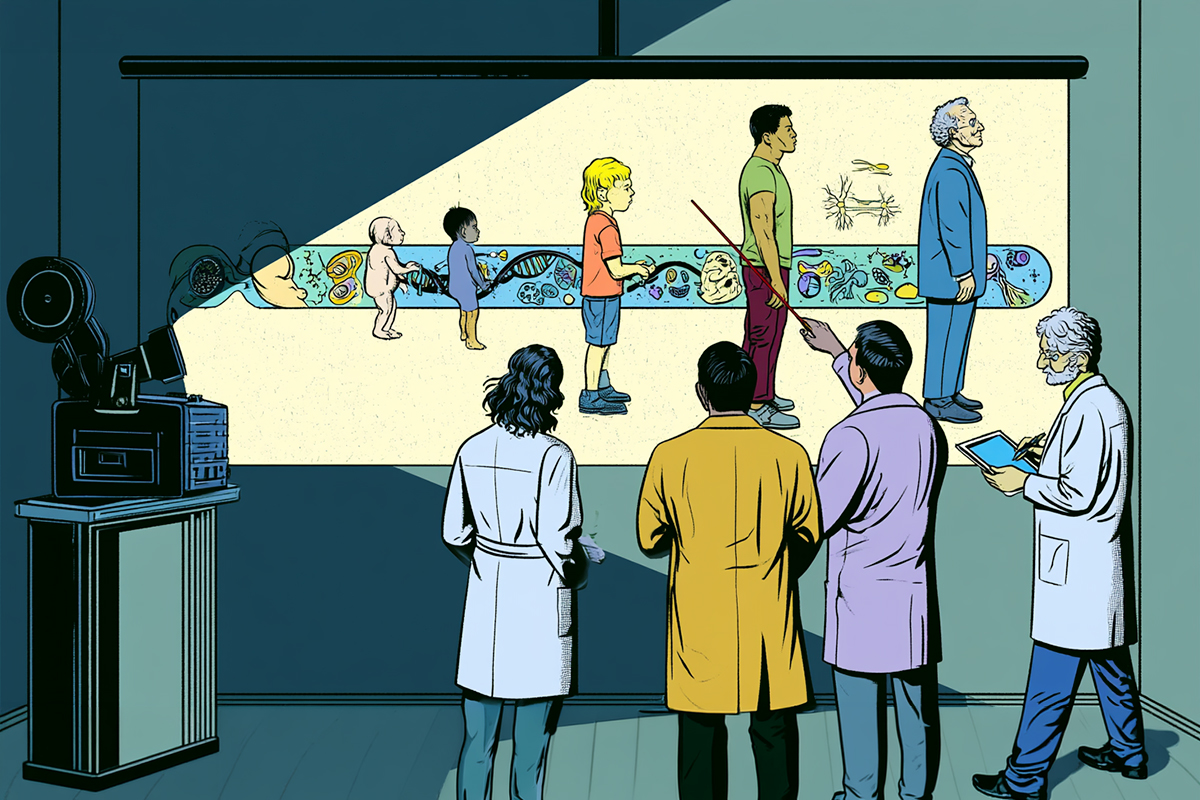
New international consortium argues healthy aging’s foundations are laid long before old age – perhaps before birth itself.
Longevity medicine has become remarkably adept at asking how we might slow biological aging in adulthood. It has spent rather less time asking a simpler question: what if we have been starting the conversation decades too late?
That is the premise behind a new Nature Health Correspondence introducing the Life-course Healthy Longevity Consortium – an international collaboration bringing together leaders in geroscience, pediatrics, obstetrics, epidemiology and precision medicine to explore how the biological foundations of lifelong health are established from preconception onwards. Rather than focusing exclusively on extending life in later years, the consortium asks whether healthy longevity should be viewed as a continuous process spanning the entire life course.
It is, in one sense, an elegantly simple idea. Increasing evidence suggests that maternal health, the intrauterine environment and early childhood exert lasting influences on physiology, resilience and susceptibility to chronic disease; yet these insights have largely remained the preserve of developmental biology and pediatric medicine, while longevity science has concentrated on understanding – and increasingly intervening in – the biology of aging once adulthood is well underway. The Life-course Healthy Longevity Consortium proposes that those two conversations should no longer remain separate.
Longevity.Technology: Perhaps the most uncomfortable implication of this paper is not that aging might begin earlier than we thought, but that longevity medicine may have defined its patient population too narrowly. The field has invested extraordinary effort in measuring, slowing and even reversing biological aging in adults; comparatively little attention has been paid to the decades during which resilience, physiological reserve and disease susceptibility are first being shaped. None of this diminishes the importance of therapies for older adults – nor does the consortium suggest that developmental biology can simply be viewed through a geroscience lens. Quite the opposite. Its central argument is that childhood requires its own biomarkers, its own biological reference curves and perhaps even its own definition of what healthy biological aging looks like. If that proves correct, longevity medicine may eventually become less about extending late life and more about quietly improving the trajectory that leads there.
Why the field is looking earlier
None of this is new. The developmental origins of health and disease hypothesis has spent decades tracing a quiet thread from maternal nutrition and fetal development to cardiovascular disease, metabolic disorders, and the long slow arithmetic of chronic illness. What has changed is not the evidence but who is finally listening to it; longevity science, having spent so long fixated on life’s second half, is only now admitting that the first half was never merely prologue.
The authors write that healthy longevity medicine has “primarily focused on adult populations” despite growing evidence that biological factors and environmental exposures during preconception, pregnancy and early postnatal life exert persistent effects on health trajectories, intrinsic capacity, peakspan and long-term disease susceptibility. They argue that this leaves a critical window of opportunity largely unexplored, with gerodiagnostic and geroprotective thinking only beginning after decades of accumulated molecular and cellular change [1].
That distinction matters because prevention, in its conventional medical sense, often means identifying disease before symptoms appear; the consortium is proposing something more ambitious – identifying opportunities to optimize biological trajectories before elevated disease risk has even emerged. Rather than asking how to repair damage accumulated over half a century, researchers may increasingly ask how that trajectory might have been shaped fifty years earlier.
The complication is that biological age means something rather different in childhood than it does in adulthood. Most of the biomarkers attracting attention in longevity medicine today – epigenetic clocks among them – were developed using adult populations, where biological age largely reflects the accumulation of molecular damage over time. Childhood is another matter entirely: a biological age that appears “advanced” might represent healthy maturation, an adaptive response to the environment, or the earliest signs of pathology, and distinguishing between those possibilities is far from straightforward. The authors argue that developmental biology requires “age-specific models, biomarkers and interpretative frameworks” rather than a simple extension of adult aging metrics; existing biomarkers, they note, “cannot be directly extrapolated to children without risking misinterpretation [1].”
 A corresponding author on the paper, Professor Evelyne Bischof is Professor of Medicine at Shanghai University of Medicine and President of the Healthy Longevity Society.
For Professor Evelyne Bischof, this is one of the consortium’s defining scientific challenges. “Healthy development and biological aging are distinct processes,” she told Longevity.Technology. “The Life-course Healthy Longevity Consortium therefore integrates developmental, functional, molecular, environmental and clinical biomarkers rather than relying on adult epigenetic clocks alone. Our goal is to identify trajectories that reflect optimal development versus early biological vulnerability across the life course.”
There are already pediatric epigenetic clocks under development, she noted, but the field remains in its infancy. Understanding which biomarkers are meaningful at different stages of development – and establishing normative reference curves against which individuals can be interpreted – will require extensive longitudinal datasets spanning pregnancy, infancy, childhood and adolescence.
Professor Tzipora Strauss believes the distinction goes even deeper. “The central premise of the consortium is that healthy longevity begins long before aging itself, through the biological and environmental processes that shape development from preconception onward,” she said. “Healthy longevity begins by optimizing development, because the trajectory of aging is shaped long before aging itself becomes clinically apparent. This life-course approach represents a shift from studying aging only in older adults to understanding how the foundations of healthy aging are established from preconception, pregnancy, infancy, childhood and adolescence.”
That represents an intriguing shift in perspective. Rather than viewing childhood merely as the period before aging begins, the consortium instead regards it as the period during which lifelong resilience – or vulnerability – is gradually established.
Building a life-course framework
The consortium’s ambitions extend well beyond publishing position papers. Its immediate focus is on building the infrastructure needed to study healthy longevity across the life course – harmonizing existing pregnancy, birth and pediatric cohorts, integrating multiomics with clinical phenotypes and functional measures, developing standardized biomarkers and creating shared analytical frameworks capable of following individuals from preconception through adulthood.
Speaking to Longevity.Technology, Bischof explained that the goal is not to create another isolated research program, but to connect the many valuable resources that already exist. “Rather than duplicating efforts, we aim to connect and harmonize these invaluable resources, because together we are stronger,” she said. “By integrating data across cohorts, populations and disciplines, we hope to better understand how the foundations of biological aging are established from preconception and early life onward, identify the key biological and environmental determinants of lifelong healthspan, and define the most informative biomarkers and surrogate endpoints to measure healthy aging trajectories from the very beginning of life.”
That emphasis on infrastructure is easy to overlook amid discussions of biological age and early intervention; yet it may prove to be one of the consortium’s most important contributions. Longitudinal human studies spanning decades are notoriously difficult to establish from scratch – connecting existing cohorts instead offers the prospect of answering questions that no single study could realistically address.
The accompanying figure in the paper quietly reinforces that philosophy. Rather than proposing an entirely new clinical pathway, it overlays life-course opportunities – from preconception optimization and neonatal nutrition to adolescent sleep, cardiometabolic fitness and transition into adult care – alongside familiar obstetric and pediatric milestones [1]. The suggestion is subtle but unmistakable: tomorrow’s routine care could eventually incorporate biomarkers of resilience and biological trajectories alongside today’s vaccinations, developmental assessments and metabolic screening.
The authors’ original Figure 1, a version of which appears in Nature Health Communications Training tomorrow’s longevity physicians
If the science changes, clinical practice must eventually follow.
Medicine has traditionally divided itself into discrete specialties, each concerned with a particular stage of life. Obstetricians manage pregnancy; pediatricians care for children; geriatricians focus on older adults. Efficient perhaps, but not especially conducive to viewing health as a continuous biological trajectory. The Correspondence identifies this compartmentalization as one of the obstacles limiting translation into clinical practice, arguing that obstetric, neonatal, pediatric and adult medicine have largely developed as separate disciplines with limited integration of longitudinal biological trajectories.
Strauss is keen to emphasize that the consortium is not proposing to replace established models of care. “For decades, maternal and pediatric care has been remarkably successful in improving survival,” she said. “The next frontier is to optimize lifelong healthspan. We are not replacing current standards of care – we are expanding them by asking how today’s clinical decisions may influence health decades later.”
A corresponding author on the paper, Professor Tzipi Strauss is Professor of Pediatrics & Neonatology at Sheba Medical Center and Head of Sheba Longevity Institute.
Bischof agrees that achieving that vision will depend on evidence rather than aspiration. “This requires a paradigm shift from disease treatment to lifelong health optimization,” she said. “The consortium aims to develop evidence-based frameworks that integrate healthy longevity principles into maternal, fetal, pediatric and adolescent care, emphasizing prevention, resilience and long-term functional outcomes across the entire life course. Once evidence is created, doctors willingly shift and expand their scope of focus.”
Strauss perhaps summarized the ambition most succinctly. “Our vision is that every obstetrician and pediatrician becomes a physician not only of pregnancy or childhood, but also of future healthy longevity.”
Measuring change without waiting a lifetime
An obvious question follows. If the interventions proposed today may not influence disease risk until middle or old age, how can researchers ever demonstrate that they work?
The consortium’s answer is that longevity research will need to become more sophisticated in its choice of endpoints. Rather than waiting for clinical events decades hence, Bischof envisages validated intermediate measures incorporating physiological function, cardiometabolic health, cognitive development, immune resilience and emerging molecular biomarkers, supported by long-term observational follow-up. “Adaptive and n-of-1 trial designs and harmonized longitudinal cohorts will help establish whether early-life interventions shift lifelong health trajectories,” she said, “without waiting decades for definitive disease endpoints.”
Strauss added that one of the consortium’s major objectives is to establish international consensus around which biomarkers and surrogate endpoints are appropriate at different stages of development. “The biomarkers relevant during fetal life or infancy will not necessarily be the same as those used during adolescence or adulthood,” she said. “This framework has the potential to accelerate preventive medicine by allowing us to evaluate interventions based on their impact on lifelong health trajectories rather than waiting decades for disease outcomes.”
It is an acknowledgement that the field may ultimately require not only new biomarkers, but new ways of thinking about clinical trials themselves.
The consortium behind the idea
Scientific ideas gain momentum when they attract communities rather than individuals, and in that respect the Life-course Healthy Longevity Consortium is notable. Alongside Strauss and Bischof, its founders include longevity A-listers Steve Horvath, Brian Kennedy, Thomas Rando, Alex Zhavoronkov, Vadim Gladyshev, Nir Barzilai, James Kirkland, David Furman, Eric Verdin, Boaz Weiss, Luigi Ferrucci, Morten Scheibye-Knudsen, Rafael de Cabo and Pinchas Cohen.
That breadth matters because the initiative reaches well beyond aging biology. Obstetrics, neonatology, pediatrics, epidemiology, systems biology and precision medicine have each pursued related questions through their own dialect for decades; the consortium’s first task, in effect, is translation before it can ever attempt consensus. Whether that proves successful remains to be seen. Coordinating international cohorts, harmonizing datasets and validating biomarkers across disparate populations is a formidable undertaking, certainly – but a life-course approach attempted any other way is difficult to picture at all.
The long view, taken late
Whether this changes clinical practice depends on evidence gathered over years, perhaps decades. That is not a flaw in the plan; it is the plan. A life-course phenomenon, studied only once middle age arrives, is retirement-age curiosity about whether childhood education mattered – asked several decades too late to do anything useful with the answer.
The consortium is not claiming to have answered that question. Its task is more ambitious, and arguably more difficult: to determine whether the biology supports it. If it does, the future of longevity medicine may begin to look considerably earlier than anyone imagined.