
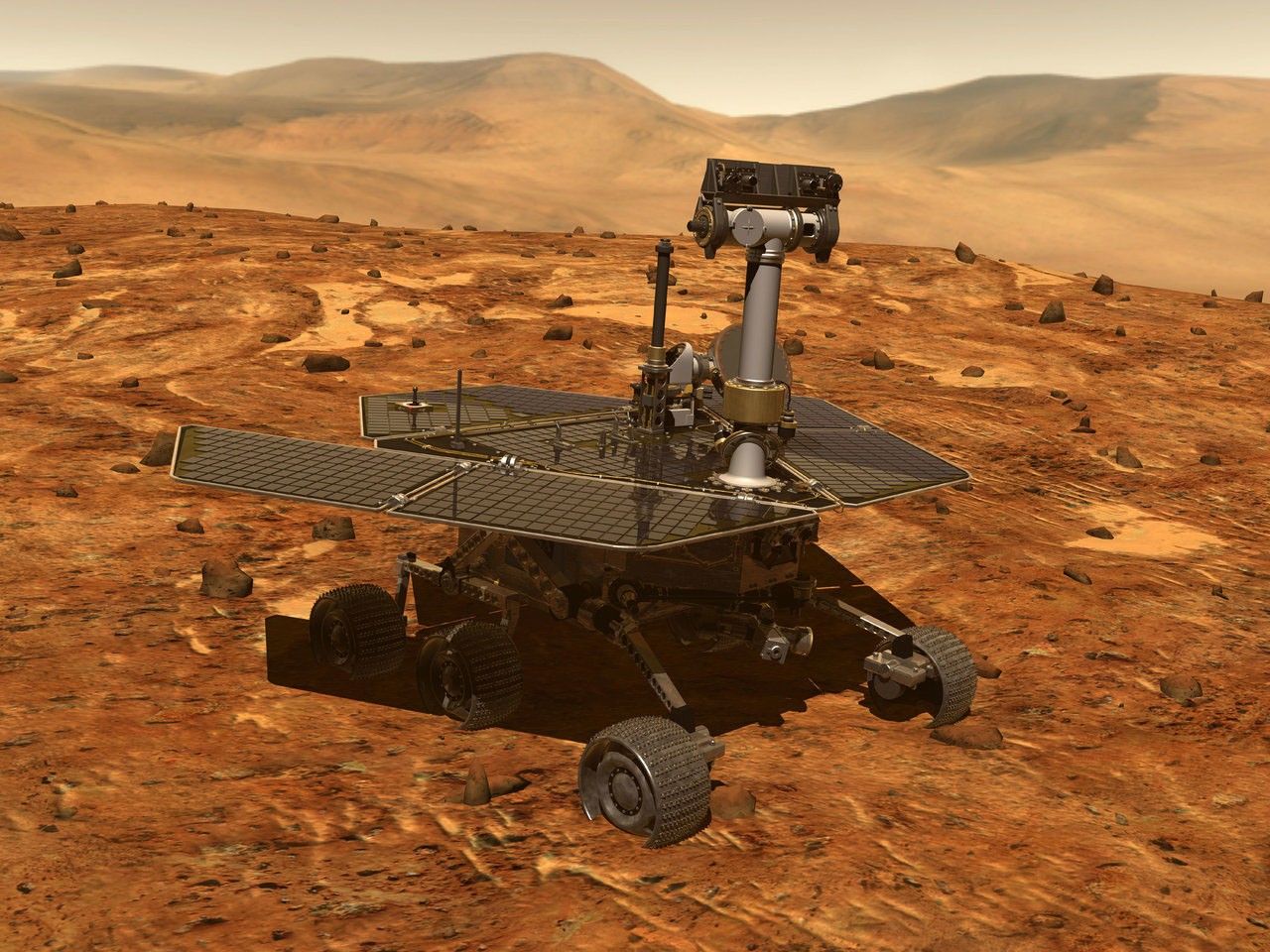
The answer was already on Earth. Nearly 5 terabytes of raw data from NASA’s Spirit rover — filed away in the Planetary Data System after the rover fell silent in 2010 — contained the fingerprints of crystalline hematite and altered magnetite in ordinary Martian topsoil. Nobody found them, because nobody had yet tried stacking all 2,062 sols of Mössbauer measurements into a single consolidated spectrum. Paulo de Souza, Deputy Vice-Chancellor Research at Edith Cowan University (ECU) and a veteran of Spirit’s original science team, did exactly that — and what emerged rewrites the water history of Gusev Crater.
Both minerals are aqueous markers. On Earth, crystalline hematite almost always forms when iron-bearing rock spends sustained time in contact with liquid water — through precipitation from Fe-rich solutions, hydrothermal alteration, or slow groundwater dissolution-recrystallization. The altered (non-stoichiometric) magnetite de Souza identified points in the same direction: its partially oxidized iron signature is consistent with low-temperature aqueous modification of primary igneous magnetite, not dry thermal alteration alone. Their presence together in undisturbed topsoil at 32 sites distributed across 4.8 miles (7.7 km) of Gusev Crater floor means the water-rock interactions that produced them were not confined to a hot spring, an outcrop, or a lucky drill hole. They were part of the common soil.
“One of the most important discoveries was finding crystalline hematite in ordinary Martian soil,” de Souza said. “This mineral’s widespread presence suggests not only that water was present, but that significant areas of Mars may have once been covered by water.”
The findings were published this week in Interactions by Springer Nature.
Spirit Carried a Gamma-Ray Mineral Fingerprinter — With a Built-In Expiration Date
To understand what de Souza extracted from the archive, it helps to understand what MIMOS II actually measures and why it ran out of sensitivity before it ran out of data.
MIMOS II — the Miniature Mössbauer Spectrometer — was built by a team led by Göstar Klingelhöfer, with funding from the German Space Agency and additional support from the Technical University of Darmstadt and the University of Mainz. It works by exploiting the Mössbauer effect, a quantum-mechanical property of iron-57 (⁵⁷Fe) nuclei: when these nuclei are locked in a crystalline solid, they can emit and absorb gamma rays at sharply defined energies without losing momentum to recoil — a phenomenon physicist Rudolf Mössbauer discovered in 1958.
MIMOS II fires 14.4 keV gamma rays from a ⁵⁷Co/Rh source at Martian soil, then reads how iron atoms in the soil absorb those rays. The absorption pattern — specifically, the positions and shapes of peaks across the velocity spectrum — is a unique fingerprint for each iron-bearing mineral. Olivine, pyroxene, hematite, and magnetite each produce a distinct pattern of doublets or sextets. The instrument can distinguish not just which iron minerals are present but what oxidation state the iron is in — ferrous (Fe²⁺) or ferric (Fe³⁺) — and whether it sits in an ordered crystalline lattice or an amorphous nanophase structure. That contactless, non-destructive capability made it ideal for a planetary rover.
The problem is the ⁵⁷Co source. It decays with a half-life of 270 days. On a mission planned for 90 sols that ran for 2,062, the source that started at 150 millicuries when Spirit landed had decayed to less than 1% of that activity by the mission’s end — severely weakening the gamma-ray signal. Every measurement became statistically noisier over time. Trace mineral phases present in concentrations below roughly 5% of the whole spectral area became mathematically invisible in any single experiment.
“The original rover observations were limited by time, power and the gradual aging of the instrument used to collect the data,” de Souza said. “Many measurements were not detailed enough on their own to identify minerals present in very small quantities.”
What Signal-Stacking Unlocks: From Noisy Solo Readings to a Six-Day Synthetic Measurement
De Souza’s solution was elegant in its simplicity. If no single measurement is statistically powerful enough to detect a trace mineral, combine all of them.
The methodology works in two stages. First, MIMOS II records spectra in 10-kelvin (18-degree Fahrenheit) temperature intervals — this matters because the instrument’s PIN-diode detectors have a temperature-dependent response, and mixing wildly different temperature readings in a single spectrum broadens spectral lines and obscures mineral peaks. De Souza first combined all measurements from the same temperature window across different sols and different soil sites. He used only spectra with a signal-to-noise ratio above 10.0 — a threshold that filters out measurements too degraded to contribute useful information.
This step was valid only because Gusev’s undisturbed topsoil is compositionally similar across the crater floor — a hypothesis supported by the Alpha Particle X-ray Spectrometer (APXS) data showing FeO concentrations ranging from 12 to 18 weight percent across all 32 sites: relatively uniform for a planetary surface. If the soil varied wildly from site to site, stacking would blur real compositional differences into noise. Instead, the soil’s homogeneity makes combining it scientifically legitimate.
In the second stage, all the temperature-grouped spectra — from 180 K (-136°F, about -93°C) to 300 K (80°F, about 27°C) — were added into a single master spectrum. The result: an equivalent accumulation time of 150 hours, 25 minutes, and 5 seconds, or approximately 6 days, 25 minutes, and 5 seconds of continuous, uninterrupted measurement. No Mars rover has ever physically measured any single target for six continuous days. The signal this synthetic spectrum contains exceeds what Spirit could have produced in the field under any operational scenario.
The consolidated spectrum confirmed the minerals already known from individual readings — olivine and pyroxene as the dominant silicate phases — along with the nanophase ferric iron oxide (npFe³⁺) that has always been understood as the primary reddening agent in Martian dust. But it also revealed two phases that had been statistically buried: non-stoichiometric magnetite with a partial-oxidation signature consistent with aqueous alteration, and crystalline hematite.
Why Ordinary Topsoil Changes the Argument
Hematite had been found on Mars before. Mars Global Surveyor’s Thermal Emission Spectrometer detected large crystalline hematite deposits at Sinus Meridiani (Meridiani Planum) and Aram Chaos from orbit in 2000, and Opportunity’s ground-truth investigation at Meridiani confirmed the famous “blueberries” — spherical hematite concretions that formed in ancient standing water. Those were isolated, large, orbitally visible deposits. Their formation in water was clear from their location in ancient sedimentary rock and their association with sulfate evaporites.
Spirit’s crater was different. Gusev Crater was selected as Spirit’s landing site because of orbital evidence it once held a lake, but the plains at the landing site turned out to be dominated by olivine-rich volcanic basalt — a finding that initially dampened enthusiasm for Gusev as a water-activity site. Hematite had been detected in specific hydrothermal features within Gusev, notably the “Paso Robles” class soils where localized rock alteration produced a clear hematite signal. But the 2004 Morris et al. mineralogical paper — the canonical reference on Spirit’s Mössbauer results — concluded that ordinary undisturbed Gusev soils had “no crystalline hematite” at levels detectable in individual measurements.
De Souza’s paper explicitly revisits that conclusion. “The method proposed here clearly demonstrates that magnetite and crystalline hematite are present in the undisturbed soils of the Gusev Crater,” he writes. “Therefore, the conclusion that soils from the Gusev crater reported by Morris et al. had no crystalline hematite should be reviewed.”
The distinction between finding hematite in a specific hydrothermal vent versus finding it in ordinary topsoil at 32 points across a 4.8-mile (7.7-kilometer) transect is the difference between a localized feature and a widespread condition. If aqueous minerals are present in the undisturbed common soil layer — the same layer that Gusev shares with the rest of Mars’s global dust mantle — the water interactions that produced them were likely not local events. They were properties of a planet.
Ancient Mars Stayed Wet Longer Than Some Climate Models Predict
The presence of crystalline hematite and aqueous-altered magnetite in undisturbed Martian topsoil also supports a specific hypothesis about Mars’s climate history: that the planet retained conditions suitable for water-rock interactions well into its middle geological period, not just in its early wet epoch (the Noachian, roughly 4 billion to 3.7 billion years ago).
Low-temperature aqueous alteration — the kind that produces the magnetite oxidation signature de Souza identifies — is slow chemistry. It requires sustained liquid water contact over geological timescales, not brief flooding events. This is consistent with Mars climate models that allow for prolonged episodic warm periods driven by obliquity cycles, volcanism, or impact heating after the Noachian, but it adds ground-level mineralogical support to those models in a region — Gusev Crater — where such evidence had previously been ambiguous.
Gusev’s Topsoil as a Global Layer
De Souza’s analysis rests on an assumption that has its own scientific backing: that Mars’s undisturbed surface soil is a globally distributed, chemically homogeneous layer, produced by millions of years of wind erosion, thermal cycling, and planet-wide dust redistribution. If this “global unit” hypothesis is correct, then a mineral signature found consistently across 32 Gusev sites is not local to Gusev — it is a property of the layer that blankets the planet.
De Souza’s paper explicitly names the test for this hypothesis: apply the same signal-stacking methodology to Spirit’s twin rover Opportunity, which carried an identical MIMOS II and spent years exploring Meridiani Planum — thousands of miles from Gusev, on the opposite side of Mars from Gusev Crater. “Future studies will assess undisturbed soils from Opportunity rover in Meridiani Planum and compare them with current results to determine if the soil represents a global unit,” de Souza writes. If Opportunity’s consolidated Meridiani spectrum also shows crystalline hematite and aqueous-altered magnetite in undisturbed topsoil, the case for a planet-wide aqueous mineral layer — and the widespread ancient water activity that produced it — would be substantially strengthened.
Data Mining as a Methodology, Not a Consolation Prize
The bigger point de Souza’s study makes is methodological. Spirit’s Gusev Crater archive — publicly available in NASA’s Planetary Data System, which holds over 2.7 petabytes of raw and processed observations from missions reaching back to the Viking landers of the 1970s — was never exhausted. The original science team extracted what its era’s analytical framework could support. The archived data kept the rest.
“This work shows that important discoveries are not always made by collecting new data,” de Souza said. “Sometimes they come from looking at existing data with fresh eyes and better analytical techniques.”
This is not a minor or obvious point in the current state of Mars science. Congress canceled the Mars Sample Return mission in January 2026, ending the joint NASA-ESA program that would have brought Perseverance’s cached rock cores to Earth-based laboratories — the facilities capable of definitively answering whether Martian organics are biological, geological, or delivered by meteorite. With no funded sample-return architecture and the existing rover fleet aging, archival reanalysis represents a form of scientific return on missions already paid for — without requiring a new launch, a new budget line, or a new decade of development.
De Souza’s paper is explicit on the future-mission implication as well: “future missions carrying Mössbauer spectrometers should have experiments that acquire data for longer times from the beginning of the mission.” The engineering lesson embedded in the finding is that the ⁵⁷Co source’s 270-day half-life makes early-mission measurements disproportionately valuable for detecting trace minority phases — a design constraint any future Mössbauer planetary instrument should account for from sol 1.
What Comes Next
The study does not resolve Mars’s water history — Mars science rarely produces final answers. De Souza’s reanalysis demonstrates that ordinary Gusev soil contains aqueous iron minerals, not that Gusev Crater necessarily held standing water at the surface. The mineral assemblage is consistent with widespread low-temperature aqueous alteration, but the specific mechanisms — groundwater interaction, hydrothermal influence, episodic surface flooding — remain to be disentangled.
What the study does shift is the baseline. Prior to this analysis, the scientific consensus was that ordinary undisturbed Gusev soils showed no crystalline hematite. That consensus was not wrong given the data available — it was a limitation of what individual Mössbauer measurements could resolve. Now that the consolidated archive has spoken, the question is whether Gusev’s topsoil is representative of Mars at large or a regional exception.
The Opportunity reanalysis, which de Souza cites as the logical next step, will be decisive. If Meridiani Planum’s undisturbed soils — already famous for large hematite deposits in surface rock — also show the same aqueous iron mineral signatures in ordinary topsoil when the full mission archive is consolidated, the global unit hypothesis will gain its strongest direct support yet, and the case for Mars having once sustained water-rock interactions across its common surface layer will become substantially harder to dismiss.
Frequently Asked QuestionsWhat are hematite and magnetite, and why do they indicate ancient water on Mars?
Hematite (Fe₂O₃) and magnetite (Fe₃O₄) are both iron oxides, but their significance on Mars is about how the specific forms de Souza detected form on Earth: crystalline hematite almost exclusively originates through precipitation from iron-rich water, hydrothermal fluid alteration, or slow groundwater chemistry over geological timescales. Dry thermal oxidation of iron minerals at very high temperatures can also produce hematite, but the associated altered magnetite signature de Souza identified — iron in octahedral crystal sites that has been partially oxidized, consistent with aqueous or low-temperature oxidizing processes — is difficult to explain by thermal alteration alone. Together in undisturbed topsoil at 32 sites, the two minerals point to water-rock interaction that was both widespread and sustained, not a brief or localized event.
Why could Spirit not detect these minerals in real time during its mission?
Spirit’s MIMOS II Mössbauer spectrometer used a ⁵⁷Co radioactive source that decayed with a 270-day half-life. By the time Spirit had completed most of its 2,062-sol mission, the source had degraded to a fraction of its original signal strength, making every measurement statistically noisier. Hematite and non-stoichiometric magnetite were present at trace concentrations — below about 5% of the whole spectral area — which fell beneath the statistical detection threshold of any individual measurement. De Souza’s signal-stacking method combined all 32 undisturbed-soil Mössbauer experiments from across the full mission, grouped by temperature to avoid thermal line-broadening, producing a synthetic accumulation equivalent to over six days of continuous measurement — the signal-to-noise ratio needed to resolve these minority phases.
How does Mössbauer spectroscopy actually work?
Mössbauer spectroscopy exploits a quantum effect discovered by Rudolf Mössbauer in 1958: ⁵⁷Fe nuclei locked in a crystalline solid can emit and absorb gamma rays without any recoil energy loss. MIMOS II fires 14.4 keV gamma rays from a ⁵⁷Co source at a Martian soil sample. Iron atoms in the soil absorb those rays at resonance energies that are exquisitely sensitive to the iron atom’s chemical environment — its oxidation state (Fe²⁺ or Fe³⁺), its coordination geometry, and its magnetic ordering. Each iron mineral phase produces a distinct pattern of absorption peaks. By fitting a mathematical model to those peaks, scientists can identify not just which iron minerals are present but estimate their relative proportions, without physically touching or chemically processing the sample. That contactless, non-destructive capability made it ideal for a planetary rover.
What would it mean if the same minerals are found in Opportunity’s Meridiani Planum archive?
De Souza explicitly cites this as the next planned step: applying the same signal-stacking method to Opportunity’s MIMOS II data from Meridiani Planum, thousands of miles from Gusev Crater on the opposite side of Mars. If the consolidated Meridiani archive also shows crystalline hematite and aqueous-altered magnetite in ordinary undisturbed topsoil, it would support the “global unit” hypothesis — that Mars’s common surface soil layer was produced by a planet-wide process of aqueous alteration rather than by local geological events at individual craters. That finding would substantially strengthen the case that ancient water-rock interactions were not confined to specific regions of Mars but were a property of the planet’s surface more broadly.