
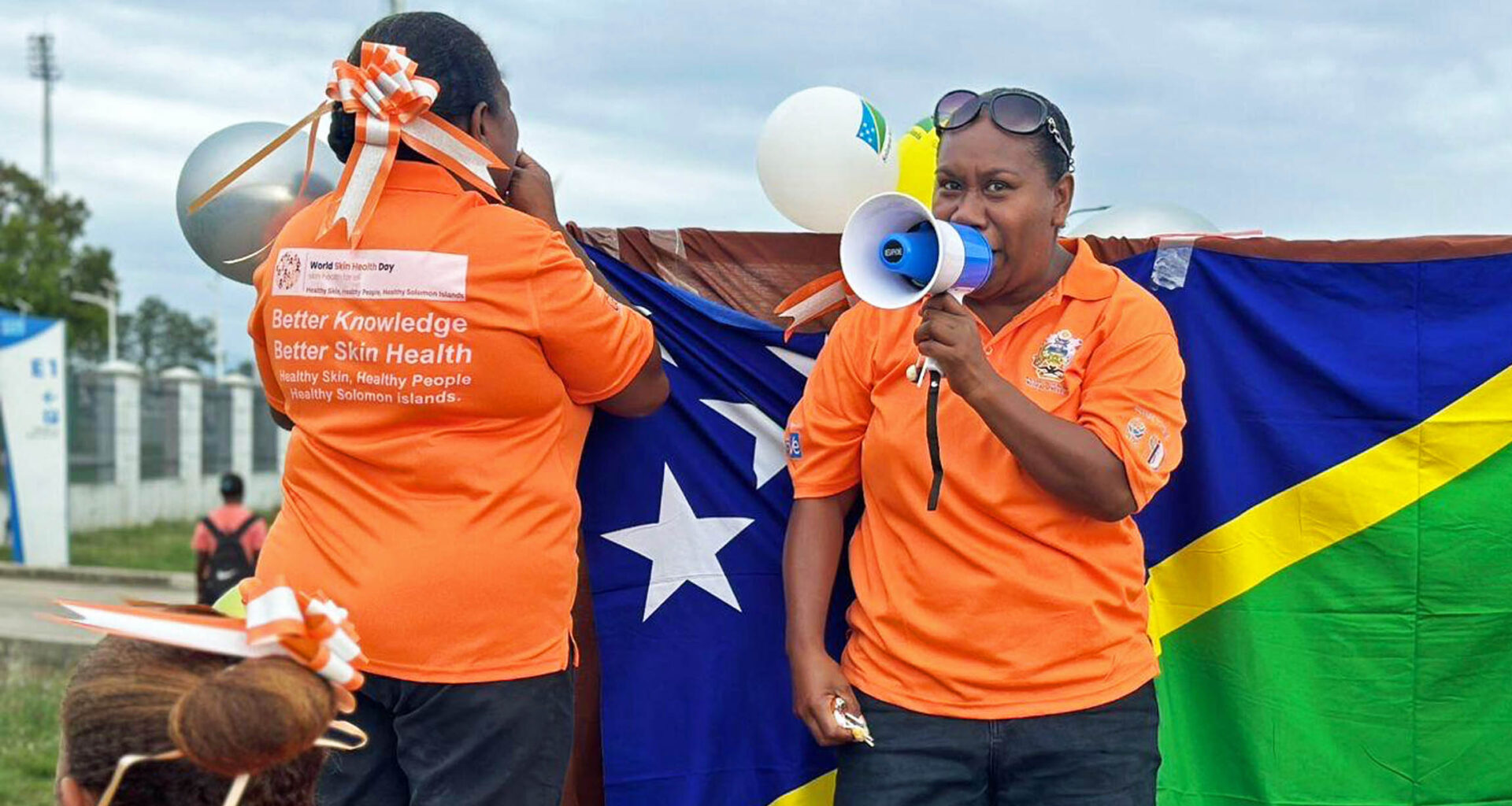
Scabies is caused by a mite you cannot see and an itch you cannot ignore. Two Pacific nations have now shown that scabies can be brought under control at the scale of an entire country. In Solomon Islands, 23.2% of people had scabies before the campaign began. After two nationwide rounds of a cheap antiparasitic pill, 3.9% did.
Fiji ran a single round and watched its own rate fall from 6.2% to 3.4%. Between them the two countries handed out more than 2.5 million doses of ivermectin.

The work was led by the World Scabies Program at the Murdoch Children’s Research Institute (MCRI), with the health ministries of Solomon Islands and Fiji and the Kirby Institute at UNSW Sydney.
Susanna Lake, who leads the program’s tropical disease work, says the campaigns settle a question that has hung over scabies for years.
“Our findings demonstrate for the first time that scabies, a disease that causes enormous suffering for children and families, can be significantly reduced when effective treatment is delivered at scale,” says Lake.
How nationwide scabies treatment worked
Mass drug administration means offering the same medicine to everyone in a population, whether or not they look sick.
It is the strategy the WHO recommends for scabies wherever more than 10% of a community is infested. The agency published a guide to running such programs alongside this study.
The logic is simple. Treating only the people who reach a clinic leaves the mite circulating through households and villages, and a treated person is reinfested within weeks.
Each round consisted of two doses of oral ivermectin, sized by body weight and taken 7 to 14 days apart. Distributors recruited from local communities went door to door.
Some people cannot take the drug. Children under 35 inches (90 centimeters) tall, those who were pregnant or nursing newborns, and people taking warfarin were offered permethrin cream instead.
Solomon Islands ran its first round from July 2022 to March 2023 and its second from February to December 2024. Fiji ran its only round between October 2022 and June 2023.
Two rounds cut scabies in Solomon Islands
The evaluation did not rely on clinic records. Teams surveyed more than 9,000 people at each of three time points, drawn from 90 randomly chosen villages and urban blocks.
Nurses examined hands, forearms, feet, and lower legs for the small clustered lesions that mark an infestation. No microscopy was used.
At baseline, 23.2% of the population had scabies. One round of treatment barely moved it, to 19.9%. The second round dropped it to 3.9%, a relative reduction of 83%.
Coverage explains the difference between the two rounds. The first reached 49% of the population with its first dose. The second reached 68%.
The most severe cases fell hardest. Two-thirds of infestations at baseline were moderate to severe, and that group shrank from 15.3% of the population to 3%.
One round reduced scabies in Fiji
Fiji’s result is less dramatic and more instructive. Scabies fell from 6.2% to 3.4%, a relative reduction of 44%, after one round that reached 26% of people with a first dose.
The starting figure was lower than anyone expected. Earlier Fijian surveys had put prevalence between 14.2% and 23.6%.
The authors think COVID-19 may explain it. Stay-at-home orders and travel limits from March 2020 to March 2022 would have cut the skin-to-skin contact the mite depends on.
Because national prevalence was already below the 10% threshold and had fallen further after one round, Fiji’s health ministry decided against a second.
The burden was not spread evenly. Among iTaukei Fijians, prevalence ran from 9.3% down to 5%, higher than the rest of the population at both time points.
Why impetigo cases also fell
Scabies rarely kills. It opens the skin, and the danger starts there. The mite drives an estimated 622 million cases a year.
Scratching breaks the surface and lets in bacteria, mainly Streptococcus pyogenes and Staphylococcus aureus. The result is impetigo, a crusted infection that spreads easily among children.
Repeated strep infections drive immune responses that can damage the kidneys and the heart. Rheumatic heart disease is the long tail of an itch nobody treated.
That chain is why the WHO named scabies a neglected tropical disease in 2017, and why failing antibiotics raise the stakes of every skin infection.
Impetigo fell alongside scabies in both countries. In Solomon Islands it went from 9.2% to 1.6%, and in Fiji from 4.3% to 1.2%.
Part of that is fewer broken skin barriers. The authors also suspect that less scabies in a community means less strep and staph circulating overall.
Children slept and learned better
Hannah Andrews, a program officer with the World Scabies Program at MCRI, answered questions from Earth.com on behalf of the team that ran both campaigns.
Asked what changes for a child in a village where scabies falls this far, she pointed to fieldwork by her colleague Elke Mitchell in Fiji.
“Children may experience less school absenteeism, social isolation, and poor quality of sleep when there is less scabies in the community,” Andrews told Earth.com.
That qualitative work shows what a prevalence table cannot. An itch that keeps a child awake and out of class is the daily cost of the 23.2% figure.
Andrews makes the same point about the infections. “The impact of scabies goes beyond scabies,” she says, and what follows it is why the impetigo result matters as much.
Young children remain most affected
The averages hide the group that matters most. Children under five carry the heaviest burden of scabies in both countries, and they still do.
In Solomon Islands, prevalence among under-fives fell from 32.9% to 11.5%. In Fiji it moved from 17.2% to 11.7%.
Both figures sit above the 10% line at which the WHO recommends mass treatment. The campaigns reduced scabies far more effectively in adults than in toddlers.
Andrews is specific about what would close the gap. Ivermectin is not licensed for children under 33 pounds (15 kilograms), so the youngest cannot take the drug the campaign runs on.
“The best way to reach children under 5 is to create ivermectin therapy for young children,” says Andrews. She points to trials run by Amanda Gwee and colleagues that are testing exactly that.
Urban delivery improved treatment coverage
Rural villages turned out to be the easy case. Established village structures let distributors reach almost everyone in a single visit.
Urban Fiji was the opposite. Coverage in the crowded Central Division stayed low, and the fall in disease there was minimal.
Solomon Islands learned from that. For the second round, teams in the capital, Honiara, handed out doses at workplaces, schools and community gatherings rather than waiting at doorsteps.
Coverage in Honiara reached 84%, and scabies dropped sharply behind it. The team also had to rebuild how it advertised the campaign for city audiences, moving to radio and television.
Andrews says that single shift in delivery is the clearest operational lesson of the two campaigns, and that reaching cities takes several strategies at once rather than one.
Both countries are among the small island nations where dispersed populations make any national health campaign expensive to run.
Study limitations remain
This was not a randomized trial. There was no untreated comparison group, so the reductions cannot be pinned on the drug with the certainty an experiment would give.
The examiners were trained nurses rather than dermatologists, working from simplified criteria that have not been validated where prevalence is low.
Fiji’s baseline came from two different periods, which weakens that comparison. Follow-up ran only 12 months, so nobody yet knows how long the gains hold.
What the authors claim is narrower and still substantial. Reductions appeared in every age group and both countries, alongside a matching fall in impetigo, with no rival explanation.
“Our research provides critical evidence to inform national and international policy and supports the broader integration of scabies control into public health and neglected tropical disease programs,” says Steer.
The study is published in the journal Nature Health.
Photo credit: World Scabies Program, Murdoch Children’s Research Institute
—–
Like what you read? Subscribe to our newsletter for engaging articles, exclusive content, and the latest updates.
Check us out on EarthSnap, a free app brought to you by Eric Ralls and Earth.com.
—–