
Martin Chandler | 8:47am BST 02 August 2026
Published: 2026
Pages: 343
Author: Hamilton, Duncan
Publisher: Abacus
Rating: 5 stars
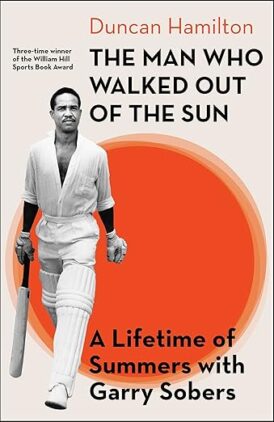
Published just a fortnight before the greatest all-rounder to have graced the game left us Duncan Hamilton’s latest masterpiece may not have been intended to be a valedictory tribute to Garry Sobers, but it is inevitable that is what it will be seen as in years to come.
There have been other biographies of Sobers, most notably by his old friend Trevor Bailey, and as recently as last year from David Tossell, but never anything quite like this. But then Duncan Hamilton has demonstrated in a number of previous books that as a writer he not only has a unique style but is one of the very best as well.
Some biographers, indeed arguably the best biographers, set out to try and judge their subjects as objectively as they can. Books that are ultimately hagiographies are not generally the best of the genre, but this one is not just an exception to that rule – it turns the rule on its head.
Hamilton is a couple of years older than I am, so was lucky enough to have had rather more Sobers watching time than I did, and being a lad from Nottinghamshire the great man was a lot more accessible to him, but essentially the thought of the man clearly inspires similar feelings of awe in both of us.
One feature of Sobers is that despite being a West Indian, his appeal was universal, and it is entirely fitting that his greatest day with the ball, at Lord’s in 1970, and with the bat at the MCG in 1972, were both for sides styled as the ‘Rest of the World’.
There were many highlights in the Sobers career, and whilst The Man Who Walked Out of the Sun is certainly a full biography, it is not simply a recital of all those performances. In each chapter Hamilton concentrates on one aspect of a particular period in time, thus the 365* in Pakistan in 1958, the tied Test in 1960/61, and the six sixes at Swansea in 1968 to give just three more examples.
The few low points in Sobers’ life are not ignored, albeit they did not generally arise on the field of play. The tragic loss of Collie Smith in 1959 is inevitably the most compelling of those, but there is also the ill-judged visit to Rhodesia in 1970 and, on the field, the eventual unravelling of a captaincy which had initially been successful but ultimately proved to be Sobers’ cricketing achilles heel.
The power in the narrative comes from the involvement in it of Sobers himself not that, I hasten to add, Hamilton spoke to him or anyone close to him for the purpose of the book. But it shouldn’t be forgotten just how famous Sobers was in the 1960s and 1970s. His thoughts appeared in four ghosted autobiographies, countless newspaper and magazine articles and his face and voice were centre stage in a number of long forgotten radio and television interviews.
Sobers was never a man for statistics and his memories of the games in which he was involved were often hazy and in that respect he was always prone to contradict himself. But on a wider level he understood his importance as a role model and was honest in his replies to whatever questions he was asked.
And Hamilton must have read just about every word written on Sobers’ behalf, watched all the interviews he could find and has plenty of memories of Sobers of his own to add. His reader is very much left with the impression that the Sobers Hamilton portrays, aided by the comments and observations of others, is the genuine article.
Towards the end of the book Hamilton tells the story of a function he attended in Yorkshire long after Sobers’ retirement at which he was the guest speaker and took a number of questions from his spellbound audience. One was a simple enquiry as to how he would want to be remembered. Sobers reply summed the man up perfectly:-
As someone who played the game in the right way and gave it the respect it deserved …… and I like to think I entertained a few people and they enjoyed it.
Amen to that and, like the man himself The Man Who Walked Out of the Sun is difficult to criticise. Had the writing not been so compelling I might have been disappointed by the photographs in the book not being printed on art paper, but given that in the course of his research Hamilton located a superb previously unpublished image of Sobers and Smith he can be forgiven that.
I have also been known to carp in the past about biographies that lack a statistical appendix, and there is none here. But then Sobers is a very special case and given his own lack of interest in that particular subject the timbre of the narrative would not have benefitted from pages and pages of numbers or scorecards.
Garry Sobers is and will always remain the greatest cricketer I have ever had the privilege of watching, and Duncan Hamilton is one of my favourite writers so in truth I am in no position to give an impartial verdict on The Man Who Walked Out of the Sun, but what I can say without fear of contradiction is that I have rarely enjoyed reading a cricket book as much as this one.