
As Australia’s domestic waste stream becomes more complex, materials recovery facilities face increasingly volatile contaminants. Every week, news headlines detail another facility fire caused by compromised lithium-ion batteries.
These incidents threaten worker safety and escalate operational downtime and insurance liabilities across the board.In response, Australian startup Oscorp Energy is developing advanced autonomous technologies to mitigate hazardous inputs before disaster strikes.
Founded in 2024, the artificial intelligence (AI) company develops intelligent material sorting equipment capable of processing complex waste streams.
“We are building intelligent machines for the waste and recycling industry with a vision to enable fully autonomous waste facilities of tomorrow,” says Ani Goswami, Founder of Oscorp Energy.
“Specifically, we are building machines that can precisely identify hazardous and flammable materials, such as batteries, in any form of waste and safely remove them so that facilities don’t catch fire.
“We call it the world’s first end-of-life battery electronics AI model, essentially covering anything and everything that contains a battery.”
Operating from a specialised prototype robotics laboratory in Queensland, Oscorp Energy is led by Ani, as well as co-founders Dr Chandrakant Bothe, who holds a doctorate in artificial intelligence, and Dhiren Rami, a robotics expert holding a master’s degree in the field.
At the core of Oscorp Energy’s technology is a high-speed robotic sorting machine that can be retrofitted into existing materials recovery infrastructure and sorting lines without requiring costly facility overhauls.
It has AI-based sensors, that can precisely identify batteries and battery electronics on a sorting belt and safely remove them.
Ani says the company built its “AI brain” from scratch for this job, rather than customising off-the-shelf software.
To accurately spot items moving fast on unpredictable conveyor belts the software needs to see thousands of examples. The company has spent a lot of time and computing power building a massive library of real-world facility data to train its AI.
Achieving this standard requires constant, disciplined data collection. The system must account for structural deterioration, crushing, and varied form factors typical of consumer electronics waste.
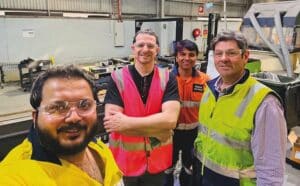 Ani Goswami, Dr Chandrakant Bothe and Dhiren Rami with Michael Kron (Antler) and Mark Griffiths (Livium Ltd). Image: Oscorp Energy
“Our AI models should be able to identify all of them, so that’s what we’ve been working towards,” Ani says. “We have trained our AI on close to a million different batteries and battery electronics so far, and our goal is two million, at least, by the end of this year.”
While the initial goal is battery electronics to limit active fire risks, the core software has expanded into broader municipal solid waste and commercial streams. The system now categorises household recyclables, organic waste fractions, heavy metals, medical waste, and discarded textiles.
To achieve this, the development team blends supervised training methods with autonomous refinement models, allowing the machinery to process real-world volumes without stalling.
“There are three ways you train your AI: first is supervised learning, the second is unsupervised learning, and third is reinforcement learning,” Ani says.
“On a fundamental level, supervised learning is essentially you have pictures of different wastes, you manually tag every item, and then train your AI, so that you’re telling the AI, ‘Hey, this is a plastic, this is a phone, this is a battery, etc.
“Once the AI has been trained to a sufficient level, then comes the component of unsupervised learning, where the AI can try and see other objects and try to identify patterns from what it has learned. We have started implementing unsupervised learning, where the AI trains itself.”
Because no two recycling facilities process the exact same types of waste, the software is built to adapt quickly to new locations. It uses a central AI system that studies the local waste mix when first installed. The equipment then tracks and memorises these local differences to create a custom sorting plan tailored to that specific facility.
“Our goal is to provide as much accurate information as possible, and our benchmark is 99.5 per cent accuracy,” Ani says.
“To achieve that, our base models would be trained heavily, and then each facility would have its own waste fingerprint. Within two weeks that AI should be able to understand ‘Okay, this is the type of waste I’m dealing with on a day-to-day basis’.”
Alongside the sorting machines, the company is developing a data platform called Vision OS. This software connects multiple sensors placed throughout a recycling facility to give managers a bird’s-eye view of their entire operation. It allows them to quickly spot where sorting errors happen, find belt jams, and track real-time trash trends.
“It tracks and logs each and every material that is on your belt and gives you the visibility on what is flowing on your belt, where your contamination rates are higher, on what specific lines, what you could do to improve,” Ani says.
The technology has attracted significant commercial attention and financial backing, with the company securing capital from European venture capital group Atlas, alongside global investor Antler and Antipodean Capital.
On the industrial front, a memorandum of understanding (MoU) signed with lithium battery recycler Livium Limited has taken the technology from laboratory testing into commercial field trials.
As part of the MoU, Oscorp is now building a robotics sorting component to complement the AI.
“So, the brain is sufficiently developed, now we have started building the body,” Ani says.
“It’s pretty exciting and I think batteries is a tough challenge when it comes to robotics, because batteries come in so many different forms, shapes, and sizes. They are chemically active as well, so the risk of them blowing up is high.
“For us to have a robot pick and sort different form factors and shapes of batteries is an engineering challenge.”
Ani says by replacing manual sorting with robotics, operators can shield employees from hazardous materials while optimising plant uptime.
“Waste sorting is a manual, dangerous, dusty job. We’re wanting to create systems that are safer for everybody.”
He says that ultimately, installing automated systems addresses fundamental blind spots that have impacted resource recovery yields for decades.
“Given the way this industry is operating, I would say our technology is a game changer for the industry, because once they see the value in it, they will realize what they have been missing all these years.”
For more information, visit: www.oscorpenergy.com.au