
The Athletic has live coverage of NFL training camp.
Fantasy football flips the quarterback position on its head. The most important position in reality is the least important in fantasy. The reason? Repeat after me: Quarterback touches are evenly distributed. If all wide receivers had the same expected targets and all running backs the same expected touches, we’d de-emphasize those positions in our drafts, too.
So we’re dealing with things like rushing, rushing touchdowns, passing touchdown rates — none of which are particularly sticky. So the best advice at QB is to make a couple of picks from the middle of the queue.
But there’s a segment of fantasy football that hates this and works to elevate the position, most commonly by starting two quarterbacks including one in a flex. So while the difference between the No. 1 QB and the No. 15 QB (5 points a week on average) isn’t likely to swing many games, the difference between the top QBs and the No. 23 and 24 QBs could easily double that. And then we’re talking about winning — and losing — margins.
So how should we adjust?
My advice, still attack the middle market of the position with two picks inside the top 20 this year and then take a flier on a third quarterback who has an uncertain starting status. You have to hope you get lucky with that player.
In recent Scott Fish Bowl drafts, the QB12-to-QB20 bucket was, on average, picks 57 to 92. But there is tremendous variance in ranking QBs because the differences are so small. So I find guys in the top 20 in my rankings as late as pick 117.
The advantage in drafting QBs later in the draft is that you’ve rostered a couple of top wideouts, which opens up certain stacking opportunities. Superflex leagues are deeper, and deeper leagues mean more scoring and thus a greater emphasis on explosive plays. Stacking a QB with a receiver or even a receiver and a tight end gives you much higher scoring potential (though obviously more variance, too).
When you draft from the top of the queue in Superflex, you have to hope you can add a stackable receiver later. But it’s so much easier to get sniped on A.J. Brown if you already drafted Drake Maye than it is to get sniped on Jared Goff if you already drafted Amon-Ra St. Brown. You can virtually be guaranteed Goff if you adjust the ADP by a round at most.
Some top receivers aren’t stackable with their QBs. Jaxon Smith-Njigba has Sam Darnold, who had seven games with 10 points or fewer last year. You don’t want that. Who knows who Justin Jefferson’s QB will be. If you have Nico Collins, do you want to have to play C.J. Stroud, a game manager on a defensive juggernaut, every week? Nope. I don’t think Tetairoa McMillan is stackable. Ditto for Garrett Wilson. That’s six of the top-20 WRs. Plus, neither top TE (Brock Bowers and Trey McBride) is stackable.
Your targets depend on the receivers you drafted, but the quarterbacks in the strike zone, who I think are stackable and have the overall scoring potential to be useful even when things don’t click with the receiver you rostered are:
Jaxson Dart (ADP: QB13)
Stack with Malik Nabers. Dart’s 6.7 yards per attempt essentially tied with J.J. McCarthy for 27th among qualifying QBs. His successful run rate based on down and distance of 62.8% led all NFL QBs (minimum 35 attempts). John Harbaugh did not use Lamar Jackson on the goal line. I doubt he wants to risk Dart in short yardage either. Dart is closer to Jackson’s body type than Allen’s. So with a more average allotment of rushing touchdowns (or elevated injury risk), Dart will need to rely on his receivers. But the best one, Nabers, may not be fully healthy until 2027. This is a very dangerous stack given the risks, but there is massive upside here.
Matthew Stafford (ADP: QB11)
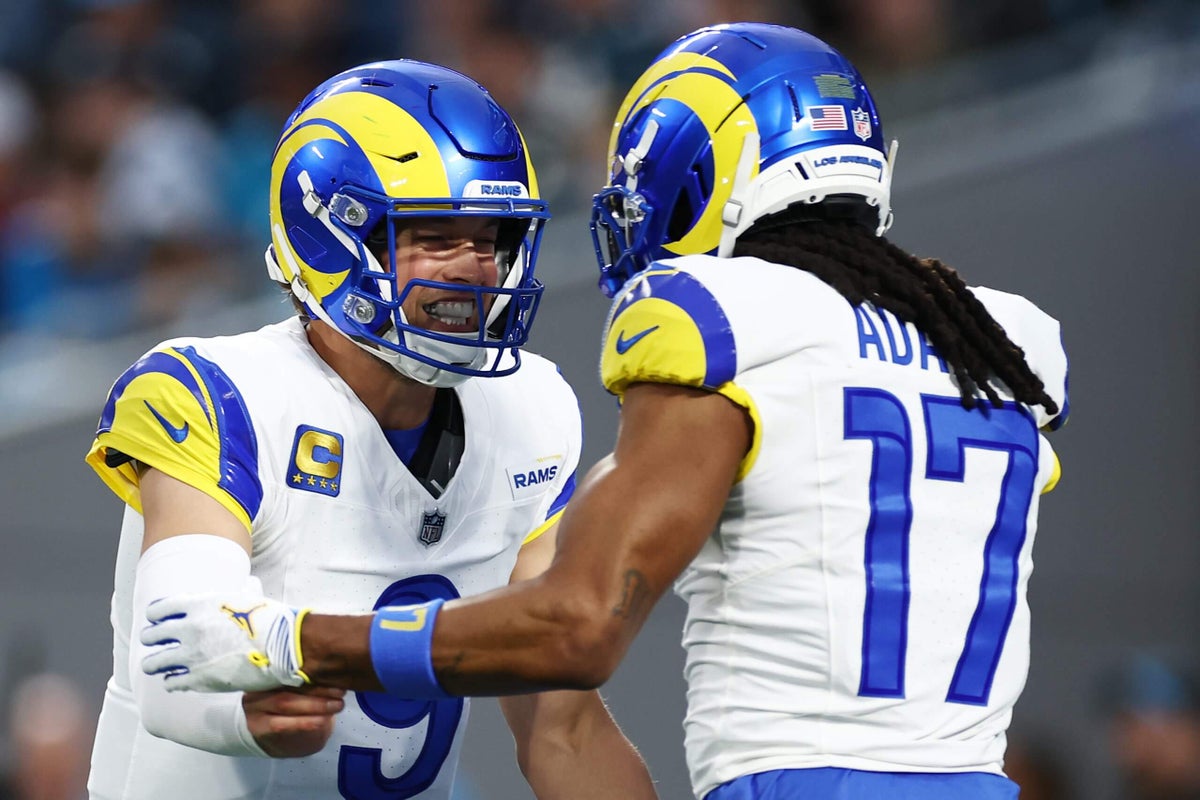
Stack with Puka Nacua or Davante Adams. Stafford is the arbitrage Dak Prescott who is the arbitrage Joe Burrow. So he has QB5 potential but is available much later in your draft. He’s old; there is injury risk. He had a lot of quiet games last year before exploding in the second half (307 passing yards and 2.7 touchdowns per game the final seven games). He followed that up in the postseason with two 300+ yard games and two three-TD games.
Jared Goff (ADP: QB14)
Stack with Amon-Ra St. Brown or Jameson Williams. Goff’s the vanilla of fantasy QBs. But vanilla hits the spot a lot, admit it. He was QB16, but scored 15 points or more 11 times — a total beaten by just four quarterbacks (in order, Drake Maye, Josh Allen, Trevor Lawrence, Dak Prescott — all much more expensive). Goff will not win many weeks for you (though he was a league-winner in the 2024 fantasy playoffs, let’s not forget), but he won’t lose many either. He had just one game of 10 points or fewer.
Tyler Shough (ADP: QB18)
Stack with Chris Olave. The best case against Shough is his 25th ranking in expected points added per dropback, between Kirk Cousins and Tua Tagovailoa. In his first five games, he scored 12 fantasy points per game; in his final six, he was QB8 at 19.6 FPPG. While it’s a compelling narrative that Shough progressed and improved as a rookie QB, arguments such as these often prove false. Shough had three rushing touchdowns and 153 yards on the ground in his final six games, bolstering his numbers. I like the Saints’ fast-paced, pass-heavy system, though.
Baker Mayfield (ADP: QB17)
Stack with Emeka Egbuka. Mayfield tied Josh Allen for the most forced missed tackles (in 2025) at QB with 19, according to PFF. Last year, he was QB19 in FPPG. That’s after being the late-round QB poster boy in 2024. He lost about 4 points per game in 2025 compared to 2024, which I think is predictive. Mayfield was let down by his receiving corps; there’s nothing bankable here. He also has a new OC with Rams pedigree but with the 2024-25 Falcons as the top line of his resume. So I can’t get excited about that. Mayfield did have 15+ points in 10 games, just one behind Goff. The floor is pretty high.
Jordan Love (ADP: QB20)
Stack with Christian Watson. We thought there would be some running to Love’s game, but his designed run rate of 2% is between Kirk Cousins and Joe Flacco. So Love has to get his points the hard way, and Green Bay’s wide receiver group, to put it kindly, is not a positive force. It’s like the pre-Randy Moss Patriots. I want to believe in Watson, but he’s not reliable physically. No one else really commands targets. I love tight end Tucker Kraft but hate to draft players the year after an ACL surgery. You probably also have to believe in Matthew Golden to draft Love. But Golden was never even prioritized in the passing game in college.