
Before the Rugby World Cup settled all arguments, the sport’s global supremacy was invariably decided between South Africa and New Zealand.
Two former outposts of the British Empire improved the game that England invented, and used rugby to forge their identity and raise their stature on the global stage.
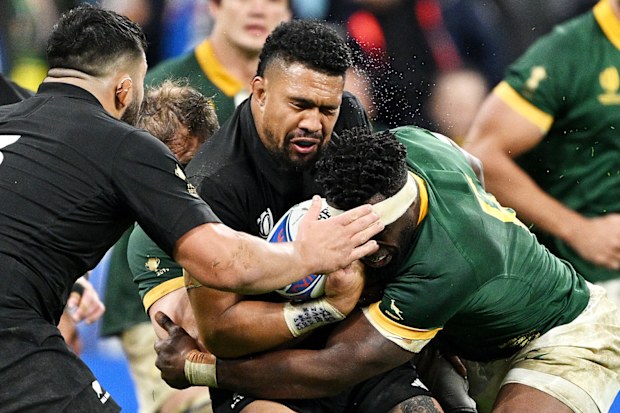
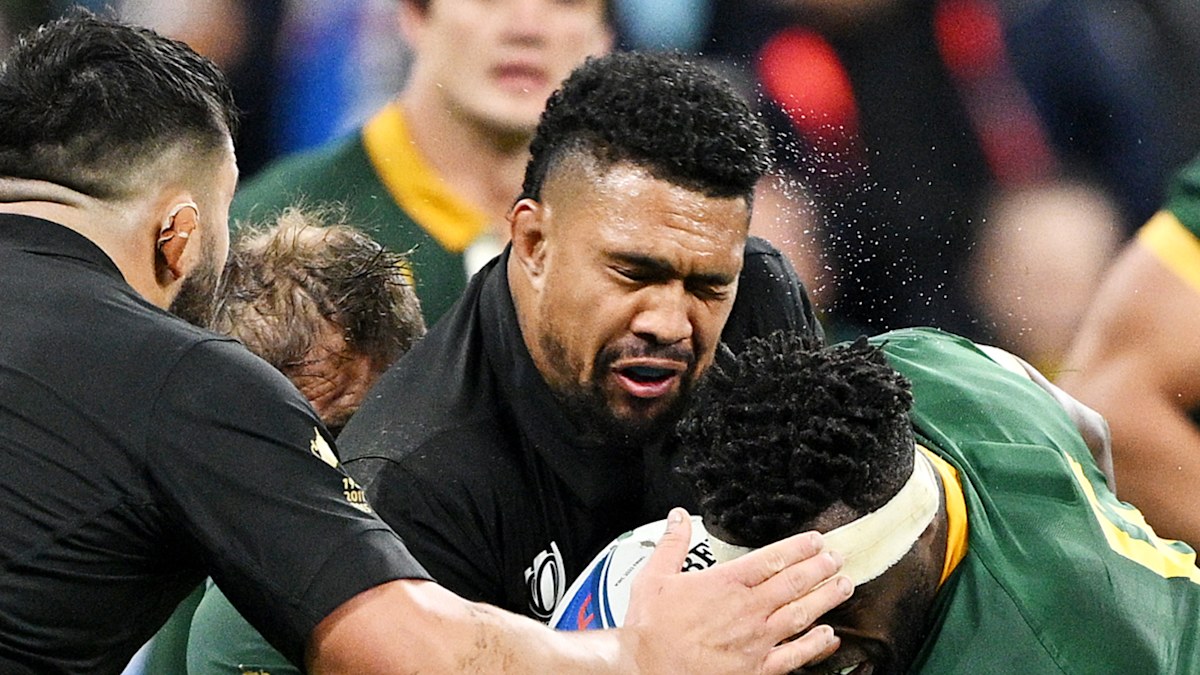
Siya Kolisi of South Africa commits a high tackle with head contact on Ardie Savea of New Zealand. nna\sworthington
The Springboks and All Blacks stopped dancing around each other in 1921 when South Africa arrived in New Zealand by steamship.
For the next 75 years, to the dawn of the professional era, the rugby tours to each other’s shores were titanic in length and depth, and fervour and controversy.
On the 30th anniversary of the last traditional tour between them, the All Blacks are in South Africa, opening an eight-match, six-week expedition on Saturday (AEST) in Cape Town.
They and the Springboks will cross the Atlantic for marketing reasons to play the fourth and final Test match in the NFL home of the Baltimore Ravens.
“These are the tours we’ve only heard of,” South Africa captain Siya Kolisi said.
“To experience this for the first time is unbelievable for us as a group.”
Two-thirds of the 88 total players across both squads weren’t even born during the last tour in 1996.
Kolisi was five and New Zealand captain Ardie Savea was two.
But they all know the history and its weight.
From the beginning, South Africa-New Zealand match-ups set the standard for intensity and tension, enhanced off the field by respect and reverence.
The Springboks didn’t lose a series anywhere from 1903 until 1956 in New Zealand.
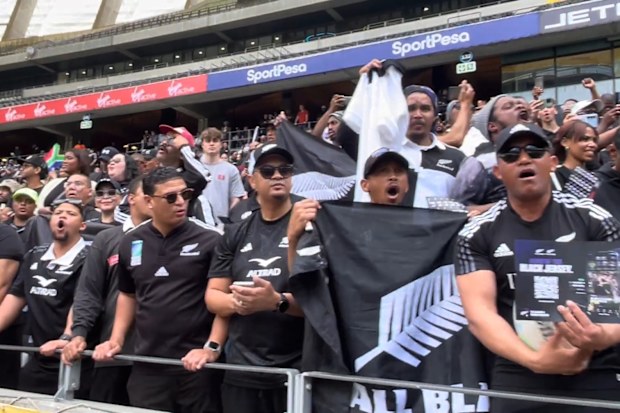
All Blacks fans welcome the team to Cape Town. YouTube
The period included their only series win in New Zealand in 1937.
New Zealand rugby officials crippled their team’s hopes by bowing to the South African government’s policy of racial segregation and blocking Maori players from touring the republic until 1970.
The lure of winning a series in South Africa outshone all other considerations for New Zealand players, including Colin Meads, acclaimed as the greatest All Blacks player of the 20th century.
He had two shots in 1960 and 1970 and was desperate enough to play two Tests in 1970 with a broken arm.
“If you’re ever going to play good rugby, you’ll play it in South Africa,” Meads said in his autobiography.
“There is always that feeling inside you, as an All Black, that THIS is what it has all been about, that THIS is South Africa and THESE are the players you most want to beat.”
But as uncompromising and bitterly fought the tours were in the apartheid era, so were the protests from the 1970s onwards which caused division and disruption on an unprecedented scale.
When apartheid laws were abolished in 1991 and South Africa was readmitted to international sport that year, the Springboks arranged their first match against, of course, New Zealand.
The All Blacks in South Africa enjoyed overwhelming support from the black population but that diminished after Nelson Mandela backed the Springboks as South Africa hosted and won the iconic 1995 World Cup.
The All Blacks, losers in the 1995 final in extra time, returned the next year and finally clinched their first series win in South Africa.
The enduring image of that 1996 tour is of All Blacks skipper Sean Fitzpatrick pounding the turf in Pretoria in joy.
Fitzpatrick and his 1996 cohorts met the current All Blacks last week with the messages that this tour will be their greatest adventure, and a successful one if they stick together.
Springboks favourites for series
In tour history, the teams are in lockstep.
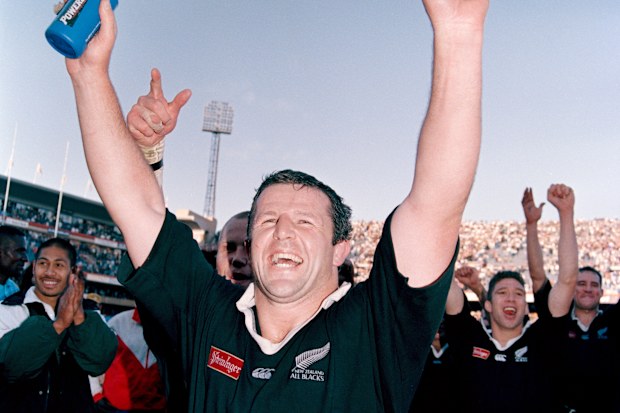
Sean Fitzpatrick celebrates after the series victory in 1996 in Pretoria. Getty
Both have undertaken six tours, have four home wins, and one win on the other’s soil.
But the All Blacks will go into the upcoming Tests as underdogs, firm No.2s to South Africa’s undisputed No.1 status.
Springboks coach Rassie Erasmus has had an eight-year runway to prepare for the series, building enviable depth while winning the last two Rugby Championships and their last 11 Tests, their best streak in 18 years.
The series will tell Erasmus who has gas in the tank to win a third straight World Cup next year in Australia.
He’s guiding the Springboks in Argentina this week for a last tune-up for the All Blacks.
On the other hand, New Zealand coach Dave Rennie has been in charge since only June and for three matches.
He’s lifted morale at home by having the All Blacks play direct and at tempo.
Rennie has rested Savea until the Tests and gearing for the tour games against the Stormers, Sharks, Bulls and Lions.
Those provincial sides have not played in at least two months and are shorn of their main Springboks but, as usual, their role will be to soften up and expose the tourists.
Typical of South African hospitality was the greeting by Cape Town Mayor Geordin Hill-Lewis when the All Blacks landed.
“Off the field we will be the perfect hosts and treat you like royalty,” he said.
“But on the field you can expect no mercy.”
They have restored the tradition of touring each other’s country in a bid to create a sporting spectacle that extends beyond both their shores and offers the opportunity to make the revenue that both New Zealand and South Africa earn when the British and Irish Lions tour their respective countries every 12 years.
The tour is being marketed as ‘Rugby’s Greatest Rivalry’ and will be hosted alternately every four years.
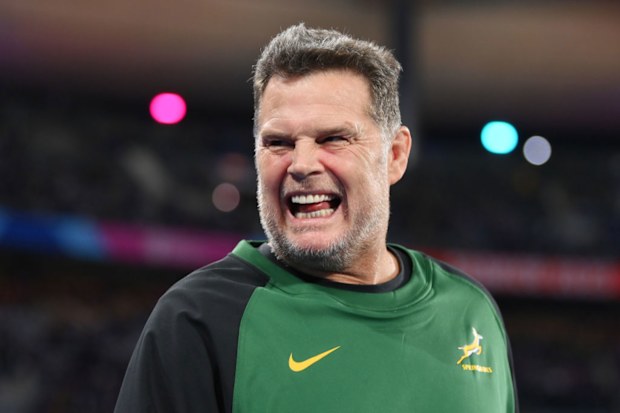
Rassie Erasmus at Stade de France. nna\sworthington
The venture is structured as a 50-50 partnership between SA Rugby and New Zealand Rugby with earnings pooled from sponsorships, stadium ticket sales, merchandise, and international broadcast rights.
Historically, the opening matches against South African provincial outfits were intended to soften up the tourists before the Tests against the Springboks, often bloody and violence-filled affairs.
New Zealand’s last full tour in 1996 had them win a series in South Africa for the first time, earning their squad the nickname of ‘the Incomparables.’
Patrick Tuipulotu will captain New Zealand in the opening match when they take on the Stormers.
Rennie named some experienced players in the side, including Beauden Barrett at flyhalf and Rieko Ioane on the wing.
Barrett did not play the three Nations Championship Tests in New Zealand last month while blindside flanker Simon Parker and reserve halfback Kyle Preston also missed the wins over France, Italy, and Ireland.
There are 13 changes to the team that started against Ireland in the Nations Championship in Auckland last month.
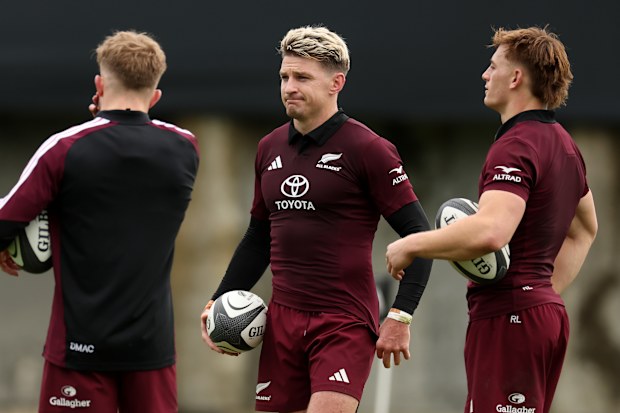
Beauden Barrett and Ruben Love of the All Blacks. Getty
Only Josh Moorby, who has switched from the left wing to fullback, and Tuipulotu remain from the 40-21 win over the Irish.
Tighthead prop Siale Lauaki and fullback Josh Jacomb are set to make their All Blacks debuts off the bench.
World junior champion Yaqeen Ahmed has been handed a senior debut by the Stormers and will play at flyhalf.
Ahmed was the star performer for the Junior Springboks when they won the Under-20 World Championship in Tbilisi last month.
The 20-year-old gets his chance because Sacha Feinburg-Mngomezulu is away with the Springboks, and Jurie Matthee is injured.
The loose forward trio of Evan Roos, Hacjivah Dayimani and Deon Fourie is the same combination that started the United Rugby Championship final four years ago when the Stormers won the title.
Outside centre Ruhan Nel will captain the team.
Teams for tour opener
All Blacks (15-1): Josh Moorby, Leroy Carter, Billy Proctor, Anton Lienert-Brown, Rieko Ioane, Beauden Barrett, Cortez Ratima, Peter Lakai, Anton Segner, Simon Parker, Patrick Tuiputotu (c), Fabian Holland, Pasilio Tosi, Samisoni Taukei’aho, George Bower
Reserves: Asafo Aumua, Ollie Norris, Siale Lauaki, Sam Darry, Ethan Blackadder, Kyle Preston, Josh Jacomb, Caleb Clarke
Stormers (15-1): Warrick Gelant, Seabelo Senatla, Ruhan Nel (c), Jonathan Roche, Leolin Zas, Yaqeen Ahmed, Imad Khan, Evan Roos, Hacjivah Dayimani, Deon Fourie, Connor Evans, Adré Smith, Neethling Fouché, André-Hugo Venter, Vernon Matongo
Reserves: JJ Kotzé, Ntuthuko Mchunu, Sazi Sandi, Ruan Ackermann, Keke Morabe, Wandile Mlaba, Dewaldt Duvenage, Wandisile Simelane
Schedule (AEST)
Saturday 8 August, 3am: All Blacks vs Stormers, DHL Stadium, Cape Town
Wednesday 12 August, 3am: All Blacks vs Sharks, Kings Park, Durban
Sunday 16 August, 3am: All Blacks vs Bulls, Loftus Versfeld, Pretoria
Sunday 23 August, 1am: All Blacks vs Springboks, Ellis Park, Johannesburg
Wednesday 26 August, 3am: All Blacks vs Lions, Ellis Park, Johannesburg
Sunday 30 August, 1am: All Blacks vs Springboks, DHL Stadium, Cape Town
Sunday 6 September, 1am: All Blacks vs Springboks, FNB Stadium, Johannesburg
Sunday 13 September, 7am: All Blacks vs Springboks, M&T Bank Stadium, Baltimore
All Blacks squad
Props: Ethan de Groot, George Bower, Xavier Numia, Ollie Norris, Fletcher Newell, Tyrel Lomax, Pasilio Tosi, Siale Lauaki
Hookers: Asafo Aumua, Codie Taylor, Samisoni Taukei’aho, Bradley Slater
Locks: Tupou Vaa’i, Josh Lord, Fabian Holland, Sam Darry, Patrick Tuipulotu
Loose forwards: Ardie Savea (c), Peter Lakai, Simon Parker, Luke Jacobson, Ethan Blackadder, Anton Segner, Wallace Sititi, Semisi Tupou Ta’eiloa
Halfbacks: Cam Roigard, Cortez Ratima, Kyle Preston
Five-eighths: Ruben Love, Beauden Barrett, Damian McKenzie, Josh Jacomb
Midfielders: Jordie Barrett, Billy Proctor, Quinn Tupaea, Anton Lienert-Brown, Timoci Tavatavanawai
Outside backs: Caleb Clarke, Fehi Fineanganofo, Leroy Carter, Josh Moorby, Will Jordan, Rieko Ioane, Emoni Narawa
Springboks squad
Props: Thomas du Toit, Wilco Louw, Ox Nche, Zachary Porthen, Carlu Sadie, Gerhard Steenekamp, Boan Venter, Ntuthuko Mchunu
Hookers: Johan Grobbelaar, Malcolm Marx
Locks: Lood de Jager, Eben Etzebeth, Ruan Nortje
Loose forwards: Paul de Villiers, Ben-Jason Dixon, Cameron Hanekom, Siya Kolisi, Elrigh Louw, Jasper Wiese
Utility forwards: Pieter-Steph du Toit, Franco Mostert, Vincent Tshituka, Marco van Staden, Jan-Hendrik Wessels, Cobus Wiese
Halfbacks: Herschel Jantjies, Cobus Reinach, Morne van den Berg, Grant Williams
Five-eighths: Manie Libbok, Sacha Feinberg-Mngomezulu, Vusi Moyo, Handre Pollard
Midfielders: Damian de Allende, Andre Esterhuizen, Jesse Kriel
Outside backs: Kurt-Lee Arendse, Aphelele Fassi, Ethan Hooker, Quan Horn, Cheslin Kolbe, Canan Moodie, Edwill van der Merwe, Damian Willemse