

Save
You have reached your maximum number of saved items.
Remove items from your saved list to add more.
AAA
It doesn’t have a catchy portmanteau name and the dates don’t quite align, but there are distinct echoes of the Barbenheimer phenomenon (when Barbie and Oppenheimer were released in the same week in July 2023) about the near-synchronous release of Christopher Nolan’s latest opus and the new Spider-Man film – not least in their extraordinary performance at the box office, and the hope it has inspired that cinema might not be dead after all.
Two weekends after opening with an impressive $13.46 million, Nolan’s The Odyssey took another $6.2 million locally, bringing its haul to $42 million in three weeks.
But Spider-Man: Brand New Day has very nearly eclipsed that total already, taking $30.43 million on its opening weekend (and $38.4 million for the full week) – the second-best result ever, behind only Avengers Endgame’s $34.1 million in 2019. Combined, those two blockbusters – each of which counts real-life couple Tom Holland and Zendaya among its stars – accounted for the bulk of last weekend’s total box office haul of $39.2 million.
 Real-life couple Tom Holland and Zendaya appear in both Spider-Man: Brand New Day and The Odyssey.Getty Images
“That was the biggest non-holiday weekend of all time,” says Palace Cinemas boss Benjamin Zeccola. “Barbenheimer was $39.9 million, but that included a public holiday, so it’s not quite like for like. If it weren’t for the public holiday in 2019 this weekend was the biggest on record.”
The story has been repeated around the world – in North America, Spidey opened to an astonishing $US360 million in its first weekend, and its global tally is already at $US1.155 billion, while The Odyssey sits at $US931 million globally.
And locally, it firms up a perception that has slowly been building throughout the year: cinema is back, baby.
To be sure, it’s had a lot of ground to make up. According to Screen Australia data, box office takings declined from $1.229 billion in 2019, the last year before the COVID pandemic upended everything, to $970 million last year.
To put that in perspective, for 11 years from 2009 to 2019, Australian cinema box office topped $1 billion annually (it peaked at $1.259 billion in 2016), a figure it has yet to reach in the post-COVID era (2020 was the nadir, with just $401.2 million).
Perhaps more significantly, attendances – which frequently hovered around 90 million a year in the noughties – have not come close to those levels since 2020. Last year, Australians bought 54.2 million movie tickets, fewer even than in each of the three preceding years.
 The Odyssey and Spider-Man: Brand New Day, as well as The Devil Wears Prada 2 (left) and Project Hail Mary (right), have boosted this year’s box office receipts.
That all suggested the cinema as an entertainment option was in structural decline. Now, though, there are signs things may be on the up.
Australian box office for the year to date stands at $659 million. “The fact that figure is 67 per cent of 2025’s full-year result, with only 59 per cent of the calendar year elapsed, shows cinema-going this year is ahead of last year,” Zeccola says.
Cynics might argue all it really proves is that tickets are getting more expensive, and theatre owners more adept at extracting more money from customers. While there is some truth in that, Zeccola claims the average ticket price (as distinct from the standard advertised price) for his chain in the 2025-26 financial year was $15.90 – “up just 45¢ on a year prior”, or 2.9 per cent, an increase less than CPI (3.8 per cent).
Premium formats certainly have a role to play in the resurgent box office, and IMAX is leading the charge. In 2022, there was just one IMAX screen in the country (at Melbourne Museum, which is still home to the largest traditional format IMAX screen in the world). Now there are 10 (with more to come).
IMAX tickets come with a significant price impost, which is why the Canada-based company claims a 3.7 per cent share of global box office with less than 1 per cent of screens.
No one loves IMAX more than Nolan, who has shot his movies at least in part with IMAX cameras dating back to The Dark Knight (2008), and with The Odyssey, became the first filmmaker to shoot a feature entirely in the format. And no one loves Nolan movies more than IMAX audiences: globally, 20 per cent of the film’s opening weekend revenue went to IMAX screens.
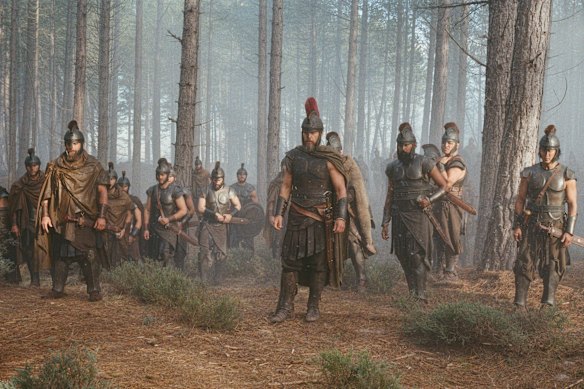 Christopher Nolan’s rendering of Homer’s epic poem has been a massive success, especially on IMAX.Universal Pictures
In Australia, The Odyssey was released on 689 screens, but the single screen at IMAX Melbourne – where a general admission ticket to a 70mm session costs $47 – has taken 3.65 per cent of the total box office in the movie’s first three weeks. Presales take the tally of tickets sold there to 89,000, and revenue to $3.99 million; every session until September 23 is already sold out.
It’s not just Spidey and Homer leading the charge, though. For the first time since 2019, there’s a solid pipeline of big movies across the year, helping build sustained appetite and anticipation. (One of the best ways to bolster the chances of people going to see an upcoming release is to expose them to a trailer for it when they’re already in the chair.)
“The industry recovery following COVID was compromised by the 2023 Hollywood writers’ and actors’ strikes, which delayed film production and reduced the number of major theatrical releases,” says Stephanie Mills, managing director of Hoyts. “The overall slate isn’t back to the levels we had pre-COVID, but it is certainly rebounding.”
Mills says that to this point last year, six of the top 10 titles locally were family films (A Minecraft Movie, Lilo & Stitch, How to Train Your Dragon, Sonic the Hedgehog 3, Mufasa: The Lion King and Paddington in Peru). “By comparison, the 2026 slate is considerably more diverse” – she points to the likes of Michael, Obsession, Project Hail Mary and The Devil Wears Prada 2 as well as the two chart toppers of the moment – “and that broader mix is attracting a wider range of audiences than we’ve seen in recent years.”
Related Article
They’re coming in bigger numbers, too. Zeccola reports a 19 per cent spike in attendances at Palace cinemas year on year; Mills says it’s about 22 per cent at Hoyts, and about 16 per cent across the industry as a whole.
Last year, attendances finished at 64 per cent of 2019 levels. If current trends continue, admissions should reach around 75 per cent of pre-COVID levels by year’s end.
So, more people spending more money is part of the equation. But there’s another significant shift under way, and it is one more reason for hope in the cinema business: the audience base is diversifying.
“We are seeing a wave of youth coming through our doors, people aged 18 to 35,” says Benji Tamir, programming manager for the Classic, Lido and Cameo cinemas in Melbourne and the Ritz in Sydney. “This started with Marty Supreme in January, then Wuthering Heights in February, The Drama in April and then of course the Obsession/Backrooms phenomenon in May. These audiences have been coming throughout the year, which has built to this crescendo of The Odyssey and Spider-Man.”
Tamir suggests these younger viewers – at least some of whom would not have seen many movies on the big screen before COVID – “are discovering cinema and sharing their experiences amongst their communities, and [the fan review site] Letterboxd is big for this”.
Before the pandemic, audiences aged 55 and above had become one of the mainstays of the cinema business. Now, Tamir says, “there has been a huge decline in this area, but that’s OK”. It simply means “it’s even more important to foster these younger audiences, as they are the future”.
Related Article
There’s another strand to the diversification picture: the emergence of a market for so-called “world cinema”. Long a staple of independent operators like the Zeccola and Tamir chains and specialists such as Mind Blowing Films, this segment now represents an important part of the market overall.
“Prior to COVID, world movies represented an average of 3.4 per cent of the national box office,” Mills says. “Since COVID, this has increased to 8.3 per cent, and in 2025 they accounted for 10 per cent of total box office, though this was predominantly driven by Ne Zha 2.” (The animated Chinese movie earned $7.54 million at cinemas last year, and is the world’s highest-grossing animated movie.)
That aberration aside, Indian films are the primary driver of growth in this area, up 200 per cent compared with pre-COVID levels. That reflects both the growth of the Indian diaspora in Australia and an increasing appetite for diverse fare among cinemagoers generally.
All in all, it might be premature to declare cinema saved. But the signs are, for the first time in years, genuinely promising.
“Our cinemas are back to pre-pandemic numbers and we feel there is still more growth to come,” says a bullish Tamir. “This is not a blip.”
Must-see movies, interviews and all the latest from the world of film delivered to your inbox. Sign up for our Screening Room newsletter.