
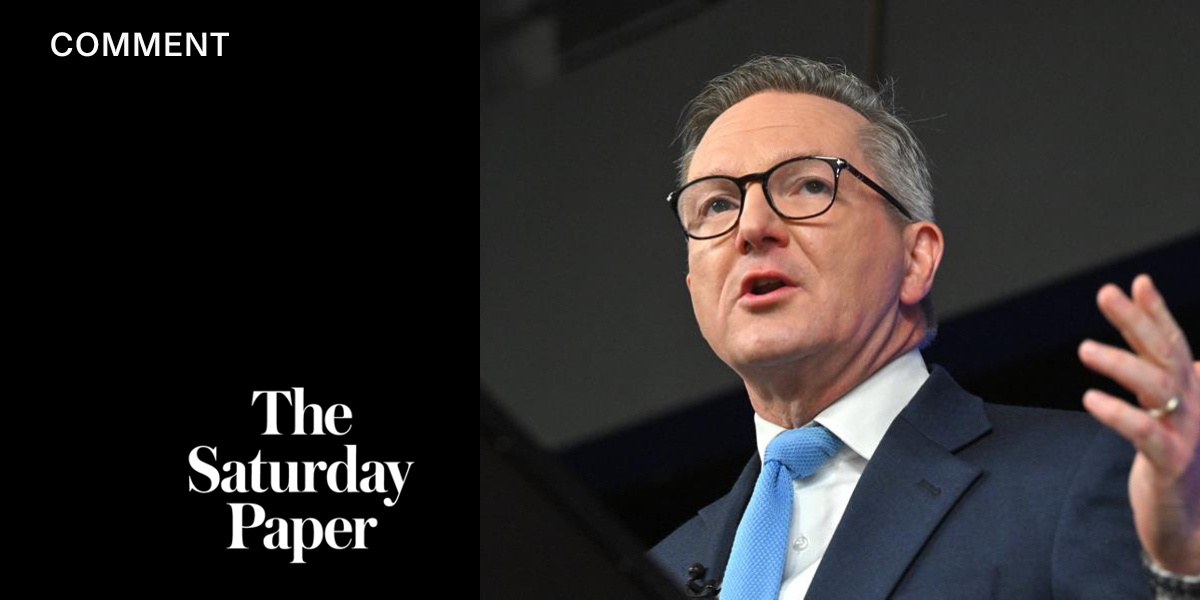
On the eve of federal parliament returning after the winter break, Minister for Climate Change and Energy Chris Bowen delivered a powerful defence of the government’s response to the global energy crisis and the incontrovertible reality of catastrophic global warming.
He told the National Press Club “building a reliable renewable energy system is building a sovereign system”, because “the sun can’t be blockaded, the wind cannot be sanctioned”.
United States President Donald Trump remained the elephant in the room, but the consequences of his rash war of choice in the Middle East were front and centre.
The impact on Australia’s energy security could not be gainsaid, especially in a week where the government ceased its fuel excise relief and, with it, price protection from the reality of our dependence on imported fossil fuels for our transportation needs.
Bowen’s narrative ran counter to that of Labor’s opponents in the Coalition and One Nation, both of which are in denial over the net zero emissions target as a critical driver of the transition away from reliance on coal and gas in a dangerously overheating world.
Bowen did not mention Pauline Hanson by name, but he scarcely concealed his contempt for denialists who cling to an outdated view that coal is a reliable baseload power and that climate science is “a hoax”.
He said every single day for three years there has been a coal outage somewhere in eastern Australia. In the first quarter of this year, outages increased by 23 per cent across New South Wales and Victoria compared with the same period in the previous year. In Queensland, it was 84 per cent.
“Every time coal breaks down, your bills go up,” Bowen said.
At the prompting of a journalist, he confirmed a fundamental disagreement with Pauline Hanson’s billionaire patron, Gina Rinehart. Bowen said that unlike Rinehart, he believes climate change is real “and we need to do something about it”.
Ironically, no one has done more to speed the uptake of electric vehicles than Trump, with the never-ending Iran conflict he keeps promising is about to end. Bowen said the take-up of EVs is most pronounced in the outer suburbs of our capital cities – hardly surprising, given these are the people with the longest commutes to work.
These same people have been leading the charge with the uptake of batteries, using their solar panels to provide their own energy security. This subsidy-driven shift has seen renewables account for 50 per cent of the energy grid.
The uptake of small-scale battery storage by Australian households rivals that of Europe and far outstrips that of the US. Bowen announced an expansion of the subsidy scheme to encourage large businesses to install rooftop solar.
In an opinion piece for the News Corp tabloids, shadow minister for energy and emissions reduction Dan Tehan had seven questions for Bowen. Not one of them premised a response to climate change action as anything other than a waste of money. There was an underlying assumption that continuing a reliance on coal and gas would be somehow cheaper.
Bowen says the government’s plan is to replace ageing coal-fired power with new, abundant renewable energy, backed by storage and gas peaking. He believes a majority of Australians are voting with their feet to support this agenda. It makes Angus Taylor’s decision to join the Nationals in rejecting this agenda mystifying.
Bowen says the government’s plan is to replace ageing coal-fired power with new, abundant renewable energy, backed by storage and gas peaking. He believes a majority of Australians are voting with their feet to support this agenda.
It makes Angus Taylor’s decision to join the Nationals in rejecting this agenda mystifying. Peter Dutton’s experience should be lesson enough. He failed to win the outer suburban seats with even a milder scepticism on climate change action.
Electrification is ever more critical for Australia in light of the nation being held hostage by recurring oil shocks and the remote prospect of us becoming substantially self-sufficient again.
Tehan says we need to drill for more oil and gas, “right here in Australia”. Commercial viability apparently doesn’t enter into this equation. BP abandoned the search for oil in the Great Australian Bight in 2016, citing a lack of project competitiveness and pushback from environmental groups.
The enthusiastic uptake of EVs has NSW and Western Australia planning a road-user tax to capture losses from forgone petrol and diesel revenue.
The NSW treasurer, Daniel Mookhey, would prefer that Canberra impose a national charge. He says it would be an example of Australia’s egalitarian ethos, “in which, if you benefit from a public service, you contribute to the public service”.
Alia Armistead, from the consumer group EV Drivers Australia, says now is the worst time to impose a tax on electric vehicles. They are providing a service by saving threatened fuel supplies for national energy security, she says, adding that independent polling has found the mooted tax impost would discourage working families from buying an EV.
The federal government is in no rush to impose a road-user charge, even though one is inevitable as the EV fleet grows. Bowen says it has to be carefully planned.
Greens leader Larissa Waters says such a charge is not something her party would support in the Senate. Waters says if the government wants to actually raise revenue “they’d be looking at the subsidies they give to big mining companies on their diesel fuel rebate”.
Minister for Immigration Tony Burke was also to give a keynote at the National Press Club this week but postponed it at the last minute. The official reason was that some elements could not be finalised by Thursday, when the speech was scheduled to be delivered.
Government sources say there were concerns in cabinet on Monday over some of the policy prescriptions. Certainly, the expectation was that Burke would unveil a suite of measures to deliver on the promise to cut net overseas migration. “Sweeping cuts” was the way one source characterised it.
There is no doubt in government ranks that migration is a red-hot issue, playing very well for Hanson and her One Nation party resurgence. What was so internally contentious is not yet clear. Burke has assiduously avoided any hint of racism or Islamophobia in his public framing of the debate.
One source says the minister is well aware that any cut cannot be so drastic as to “crater the economy or damage social cohesion”.
The prime minister was on leave this week and it appears cabinet was keen to involve him in any nod to a policy that could prove decisive at the election.
One insider says there’s not much room for mistakes in shaping immigration policy. There probably wouldn’t be the sort of tidy-up that the treasurer was granted with his changes to capital gains and negative gearing.
The postponement gave shadow minister Jonno Duniam the opportunity to claim the government had “plunged into even more chaos and confusion over migration policy”. Duniam, who has delayed his departure from politics to help engineer the Coalition’s own policy, said “migration must be returned to a sustainable level”. So far, he hasn’t come up with this magic number.
Hanson is not so shy. She is promising to cut net migration to 130,000, a level economists warn would be very damaging if ever delivered.
The One Nation leader unveiled her upper house candidates for the Victorian election on Tuesday but made bigger headlines by banning journalists from the ABC, The Age and Guardian Australia from the event.
Cabinet minister Amanda Rishworth wondered what Hanson had to hide. “As a politician you have to turn up and answer questions,” she said, adding that “you need to be accountable.”
Hanson confuses the role of journalists with that of a cheer squad, something a democracy such as Australia rejects. The freedom of the press is, after all, the ultimate safeguard against tyranny.
Denis Muller, a research fellow at Melbourne University’s Centre for Advancing Journalism, says Australia has no constitutional protection for freedom of the press. “This cornerstone of democracy rests on conventions,” he says, and Hanson is following the example of Trump in trashing conventions that sustain good government.
The Greens’ Sarah Hanson-Young was scathing in her condemnation of Hanson. “Pauline Hanson is showing herself to be a political coward by hiding from certain media because she doesn’t like questions from journalists,” she said, “and this is a very, very bad start to any political campaign.”
Hanson-Young says Hanson is a politician who thinks she should have the right to say whatever she wants but believes no one else should have the right to ask questions.
Excluding the ABC is indeed a brave move, given the polling in Victoria suggests One Nation’s support is strongest in the regions, where the national broadcaster is the dominant media presence.
Hanson told the media allowed to stay that she was “not putting up with the spin, gotcha moments, wanting to have a go at me”. She said these journalists “treat us totally different to what you do the other major political parties”.
This brittleness betrays a hubris few other politicians would get away with. Hanson is not a very astute observer of the way the mainstream media treats other political leaders and parties, either. Calling them out is in the job description.