


August 9, 2026 — 5:00am
Save
You have reached your maximum number of saved items.
Remove items from your saved list to add more.
AAA
The nation’s big four banks expect the property market to recover next year but not enough to offset this year’s declines, even as chances grow that the Reserve Bank will start slicing interest rates in the second half of 2027.
Forecasts released by economists from the Commonwealth, Westpac, NAB and the ANZ all show that property prices in Sydney and Melbourne could fall by between 3 per cent and 9 per cent his year.
Other capital cities are expected to climb, although the pace of growth is expected to be down from the double-digit increases recorded through 2025.
The combination of interest rate increases, poor affordability and the federal government’s property taxation reforms have led to the sharpest fall in nationwide property values in four years.
Last week, Cotality reported that dwelling values dropped by 0.9 per cent through July, led by a steep fall in house values in Sydney and Melbourne. The national median value dropped 0.7 per cent to $928,421, taking it back where it was in March.
Related Article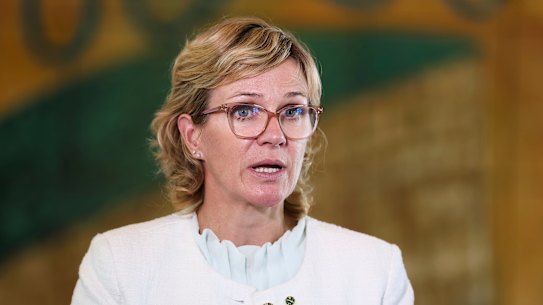
But values are likely to continue falling before beginning a tepid recovery in 2027.
Economists with the Commonwealth Bank, which has the nation’s biggest mortgage book, expect prices in Sydney to fall by 6 per cent and in Melbourne by 7 per cent this year before recovering 3 per cent next year. Brisbane prices are expected to lift 8 per cent in 2026 and then slow to 4 per cent in 2027.
Perth prices are tipped to climb 4 per cent next year after a jump of 12 per cent this year.
But NAB, which last week updated its forecasts, believes prices in Sydney and Melbourne will fall 9 per cent this year before eking out a 1 per cent increase in 2027. While Brisbane and Perth are still expected to grow this year, NAB is tipping effectively flat price growth next year.
The most bearish bank on the property market is ANZ. It is the only one expecting prices to fall across all major capital cities next year, led by a 4.6 per cent drop in Brisbane with both Sydney and Melbourne tipped to edge down by 2.9 per cent and 2.3 per cent respectively.
If Sydney and Melbourne fall in line with ANZ’s forecasts, prices in both cities will be down by more than 5 per cent since 2024. But Brisbane will still be up by 17 per cent while Perth would be up by almost 25 per cent.
Westpac chief economist Luci Ellis, who believes interest rates could be falling by August next year, said her bank’s property price forecasts were likely to be a little strong given the slowdown in the market over recent weeks.
She said that despite some “alarmist predictions” about property prices, the market was going through an “air pocket” that would likely dissipate next year. The Reserve Bank would not be overly concerned by what is the fourth downturn in housing prices in the past decade.
“A lower path for interest rates and earlier timing of subsequent rate cuts mean that any housing market downturn is likely to be relatively short-lived,” she said.
 Westpac chief economist Luci Ellis says the property market is not crashing but going through an “air pocket”.Renee Nowytarger
The Reserve Bank will provide some insights on interest rate movements after its two-day meeting begins on Monday. Before the meeting, financial markets believed there was almost no chance of a rate rise. The same markets expect the RBA will hold the cash rate steady at 4.35 per cent until late next year with a cut priced-in from December.
Market pricing of rate movements, however, have been volatile due in large part to ongoing uncertainty about the fallout from the US’s war against Iran. Oil prices alone have swung between $US76 and $US100 a barrel over the past fortnight.
The Reserve will also update its key economic forecasts, which were last released in May just before the federal budget.
All of its key economic indicators have proven softer than expected. In May, the bank expected headline inflation to be around 4.8 per cent, but in June, it was at 3.8 per cent.
Related Article
Underlying inflation is also weaker than anticipated, while unemployment is slightly higher at 4.4 per cent.
Much of the change is due to the fallout from the war against Iran. In May, Brent crude was forecast to be around $US101 a barrel.
The softer outlook has been a key factor in markets and economists marking down the chances the Reserve will deliver a fourth interest rate rise this year.
HSBC Australia chief economist Paul Bloxham, who expects the RBA to hold rates steady on Tuesday, said with both the economy and property market slowing, the bank could be cutting rates next year.
“Our central case is that the slowdown in growth, weakened further by the cooling housing market, will see the jobs market loosen further,” he said.
“This will see core inflation head to target fast enough that the RBA will not lift its cash rate any further in coming quarters. We see the downswing in growth being sufficient that the RBA begins to cut its cash rate in the second half of 2027.”
Cut through the noise of federal politics with news, views and expert analysis. Subscribers can sign up to our weekly Inside Politics newsletter.
Save
You have reached your maximum number of saved items.
Remove items from your saved list to add more.
 Shane Wright is a senior economics correspondent for The Sydney Morning Herald and The Age.Connect via X or email.From our partners