
It wasn’t long ago that the Wallabies were expected to account for Japan easily. Now, it would seem that the masses are happy enough just to beat the Brave Blossoms.
It wasn’t even two decades ago that the Wallabies smashed Japan 91-3 in the 2007 World Cup. Michael Cheika’s side even racked up a half-century in their loose but convincing 63-30 win in 2017.
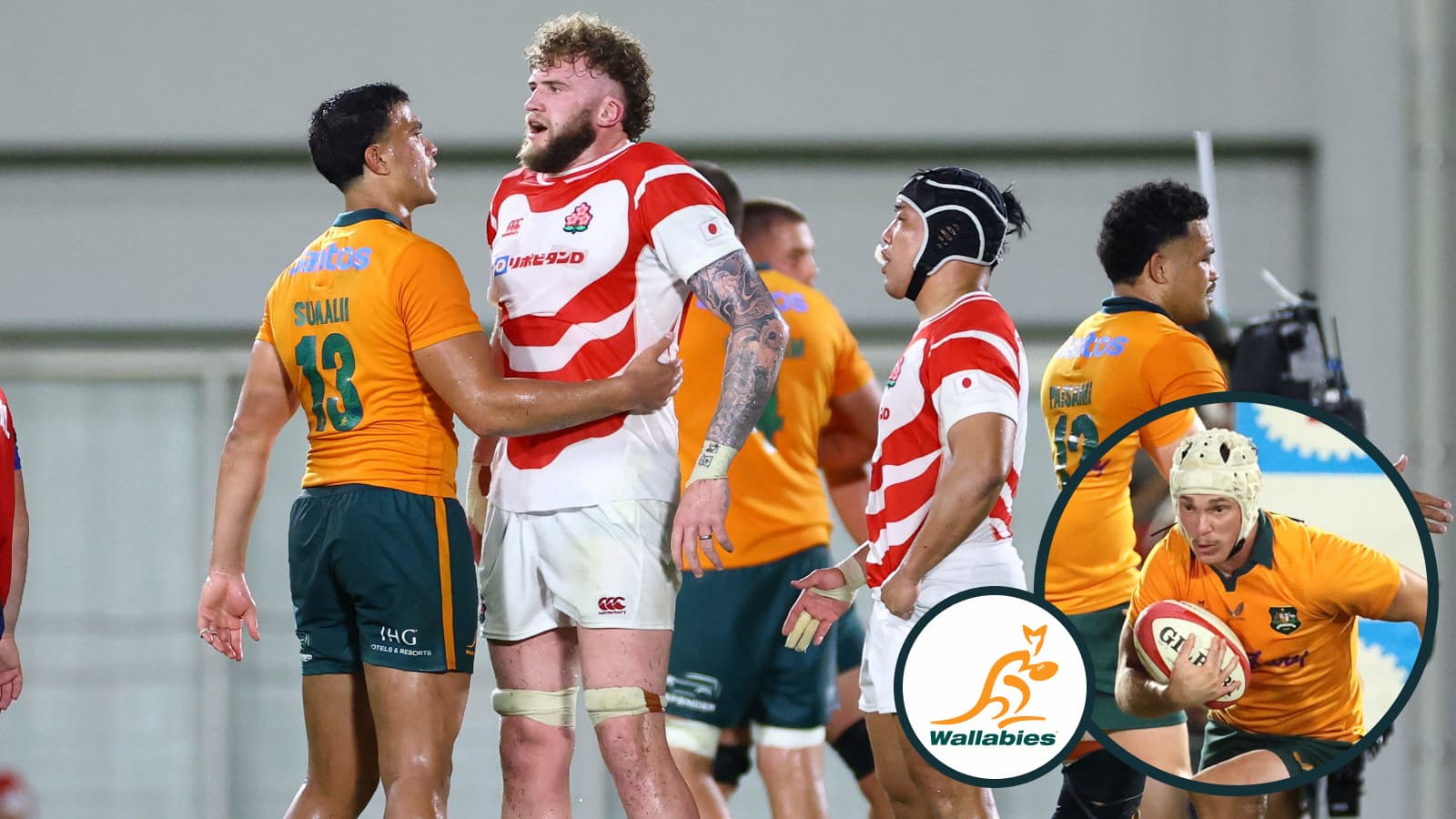
But the latest example that Australian rugby is falling at a rate of knots is Saturday’s heart-in-the-mouth 35-32 win in Osaka. The victory came 10 months after holding on 19-15 in Tokyo.
Eddie Jones was quite rightly frustrated by the result, describing the three-point defeat as “disappointing”.
While Japan has gone from a league where players collected early retirement packages to a competition where the last three World Rugby player of the years have featured, the Wallabies, who are full of power athletes that only the Brave Blossoms could dream of having, should still be beating Japan convincingly. After all, Ireland’s second-string side managed to put away Japan easily last month in Newcastle despite having a set-piece that was smashed.
The weather was used as an excuse by many, the sun was down and it wasn’t all that different to playing in parts of Australia early in the Super Rugby season or Fiji, where the humidity is high.
But in truth, the Wallabies were simply poor.
Their decision-making was mind-bogglingly bad – the Wallabies twice played on quickly from penalties, including after two scrum penalties deep inside Japan’s 22 when a yellow card was a real possibility and Taniela Tupou’s power was coming to the fore – and it brought Japan into the contest.
Until Rugby Australia truly accepts where the game has gone, where it’s going and what needs to change (a serious introspection on the game’s pathways, especially in the recruitment and retention areas), the trajectory will only continue down.
Battle of 10s exposes Australia’s selection and talent issue
The harsh reality for Declan Meredith is the 27-year-old was completely outplayed by someone six years younger than him and a rugby novice.
Meredith looked like a cat on a hot tin roof as he failed to show the required composure needed to succeed on the international stage.
His decision to play on quickly from the penalty deep inside Japan’s 22 was Meredith’s biggest blunder, but he also spilled an early out-the-back-pass from Hunter Paisami, kicked out on the full once from a kick restart and regularly sliced the ball into touch when clearing his own line.
It wasn’t all bad though, with Meredith continuing to kick well for the line while his quick hands ahead of Tom Wright’s try midway through the first half was a nice touch.
But the biggest difference is that where Meredith rarely played with time and attacked the line, Ryunosuke Ito took the game on from the outside.
His lovely left-foot grubber freed up his winger to make an early break.
But it was his big right-foot step to leave Harry Wilson on the ground that was special.
Les Kiss reflects on debut Wallabies win over Japan: ‘When we had to find a way, we did find a way’
The 21-year-old, who has yet to play a domestic match after being plucked from university this year, has all the tools to turn into something special.
While the Wallabies are banking on Carter Gordon to come good, the 25-year-old’s injury-riddled two years have left everyone crossing their fingers that he stays on the field.
His return to Australian rugby also came after the national body wasn’t convinced that he – like Noah Lolesio – was the answer at fly-half.
Time for bravery to enter the selection equation
With the World Cup edging closer, Les Kiss needs to take a leaf out of Rassie Erasmus’s book and look at other combinations.
Despite the Wallabies struggling for consistency and results, coaches can navigate the tricky balance of giving opportunity and trying to win by explaining decisions thoughtfully and truthfully. That’s not always occurred recently.
One is bringing Samu Kerevi back into the fold to add some depth alongside Japan-bound Paisami.
It’s easy to forget that it wasn’t long ago that Kerevi and Len Ikitau were one of the most destructive midfield pairings – they even knocked over the Springboks in consecutive Tests in 2021.
The other is seeing more of Joseph-Aukuso Suaalii in the backfield.
While Kiss moved the code-hopper to the wing when Isaac Henry entered the fray late against Japan and Wright left the field, with Ben Donaldson featuring at full-back, Suaalii didn’t touch the ball.
It was likely a sign of things to come.
But Kiss shouldn’t be scared of starting Suaalii at number 15 despite Wright featuring prominently against Japan in what looked like a return to form for the full-back.
Comment: All Blacks need not ‘worry’ after Springboks ‘escaped to victory’ against Argentina
The Wallabies need options, including in Tests, and one of those has to be unlocking and unleashing Suaalii at full-back, where he showed huge promise for the Waratahs in 2025.
Biggest positive out of Osaka
Angus Bell might have been player of the match and offered the desired impact off the bench, but Josh Canham was the Wallabies’ best by a country mile.
The lock was everywhere for the Wallabies and the big man was at the heart of everything they did well in the first half.
He won turnovers on the ground and at the lineout.
The second-rower has always been a baller but now he’s showing the skill-set, physicality and the maturity that many have long hoped for.
He’s been the find of the international season so far.
Lesson in South Africa
As the All Blacks got well-beaten at the set-piece in their tour opener in South Africa, New Zealand – and by association Super Rugby – got another reminder of what playing rugby in the Republic offers.
But the other reminder Super Rugby’s cohort got, including Australian rugby, was that age isn’t always an impediment.
Want more from Planet Rugby? Add us as a preferred source on Google to your favourites list for world-class coverage you can trust.
Days after returning Waratahs half-back Nick Phipps bemoaned the fact that players were seen as over the hill after turning 30, Stormers forward Deon Fourie turned back the years by producing an incredible performance against the All Blacks.
The 39-year-old was everywhere, including on the ball, and the All Blacks only finished over the top of the Stormers after the loose-forward was replaced.
But his performance wasn’t missed, with Erasmus recalling the World Cup winner, who featured prominently at hooker in the 2023 final win over the All Blacks, to his Springboks squad. He’s the second hooker Erasmus has backed despite getting on, with the Springboks coach including then 38-year-old Schalk Brits in his World Cup squad in 2019.
Fourie’s call-up should serve as a reminder that age is just a number for a code and nation that is obsessed with picking youth and from home.
READ MORE: All Blacks relishing Ma’a Nonu ‘spectacle’ as reason for Sharks veteran’s longevity revealed