
Welcome to our live coverage of today’s RBA interest rate decision.
The RBA has held the cash rate at 4.35%. Stay tuned for reactions from economists and updates live from the press conference following the announcement.
Jump to key updates

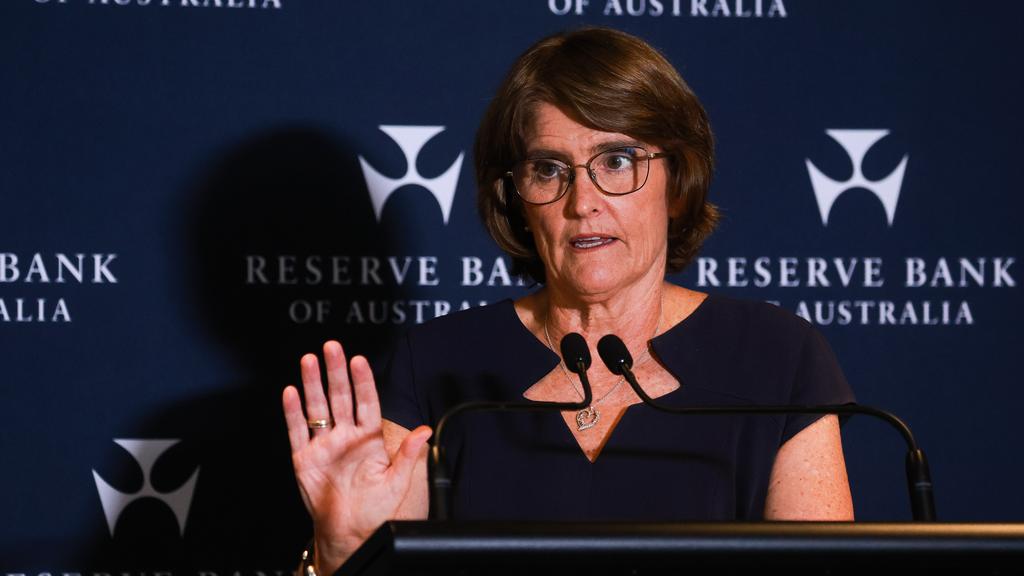
RBA Governor Michele Bullock. Picture: Gaye Gerard
More rate hikes still on the table, RBA warns
3:44pm
Governor Michele Bullock says the Reserve Bank will still need more time to see whether its earlier rate hikes will be enough to ensure inflation will continue to cool in line with its latest forecasts.
Speaking at this afternoon’s media conference following the RBA board’s decision to keep the cash rate at 4.35%, Ms Bullock confirmed the bank did also consider raising the cash rate for a fourth time.
“Increases have been tough for households with mortgages, but they were necessary,” she said. “Our forecasts see inflation coming down to around the middle of the [2-3%] target band by 2027, but the forecasts are uncertain. In waiting, the board isn’t ruling out that there might be a need for further rate rises.”
Ms Bullock added: “The board will raise interest rates further if that is what is required to bring inflation down in a timely way. Bringing inflation down is the board’s key priority.”
RBA governor to face media over rate decision
3:31pm
Governor Michele Bullock is preparing to front the media, where she will answer questions from journalists on the decision of the RBA board to keep the cash rate on hold despite high underlying inflation.
Ms Bullock will start her appearance by speaking through the discussions had among the board’s nine members over the last two days. This is expected to touch on its consideration of the ongoing war in the Middle East and its longer-term effects, persistent high inflation, and household spending indicators.
Media attention is expected to be on the bank’s latest forecasts, including any revised outlook for the path of inflation, which came in notably cooler than the bank expected in June when a 5% peak had been expected.
Reporters are also likely to question Ms Bullock on how imminent a move on interest rates will be, and whether it is likely to be another hike or a rate cut.
Iran war inflation impact ‘less than expected’, RBA says
3:15pm
A statement released by the RBA this afternoon says the impact of the Middle East conflict on inflation has been “far less than expected”. It’s a major acknowledgement from the bank’s monetary policy board and follows recent ABS findings that inflation in June was not the peak the bank had anticipated.
The RBA says its three earlier rate hikes mean financial conditions have tightened since the start of the war six months ago, leaving space to keep the cash rate on hold.
“Money market interest rates and government bond yields have risen, and the exchange rate has appreciated,” it read. “There are signs that consumer spending growth is slowing gradually as expected, while growth in business debt and investment is strong.”
The statement also confirms the MPB appears to be getting back on track with its decision-making, with all nine members unanimous on the decision for the second time in a row, after struggling at the first three meetings of the year.
RBA: AI investment is offsetting Middle East impacts
2:58pm
Slow economic growth in Australia continues to be a major focal point for the RBA, with its monetary policy board noting the “prolonged uncertainty” from the continuing Iran war and the ongoing uncertainty around interest rates.
In a statement released alongside its decision to hold the cash rate steady this afternoon, the bank said growth in the nation’s major trading partners had been stronger than expected in the months since the conflict began, specifically calling out AI-related investment in its statement.
“It has outweighed the adverse effects of the Middle East conflict,” the statement read. “Historically weak productivity growth continues to constrain potential growth.”
It comes after several weeks of messaging from RBA executives around its concerns for the negative effect rate that hikes have had in quashing economic growth prospects, warning wages will not improve until inflation is successfully brought back into a low range.
Rate hold protects Aussies from grim record
2:46pm
Today’s news of another cash rate hold will be welcome by Aussie households, many of whom are continuing to feel the cost-of-living pressures from the first half of the year.
A second consecutive decision to keep the cash rate at 4.35% marks an important moment for the nation; the cash rate is just 0.15 percentage points away from a 15-year high, meaning a regular 0.25 percentage point hike today would have taken the cash rate above that.
The cash rate sat at 4.75% between November 2010 and October 2011, before dropping slightly to 4.60%. Robust economic growth off the back of resource demand from Asia and Australia’s mining where behind the tight conditions, along with some global instability from European banks.
While homeowners can expect some stability over the next two months now, the bank still has four more meetings ahead this year in which the cash rate could be raised yet again.
Read more: Lender wars: The secrets to locking down the best home loan
RBA holds the cash rate steady at 4:35%
2:30pm
The Reserve Bank has left the cash rate on hold today in a move that will keep it at 4.35% until at least the end of next month.
It’s more welcome relief for borrowers, though not unexpected thanks to cooler-than-forecast inflation, a softening labour market and employment figures holding steady across June.
While tensions in the Middle East continue to cause spikes in global oil prices, market volatility associated with the war has been largely mitigated by the Reserve Bank’s three rate hikes in the first half of the year, giving households some breathing room as they adjust to the pressures of higher fuel prices as the government’s fuel excise discount winds up after four months.
The RBA board’s statement that accompanies today’s decision will be published shortly. It will provide a look into members’ deliberations this week, along with its latest forecasts for inflation, economic growth and broader market conditions as the second half of the year unfolds.
Read more: RBA keeps interest rates on hold at 4.35% ahead of spring selling season
Markets confident the RBA will hold rates
2:14pm
Market expectations for a rate hold have been mixed over the last few weeks, though latest data from the Australian Stock Exchange shows pricing was trading at 95.65 as of Friday, meaning there is a 0% expectation for the cash rate to rise.
If the cash rate is left unchanged, it will mark the second consecutive hold decision from the RBA and represent a long-awaited turning point for households in a year that has been dominating by a tightening cycle.
One or more cash rate hikes later in the year are still expected by some industry experts, though cooler-than-forecast inflation and a slowing labour market are painting a more positive picture than what the bank was looking at when it held rates steady in June.
The RBA Rate Indicator calculates the probability of a rate change using market-determined pricing from the ASX 30-Day Interbank Cash Rate Futures.
Read more: RBA governor warns sluggish productivity is hindering rate cut chances
Room in the tank for more hikes, RBA says
1:59pm
While hard-pressed households will be hoping the cost of living isn’t further compounded by a rate rise this afternoon, the RBA has signaled there is space for more tightening.
Assistant governor Sarah Hunter’s appearance at an economic forum in Sydney two weeks ago raised eyebrows after the chief economist said there are “absolutely no signs in the system of any systemic stress”. This means things such as mortgage repayment capacity levels, bank lending and liquidity levels are not keeping the RBA awake at night.
Ms Hunter said it “doesn’t look like households with a mortgage are systemically struggling to meet that bill at the moment”, raising concerns the RBA feels another rate hike is manageable.
The average owner occupier mortgage in Australia is approximately $735,000, according to the ABS, with Mortgage Choice calculations showing each 0.25 percentage point rate hike this year has added around $115 a month to minimum repayments on that amount.
Read more: Room for a hike? RBA says households show ‘no signs’ of widespread stress
Economist prediction: No rate hike today
1:45pm
The Reserve Bank is not likely to hike interest rates today and will instead wait and see how the economic picture develops as this high inflationary period continues, a leading economist believes.
Realestate.com.au’s Angus Moore says a hold is “nearly universally acknowledged” today after the June inflation data from the ABS showed there had been no uptick in underlying inflation since its reading in May. Nevertheless, Mr Moore warned Aussies aren’t out of the woods just yet.
“What is going to be important to watch is not the decision, but the RBA’s forecasts,” he explains. “How much signal the RBA is taking from the better-than-expected inflation outcome is really going to dictate whether and when we might expect to see another move.
“If the bank is viewing last fortnight’s inflation data as just a transitory surprise and still forecasting inflation to pick up that means we might see a hike sooner rather than later.”
Read more: RBA tightrope puts Aussie households at centre of rate balancing act
Australia’s four big banks agree on a rate hold for today
1:29pm
Australia’s largest home loan lenders – big banks CBA, Westpac, National Australia Bank and ANZ – agree that this week’s Monetary Policy Board meeting will not end with a rate hike announcement.
While there are mixed views from the banks on what the rest of 2026 will bring, all four say the Reserve Bank will need more time to assess the impact of its February, April and May rate hikes, while also waiting to see whether peace negotiations in the Middle East can stabilise the Iran War’s various geopolitical conflicts.
Westpac has been the outlier among the four this year, with consistently hawkish expectations for tightening. Despite this, the bank has revised its long-held view for a rate hike today, instead shifting in line with broader market forecasts for a hold.
Smaller lenders have also been sharpening variable rate offerings for new customers over the last few weeks, suggesting a wide consensus for a hold.
Read more: Major bank drops new expectation for 2027 rate cuts
Middle East challenges weigh on RBA oil price concerns
1:15pm
While the labour market is easing quicker than expected and inflation is tracking below the RBA’s expectations, uncertainty stemming from the Middle East conflict continues to weigh on the bank’s short-term forecasting.
Consensus across markets and economists is for interest rates to remain on hold for the rest of the year, though Australia’s largest lender Commonwealth Bank has warned of “lingering risks” including a full-scale re-escalation of the Iran War.
The memorandum of understanding signed by American and Iranian officials in June outlined a 14-point agreement to end the almost six-month long conflict, but its truce agreement was violated in July after commercial ships in the Strait of Hormuz were targeted. A corresponding spike in oil prices leaves Australians in a continued period of vulnerability as tensions remain high globally.
“We expect the RBA to remain concerned about elevated inflation,” head of Australian economics Belinda Allen said. “[We] reiterate they will be willing to hike again if required.”
Read more: Why the Reserve Bank’s elusive inflation target means it must hold rates
Home prices continuing to drop
1:02pm
While households will be hoping the Reserve Bank has finished hiking rates for now, continued fears around the resilience of the property market are clouding the outlook for this afternoon.
The realestate.com.au Home Price Index shows national home prices fell in April, May, June and July, wiping $14,000 in value off a median priced Aussie home since the start of the Iran War in late February.
Regional areas continue to outperform their capital city counterparts, with prices in regional Australia up 8% on July 2025, led by strong growth in Western Australia, Tasmania and South Australia.
Property values in Sydney and Melbourne are down compared to 12 months ago, while Australia’s cheapest capitals Darwin and Hobart have seen 14.9% and 7.8% price growth, respectively. Despite weak performance overall, Sydney remains the most expensive city in which to buy a home, with a median price of $1,205,000 – close to double that of Darwin ($636,000).
Read more: PropTrack Home Price Index – July 2026
RBA concerned about public’s lack of knowledge around inflation
12:44pm
As the RBA prepares to hand down its decision on the cash rate this afternoon, discussions among its monetary policy board (MPB) members are likely to touch on its recent findings about households.
In a three-phase survey of 9000 Australians between February 2025 and March 2026, the RBA looked at how the public experience and understand the economy.
While the bank says having a grasp of its work is “crucial” for its success, it found a “fundamental” lack of understanding about economics among three quarters of those surveyed when publishing its findings late last month. The bank particularly pointed out 75% of the public largely misunderstand how interest rates affect inflation, adding this could be denting its reputation.
It comes after RBA executives used media appearances in recent months to stress the importance of public confidence in its work, adding there is “less risk of inflation getting out of control” when public expectation is closely anchored to its 2-3% target.
Housing market worse than the RBA expected
12:32pm
This year’s combination of high inflation, war-induced price pressures and uncertainty around property tax changes have left the housing market in an uncharacteristic slump over the last few months.
Home prices fell for the fourth straight month in July, with the nation’s priciest capital cities leading the decline. The median price of a home in Australia now sits at $894,000, down from $908,000 in March.
In the leadup to today’s rate decision, the RBA warned the housing market has been weaker than it anticipated since the start of the war, with governor Michele Bullock saying it is a standout poor performer in the economy.
What will factor into the bank’s interest rate decision is how changes in housing prices affect household confidence, with spending and investment decisions often dropping off when home prices are down. This is then likely to slow further an already-sluggish domestic economy, opening the door for the RBA to consider holding off on hikes.
Read more: RBA says Iran impact on housing market worse than expected
RBA optimistic despite high inflation
12:14pm
The RBA’s three rate hikes earlier this year have gone a long way to softening its drastically high inflation expectations, opening the door to a sustained period without any change.
Data published by the Australian Bureau of Statistics shows the Consumer Price Index rose 3.8% in the 12 months to June, significantly under the grim 5% forecast the RBA and Treasury had anticipated earlier in the year.
June also spelled good news for underlying inflation; measured by the trimmed mean, it leaves out the most volatile price changes each month and is a more accurate reading the RBA relies on for decision making. While it is still far outside the RBAs 2-3% target, a reading of 3.6% in the 12 months to June means there was no change from May.
REA Group executive manager of economics Angus Moore labelled the inflation data “a good surprise” for households, adding it largely cuts any chance of a hike today.
Read more: Inflation stability shows RBA’s three rate hikes are doing their job
Welcome to our live coverage of today’s cash rate decision
12:01pm
There are just a few hours to go until the Reserve Bank of Australia’s (RBA) monetary policy board wraps up its latest meeting – two days of deliberation that will end with an announcement on the cash rate.
The bank is largely expected to keep interest rates on hold today at 4.35% for a second consecutive time, following cooler than anticipated inflation figures from June. The unemployment rate also held steady last month, further adding to the case for no action for now.
We’ll be here in the lead up to the 2:30pm announcement this afternoon, sharing the latest news, forecasts, data and expert commentary around the potential outcomes for the decision and what it means for homeowners and the wider property market.
As war continues in the Middle East despite peace negotiations and a memorandum of understanding aimed at ending the conflict, homeowners and borrowers will be looking for interest rates to remain steady as other cost pressures continue to bite.
Read more: A hike too far? RBA says higher rates are hurting but working