
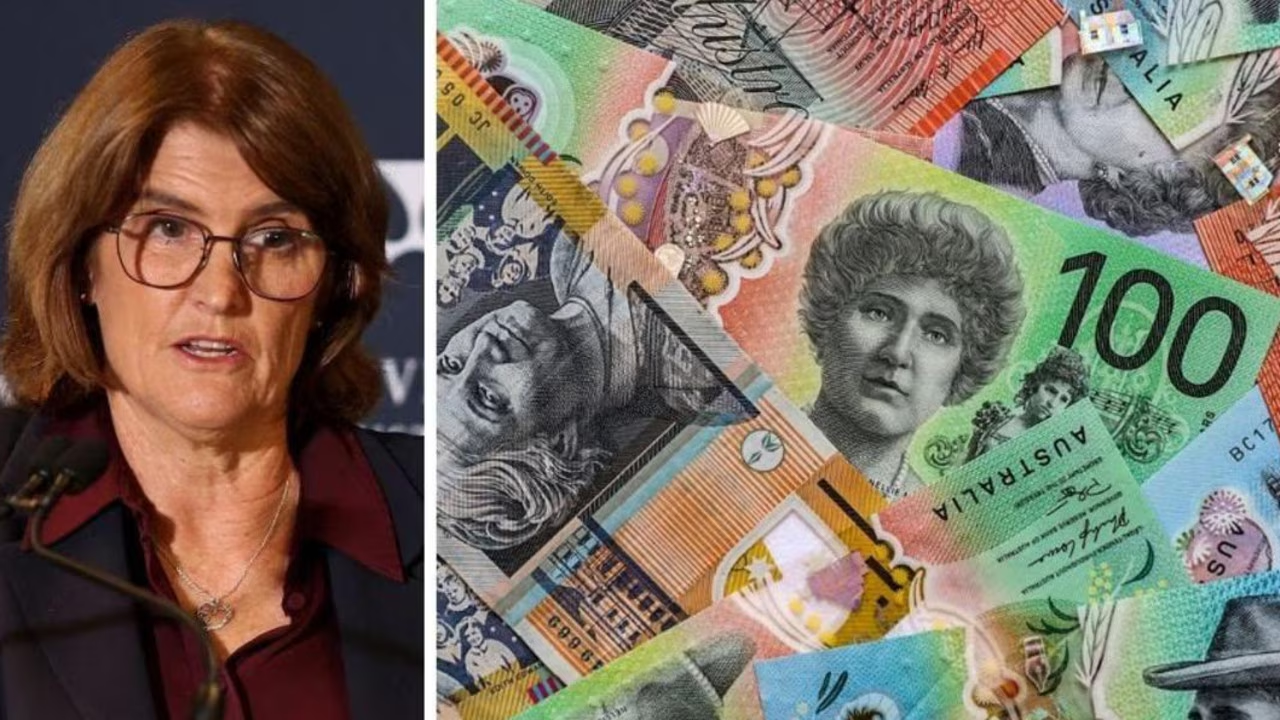
A leading economist has warned the official cash rate needs to be much higher or Australia risks an economic crisis, blaming the Reserve Bank for being “too kind”.
The RBA is widely expected on Tuesday to announce the cash rate will be kept on hold at 4.35 per cent, which would be a relief for households who have been hit with three rate hikes this year.
But EQ Economics managing director Warren Hogan says that would be a mistake and could be worse for the economy.
Mr Hogan has told NewsWire the RBA’s “economic experiment” of keeping interest rates lower than the rest of the developed world had failed to tame inflation.
He said the RBA’s should not have ended the hiking cycle at 4.35 per cent in 2024, and it needed to be at least 5.6 per cent.
“They’ve been too kind … pulling up stumps on the hiking cycle at 4.35 was a risky proposition and they needed to get up to 5 per cent if not a bit higher because they needed to kill this thing off when they could,” Mr Hogan said.
“The problem the Reserve Bank has is the framework and thinking over the last few years has proven to be wrong.
“The reality is the interest rate is not out by one or two rate hikes, it is out by at least four.
“That is why they need to raise rates this week.”
According to Mr Hogan, time will show the central bank needed to use every opportunity to slowly lift the cash rate in order to get on top of inflation.
“We need to get to 5.60 per cent. That is where every other central bank went in 2024 and we decided to run an experiment that said no we are going to do less,” he said.
“It has proven to be just disastrous because the reality is if 2000 years of economic history is anything to go by, we probably need to go to 6 or even 7 per cent, in which case it will be the late 1980s again and we will have a financial crisis.”
While Mr Hogan conceded a rate hike would hurt households over the short-term, he pointed out it would stop worsening economic outcomes – including a massive recession.
Will the Reserve Bank lift the cash rate?
The RBA meets this Monday and Tuesday, where they are widely predicted to keep the official cash rate on hold at 4.35 per cent.
Currently money markets are predicting just a five per cent chance of more rate pain for households in August, with all four major banks saying rates will stay on hold until at least 2027.
So far the RBA has lifted the cash rate in three of its four meetings in 2026, by a total of 75 basis points, in its fight against inflation.
While households have been hit with higher interest rates, it has not completely slowed down inflation.
Australia’s trimmed mean inflation rate – which strips out the top and bottom 15 per cent and is used by the RBA – came in at 3.60 per cent for the 12 months to June.
This is above the 2 to 3 per cent target range.
Mr Hogan said Australians had been suffering from four years of cost-of-living pressures because of this decision.
“If the RBA had done their jobs and been the adult in the room and brought some sanity, but they decided not to do it for whatever reason and we are in a situation we are in now which is a destabilised political environment and economy, which we haven’t faced for 50 years.”
While higher interest rates hurt mortgage holders and businesses directly and have a flow on impacts to renters, RBA governor Michele Bullock previously said inflation also hurts everyone.
“Higher inflation isn’t just a statistic. It strains household budgets, complicates business planning, and weighs on confidence,” Ms Bullock said during her speech at the Anika Foundation.
“Many Australians are again feeling this pressure; indeed, we recently published survey evidence showing that inflation is the single most pressing economic concern for Australians.
Getting rid of Australia’s inflation woes
Mr Hogan said Australia may need to go into a recession in order to get rid of its inflation problem, although he points out not every economic downturn leads to long-term consequences.
He said there were three types of recessions – per capita recessions when the economy grows thanks to population growth only, “the garden variety recession” which is a short and shallow dip, or a financial crisis.
Mr Hogan said Australia in trying to remove the garden variety recession, the economy could be heading towards a financial crisis.
“We can avoid it and of course the way to avoid it is for everyone to get on the same page about the problem,” he said.
“But if we saw state and federal governments play a concerted and gradual role at reducing their spending combined with the Reserve Bank gradually raising rates, we may get away with a garden variety recession.
“If the governments of Australia keep doing what they are doing, that opens the door to the RBA having to do all the heavy lifting.”
Reserve Bank should fear ‘spectacular’ economic data
Despite the US-Iran war’s impact on fuel prices and rising rates, Australia’s economy has not slowed, which is adding pressure on policy makers.
It is currently forecasted the Australian economy needs to grow at 2 per cent or under, in order to get rid of the country’s inflation problem.
A growth rate above this will exceed Australia’s “economic speed limit” and add to its inflation woes.
Last week, Australian Bureau of Statistics figures showed household spending rose 0.8 per cent in June, despite fears that previous interest rate hikes and fluctuating oil prices could slow consumption.
Household spending is now up 6 per cent for the 2026 financial year following a bumpy few months.
In May, household spending rose sharply by 1.3 per cent, but this was after a 1.1 per cent fall in April.
Most of the growth was in discretionary spending items.
Mr Hogan said recent data is showing households might be feeling bad, but they have not stopped spending.
“We know that the biggest impact of the Iranian war was sentiment …. We got the latest number earlier this week and they were nothing short of spectacular, after a strong May,” he said.
“Overall, an overall picture being painted by the numbers shows the consumer is hanging in there.
“We have this data saying Australian consumers hardly missed a beat.”
Ms Bullock has said some demand needed to be taken out of the economy in order to get inflation back under control.
“There is a lot of commentary like ‘oh no growth is slowing’ but we assess at the moment that demand has to slow so it is not growing more than supply and generating inflation,” she said.
“So the point I want people to take away is this is part of the plan.
“This is what interest rates are designed to do. (Hikes) are designed to slow demand so it is more in line with growth in supply and alleviate those inflation pressures.”
Repeat of the 1970s
While household spending remains strong, the majority of state and federal budgets are also running a deficit, adding to Australia’s inflation woes.
Government spending has increased from a pre-Covid period of below 25 per cent to around 27.3 per cent of total economic growth.
This increase in spending is taking resources and putting pressure on inflation.
Mr Hogan said Australia’s current economic settings were remarkably similar to the 1970s, when a damaging mix of soaring consumer prices, rising unemployment and slowing economic growth combined to hurt living standards.
“We’ve gone from a perspective a couple of years ago when people looked at this (inflation) episode and compared it to the 1970s and how it could play out in a similar way,” Mr Hogan said.
“I would be saying we are at the point where we have to look at evidence as to how it is different from the 1970s.
“Right now we are in about 1976 ready to have another ripping of inflation for the next couple of years.”
Despite long-held concerns that government spending was driving inflation, federal Treasurer Jim Chalmers has said “savings and spending restraint” were doing the “heavy lifting” on improving the budget position, which was $44.9bn better off than the mid-year update.
Pointing to the $63.8bn in net savings and reprioritisations revealed last week, he said the budget delivered “the largest savings package on record”.
“A big part of our savings package will restore the (National Disability Insurance Scheme) to its original intent and secure its future, so it grows in a sustainable way in line with programs like Medicare,” he said.
“This difficult but necessary reform will save $37.8bn over the forward estimates.
Read related topics:Reserve Bank