

The Irish scientists chasing the total eclipse across the Atlantic at 10,000 ftpublished at 14:26 BST
14:26 BST
 Jack Grey
Live reporter
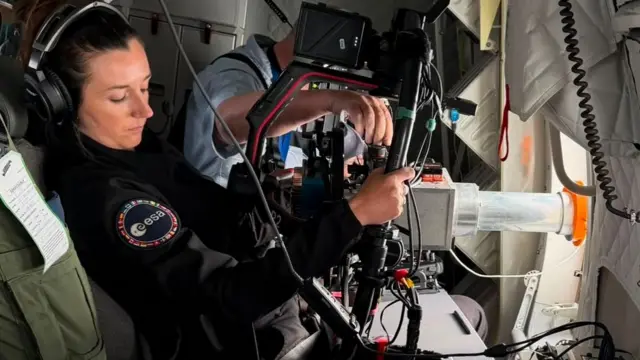 Image source, DIASImage caption,
Dr Laura Hayes is among the team of scientists that will be chasing the eclipse in a military plane hundreds of miles off the Irish coast
Later this afternoon an Irish Air Corps aircraft filled with scientists will be heading to an exact point 10,000 feet (3km) high and 350km (218 miles) out over the Atlantic Ocean.
It will be plunged into complete darkness.
The plane, after having intercepted the total eclipse cast by the Moon’s shadow, will chase the darkness across the ocean, giving the scientists on board an invaluable two minutes to study the Sun’s corona.
“Being hands on with this experiment is extremely exciting,” says Dr Laura Hayes, who will be among the team of scientists on board.
The assistant professor at the school of cosmic physics at the Dublin Institute for Advances Studies tells me this is the first solar eclipse she will experience.
Once the plane is in darkness, Hayes and her team will depressurise the cabin and pop open a hatch that exposes the interior of the plane to the elements so their solar telescope can get a clear view of the sky.
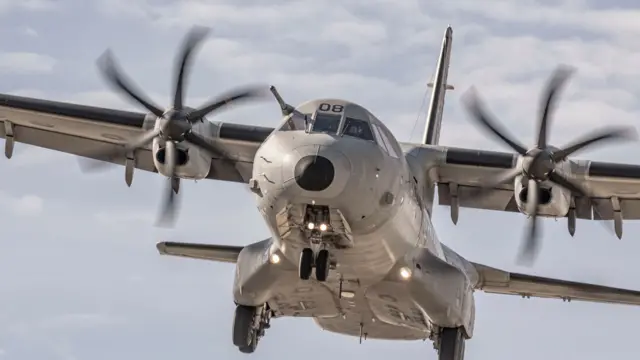 Image source, Getty ImagesImage caption,
The scientific team will be flying aboard a Irish Air Corps C295 turboprop aircraft – similar to the one pictured here
Hayes says the team will be studying the Sun’s corona – essentially the Sun’s “atmosphere” – which is usually “really challenging” to observe due the Sun’s glare.
This allows scientists to map out parts of the Sun’s magnetic field, which Hayes says is key to learning more about what drives the “huge solar flares” which can effect things like GPS satellites or the Earth’s power grids.
The images taken by the team will then be compared with Nasa’s observations, who are operating a similar flight “at a much higher altitude” from Iceland.
“We are prepared for this. We’ve had test flights. We’re currently still here in the lab, putting things together… our biggest concern now is just weather,” she adds. “But we have our fingers crossed.”