
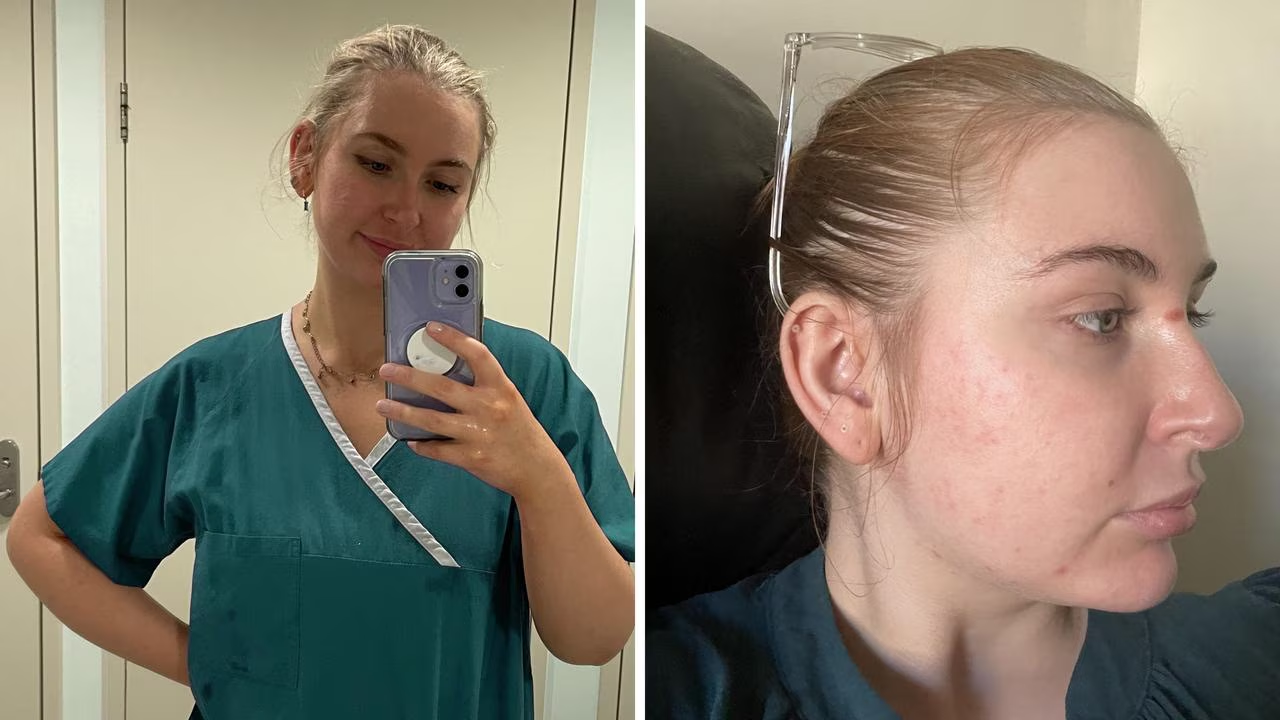
Queensland nurse Grace Young can be doing something as simple as shopping at Woolies when it happens. A small beep – and suddenly she is back in the ICU at the peak of the Covid pandemic.
For anyone else, it’s the everyday sound of a tap-and-go card reader.
But for the 27-year-old ICU nurse, it is nearly identical to the “critical” alarm for a Covid-19 patient, and suddenly, her entire body is in fight or flight mode.
“I’d be standing in a supermarket queue and suddenly be back on the ward,” she said.
“I didn’t know why I’d be suddenly activated, and then I realised later on. It has diminished over time … but to be honest, I still feel that occasionally.”
For Ms Young, two years of her life were spent working more than 12-hour days in full PPE – which she had sweated through by the end of each shift.
The N95 mask caused an injury to the bridge of her nose from wearing it day after day. Her hair turned to straw after washing it every day in line with protocol.
The scar on her nose has since faded, but her mental scars remain.
“I don’t think people understand the reality of what we went through,” she said.
“We needed a lot more support than maybe we were given.”
Shortfall incoming
Australia is staring down the barrel of a shortage of 70,000 nurses by 2035, with news.com.au launching an investigation into the major issues within the industry.
Figures exclusively obtained by news.com.au show that the number of nurses who have left the bedside but remained registered as nurses with APHRA exploded in 2023 after the pandemic, and has only continued to rise.
From March 2022 to March 2023, the number of nurses on APHRA’s non-practising register jumped from almost 6000 to more than 11,000 and has continued to increase year on year.
As of March this year, 12,163 nurses across Australia were on the register, with little being done to bring them back.
After Covid-19, Ms Young said she almost became part of that cohort – believing she had to “completely write off nursing” due to her burnout.
Even after taking a full month off in 2024, Ms Young said she walked into her first shift back full of dread, and instantly burnt out again.
“I just felt so empty inside,” she said.
“I walked straight back into the same conditions that triggered my burnout in the first place.”
Instead of leaving nursing altogether, Ms Young now works part-time in the ICU and part-time as a burnout strategist.
She said most of her clients work in healthcare, and that many nurses she worked with during Covid-19 have also gone part-time or left altogether due to burnout.
“It’s been a really common experience,” she said.
“A lot of people have just completely changed, and a lot of it was forced. You get to a point with your burnout, you are at a crossroads and are just like, ‘I can’t continue’.”
Nurse left with lifelong disorder
One ICU nurse, who spoke to news.com.au on the condition of anonymity, said she developed an auto-immune disorder called fibromyalgia due to the amount of exhaustion and stress she faced during Covid-19.
She said it began one shift when she was looking after an unconscious patient. She suddenly became overwhelmed with excruciating pain and her shoulders locked up.
“I couldn’t get my arms up to tap on the window or use the alert bell, so I had to tap on the window with my head to get help,” she said.
“I came out of the room and just knew something was seriously wrong with me.”
She was told to “suck it up” and continued working throughout the pandemic.
One in three nurses in ‘high-frequency stress’
In May, the Australian Primary Health Care Nurses Association released a report which revealed more than one-third of nurses and midwives were looking to reduce their hours or leave their jobs altogether.
It also revealed that burnout is still on the rise post-Covid, with 33 per cent of nurses and midwives reporting they feel “high-frequency stress”.
Hobart mental health nurse Evan Kurzyp, who became a registered nurse just six months before Covid-19, said as more people leave, more pressure is being placed on those who remain.
“We’re just going to need so many more nurses,” Mr Kurzyp said.
“I think if we aren’t preparing now (rather than) in 10 years, if we’re not ramping it up now, making sure senior staff and long-tenured staff are lasting, we just won’t have enough, and it just won’t go well.”
Cost of understaffing
Sydney nurse and NSW Nurses and Midwives’ Association member Ellie Peach, 31, moved to part-time work last year after finding that she was being emotionally drained from her job.
Ms Peach said full-time nursing meant she “didn’t have a social life”, and that she was cancelling plans with friends just to recover from the stress of work.
“My friends that are in different careers … they just don’t have that issue,” she said.
“They get tired and all of that, but they still have social lives and everything, but … I just had nothing.”
Ms Peach said that nursing has always been an “emotionally demanding job”, but that the abuse and understaffing had made it unmanageable in recent years.
“Yes, you get resilient, but resilience can only be pulled so far before the string breaks,” she said.
The solution
As part of an investigation into Australia’s nursing shortage, news.com.au has compiled a list of possible solutions after speaking to more than a dozen nurses about how we can better improve their working conditions.
Right now, each state and territory has its own EBA, meaning nurses in some states are being paid less than others.
It means as pay rates change, many nurses move interstate for better pay or conditions.
Nurses are calling for improved equal pay across the board, as well as free parking for healthcare workers at their own hospitals.
Nurses are also calling for mandated 1:4 national ratios across all wards and aged care facilities, which includes a mixed skill element.

Right now, most states have 1:4 ratios in hospitals during morning shifts. However, often just one senior nurse is left with three inexperienced nurses, putting pressure on the system as a whole.
Nurses are also calling for better mental health support, given the increasing rates of abuse they are facing, and are seeking fully-subsidised private therapy sessions as a result.
Governments say they are addressing crisis
In response to news.com.au’s investigation into the nursing crisis, the federal government has responded by saying it had recently developed a National Nursing Workforce Strategy, which demonstrated “the Government’s commitment to supporting and strengthening the nursing workforce”.
The strategy includes the development of leadership and anti-racism programs, as well as initiatives to grow the Aboriginal and Torres Strait Islander nursing workforce.
“A key focus is growing and retaining the nursing workforce Australia needs now and into the future,” a spokesperson for the Department of Health, Disability and Ageing told news.com.au.
A spokesperson for NSW Health said the state government had worked to increase the nursing workforce by more than 10 per cent between June 2023 and June 2026.
“NSW Health recognises and is deeply thankful for the outstanding commitment of our
dedicated and skilled nurses who provide high-quality, safe and compassionate care
to the people of NSW every day,” the spokesperson said.
Get in touch with our investigative reporter. Sarah.Keoghan@news.com.au
Read related topics:BrisbaneWoolworths