
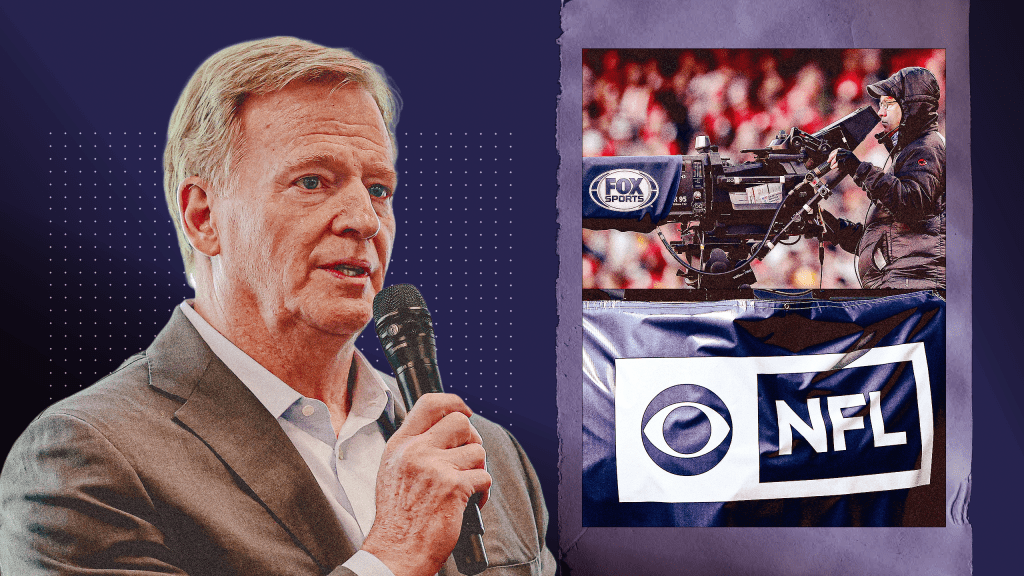
While nuance and 21st century thinking are about as complementary as the ingredients in a serving of lobster ice cream, two seemingly contradictory statements can still be true at the same exact time. On the one hand, Roger Goodell’s plan to rewrite some, if not all, of the NFL’s legacy media contracts before the 2026-27 season kicks off is clearly not coming to fruition; on the other, to say that the league misinterpreted the power of its own leverage is about as daft as putting hunks of giant seabugs in your waffle cone.
Last week, Fox Corp. executive chair and CEO Lachlan Murdoch announced his company would “not be making any amendments to our existing contractual relationship [with the NFL], which extends through the completion of the 2029 season.” In other words, informal conversations between Fox and the NFL had been going on over the last few months, but Murdoch wanted investors to understand that the broadcast flagship intended to wait until the league’s official opt-out clause kicked in after the 2029-30 campaign, rather than get way out ahead of that deadline with a much pricier extension.
As much as it’s feasible that a parallel universe exists in which Fox and the NFL might want to go their separate ways, we happen to reside in a reality where that is not the case. Weird things happen all the time—the Knicks win the NBA title, Mainers blend the meat of clawed crustaceans into their dairy desserts, etc.—but in the particular existential construct we inhabit, there’s a teeny-tiny probability that either partner would come away from a split in better shape than before.
Let’s hear it for symbiosis. Fox needs the NFL because the live games account for over $1.3 billion in annual advertising revenue and nearly 65% of the total time that viewers spend with the linear network during the season. The NFL, for its part, is a big fan of Fox’s because there simply aren’t all that many media companies roaming around out there that can produce six or seven games every week at the level of quality Fox brings to the table. (Oh, hell, let’s just say it: Any media entity that has the capacity to match Fox’s production output is already in business with the NFL.)
Also, with an annual rights fee of $2.3 billion, Fox holds the NFL’s second-priciest contract behind only Disney’s ESPN unit. Both parties derive a whole lot of value from their association, which frankly nobody wants to see come to an end.
Incidentally, if the $1 billion discrepancy between Fox’s in-game ad haul and its annual payout to the league seems jarring, it’s worth noting that no rights-holder makes back its contractual fee via Madison Ave. While ad rates continue to show steroidal growth—per Guideline data, the compound annual growth rate for NFL ad spend is 7%, with the total commercial take poised to increase from last season’s $5.87 billion to $6.26 billion this time around—the sponsor breaks are only part of the revenue calculus.
Retransmission consent and carriage fees, which are often overlooked, also pour billions into the networks’ coffers—although you’d admittedly have to get pretty creative with the accounting to demonstrate that any partner actually realizes a profit from their NFL package.
Also, and not to totally belabor the point, but limiting analysis of the NFL’s impact on the ad market to in-game revenue effectively undermines the second-order impact on non-NFL pricing. For example, CBS’ ability to sell 30-second units in 60 Minutes for around $100,000 a pop has in many ways been a function of the massive lead-in audience afforded by the network’s national Sunday afternoon NFL window. Even Bari Weiss hasn’t figured out a way to screw that up (not yet, anyway).
Speaking of CBS, it’s telling that the NFL isn’t pressuring its longest-standing partner to get a deal done despite the seeming imperatives baked into the network’s change-of-ownership clause. Again, that’s very likely a function of the esteem with which both parties hold one another; compared to the less-than-cuddly vibe that once characterized ESPN’s relationship with the NFL (Playmakers: yipes!), pretty much everything these days is all teddy bears and rainbows. Also, the pool of players that can execute on CBS’ level is vanishingly small.
More to the point, nobody’s emerged as a sort of stalking horse as CBS’ parent company wrangles with its planned acquisition of Warner Bros. Discovery, a process that has been complicated exponentially by a looming antitrust trial. If one of the well-heeled streamers had sidled up to the NFL with a $3 billion offer to assume a bunch of the league’s TV inventory, such inveigling very likely would’ve provided the necessary leverage to force a preseason renewal.
But a digital disruptor never materialized. And since neither YouTube nor Netflix nor Amazon expressed the sort of interest that might have reformed (or deformed) the rights market, and because it now seems apparent that no such entity is about to materialize, there’s arguably no upside to the NFL playing hardball with the partner that produces its top-rated package.
The informal conversation between CBS and the NFL will continue, and the two sides will remain in near-constant contact as the season gets underway, but there’s no imperative to get an early deal done.
Again, this is not to suggest that the NFL has suddenly come up on the short edge of the leverage stick. The league remains as much of an existential necessity to CBS as it was well before it became clear that a digital interloper wasn’t about to crash the party. While the NFL season is underway, the league accounts for approximately 35% of time spent with the Tiffany network, and about the same share of its Q4 ad revenue—and neither side is in any rush to end a partnership spanning nearly 70 years.
Absent any external stressors, it’s still likely that the legacy TV contracts get rehauled within the next year or so. If precedent is any guide, the requisite renewals may very well get hashed out a good 18-to-24 months ahead of the official triggering of the NFL’s opt-out clause; witness the current $100 billion blockbuster, which was finalized in March 2021 … or nearly two full years before the 2014-22 deals were set to expire. And unless one of the ungodly rich streamers suddenly has a change of heart, or one of the legacy broadcasters ceases to exist between now and then (run for the hills!), the house money is on the status quo remaining intact.
All of which is to say that the last several months have given the NFL a pretty good sense of where things stand on the distribution front. The league in all likelihood will continue to carve out smaller exclusive packages for the digital players, but given that the TV market is supersaturated and there’s no longer a viable alternative to be found among the cable ranks, it’s hard to piece together a scenario in which one of the old school networks finds itself out in the cold when the next deals are being drafted.
As a new NFL season begins to take form, the league and its partners have a somewhat more refined sense of where everyone ranks in the media-rights standings. Failing to get an early jump on renewals should not be interpreted as a diminution of leverage; if anything, the suggestion that the mutually rewarding relationships are likely to continue well into the next decade should come as a great relief to all interested parties. (This category should also include all the fans who grew up on televised football, because streaming still sucks.)
And if it turns out I’m wrong about any of this, the lobster ice cream’s on me.