
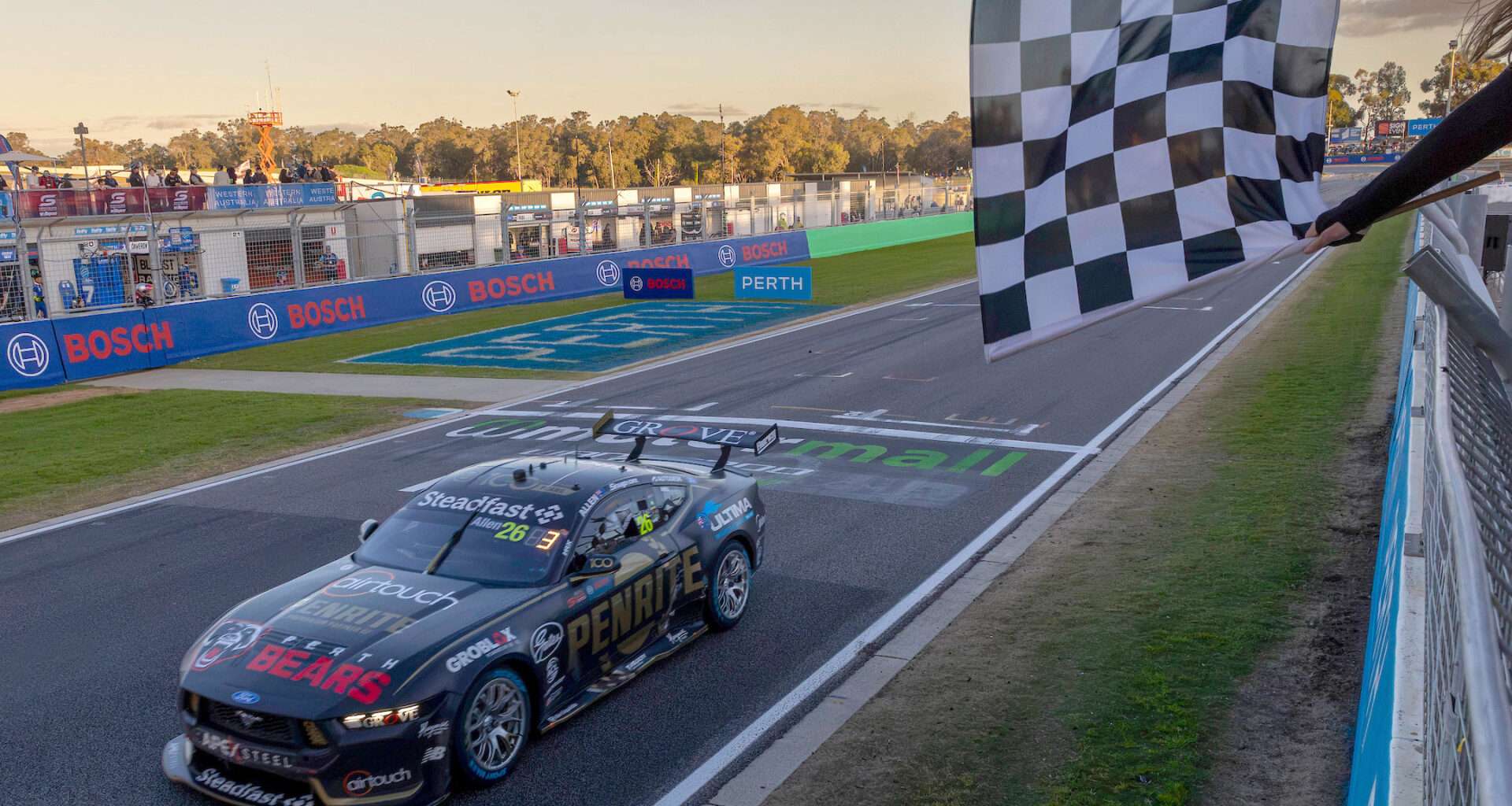
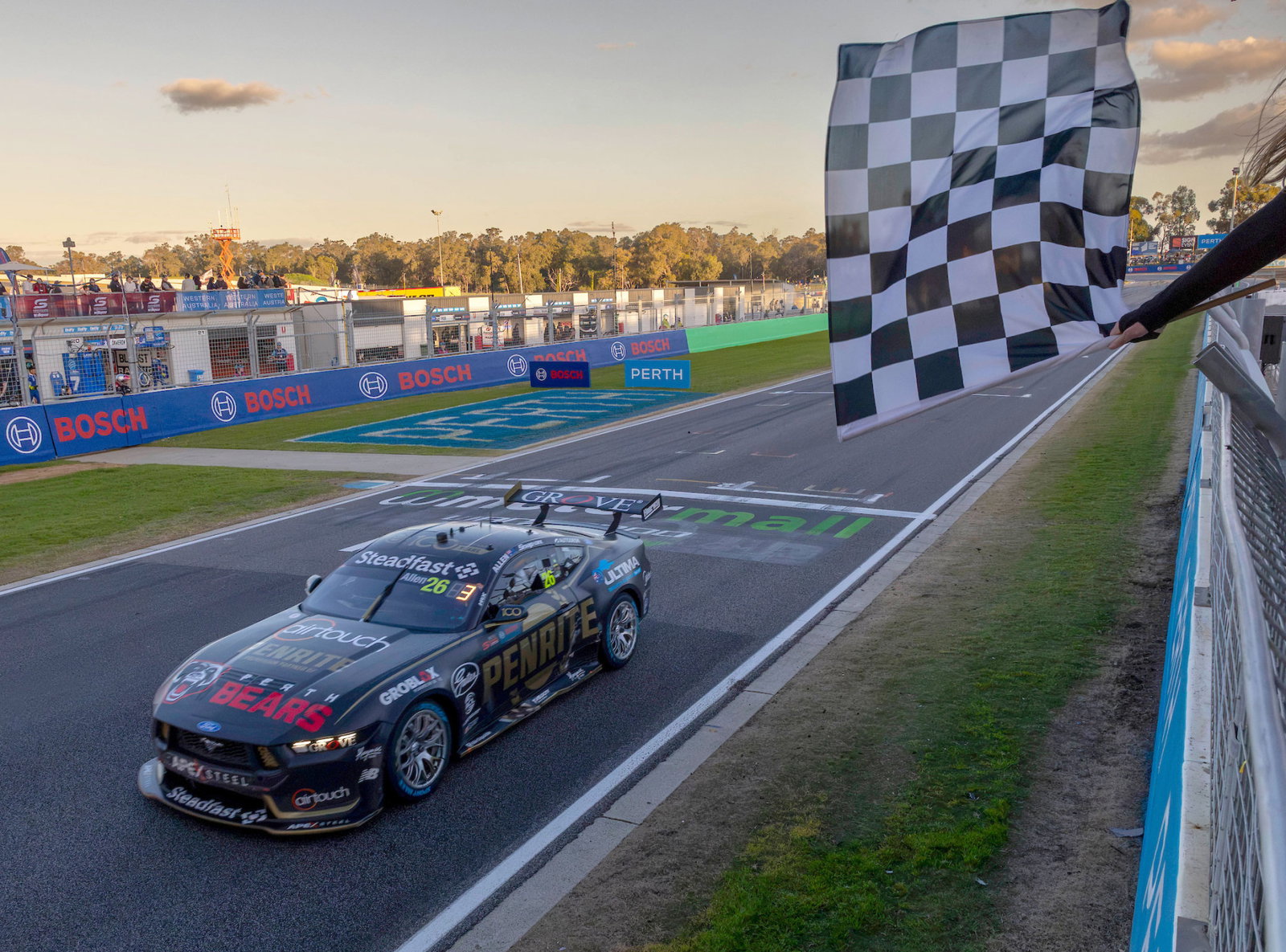
 Kai Allen at the Perth Super440. Image: Supplied
It’s the first time Supercars has appealed a decision by Motorsport Australia stewards and is being touted as a watershed moment for the category.
So what’s it all about? And what are the consequences of Supercars winning or losing its appeal? Let’s recap.
The case
Kai Allen and Grove Racing were alleged to have breached Rule D 17.1.18 – stipulating a minimum tyre pressure of 16psi – while on the grid ahead of the Sunday race.
Supercars’ tyre pressure monitoring sensors (TPMS) recorded the front-right and rear-right tyres at 15.959psi and 15.786psi respectively.
Stewards acknowledged the breaches had been proved as alleged, but opted against dishing out any penalty based on a number of mitigating factors.
They included the fact there is an “acknowledged TPMS accuracy of 0.4 psi” and that “all tyres were above the minimum pressure at the start of the race”.
The appeal
That verdict triggered a furious reaction by rival teams and a formal appeal by Supercars in the days after the event.
Supercars was clearly caught off guard by the decision not to award a penalty given the breaches were proven.
A statement from the category made clear the case is about more than Allen’s tyre pressures.
“The appeal has been lodged to seek clarification and determination of issues relating to the application of the championship’s technical and sporting regulations and the consistency of outcomes arising from those regulations,” it read.
“Supercars considers that clear and consistent application of the rules is fundamental to maintaining the integrity, fairness and credibility of the championship.”
The standard penalty for such a breach is disqualification, although as the rule is in the Division D sporting regulations and not Division C technical, stewards could have enacted a lighter penalty.
The hearing
The Supercars National Court of Appeal will hear the case at the Motorsport Australia office in Melbourne today (Monday, August 17) from 4pm.
It’ll be up to Supercars to present its case, but Grove Racing representatives will be present and may be called upon to give evidence.
There are strict rules around how the appeal case can be structured, as referenced by the court upon throwing out Triple Eight’s appeal against its Newcastle disqualification in 2023.
“An appeal is not an opportunity to rerun the arguments on penalty that failed before the stewards or to mount new arguments that were not run,” it said. “It is a process to correct actual error.”
According to MA, the court must give its decision in writing within 14 days from the conclusion of the appeal hearing.
Any party wishing to appeal that verdict and take the matter to the FIA International Court of Appeal will then have a further seven days to do so.
The consequences
If Supercars wins the appeal, the most extreme outcome is that Allen is stripped of his fifth-place finish in the race, and the 105 points that came with it (including for fastest lap).
That would drop Allen from fifth to sixth in the drivers’ standings, while Grove’s lead over Triple Eight in the teams’ would be reduced to 150 points.
If Supercars loses the appeal, the consequences are less clear but potentially more wide-reaching, as the case is essentially about Supercars’ ability to enforce its own rules.
Rivals warn that a dismissal would open up a can of worms and give the green light for teams to exploit the manufacturer tolerance of every sensor on the cars.
“If the appeal is dismissed, what it means is that every team and Supercars themselves will spend an enormous amount of time and energy understanding where they can take the mickey,” warns DJR team boss Ryan Story.
“It’s a very bad outcome for the sport.”
The hearing will take place in the lead-up to the resumption of Supercars action at the Ipswich Super440 this weekend.