
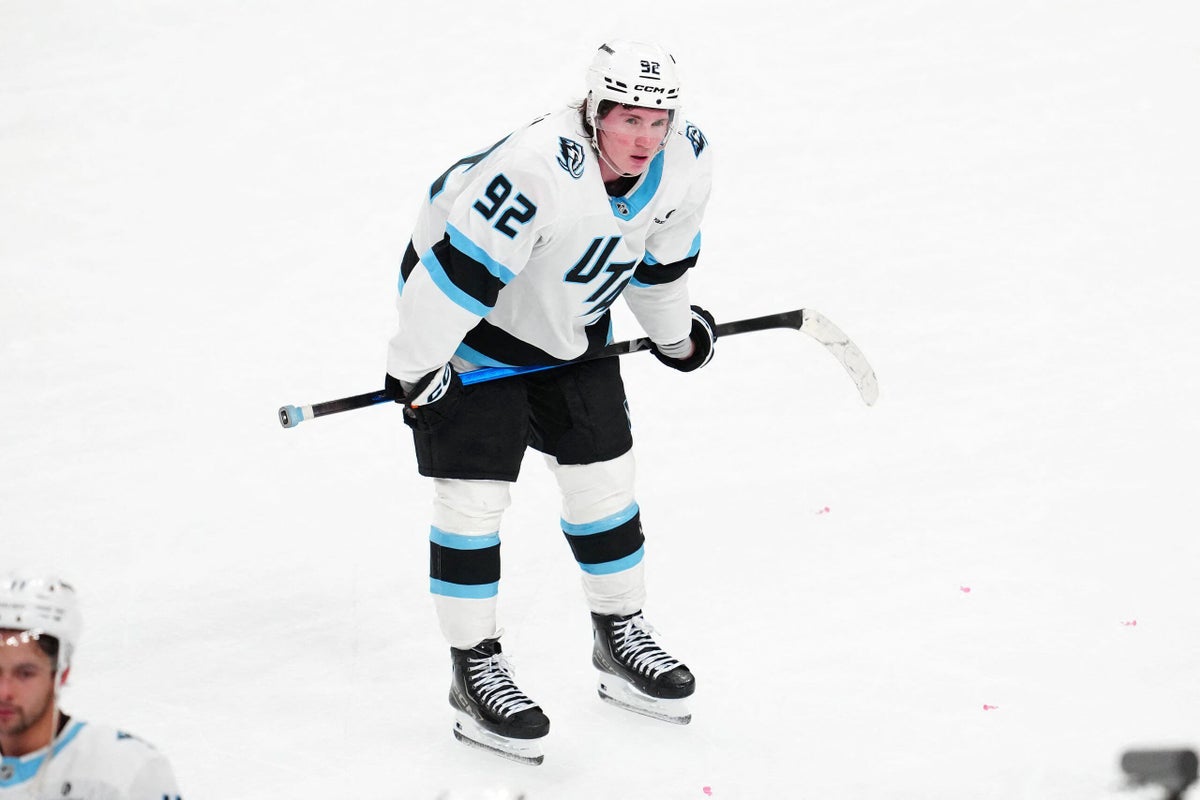
Utah’s rebuild has gone admirably, acquiring premium young center talents like Logan Cooley and Caleb Desnoyers through the draft without completely bottoming out. Between impressive center depth and a prospect pool brimming with guys who possess playoff-style traits, the Mammoth have a well-rounded system that should turn this franchise into a perennial playoff contender.
2025 ranking: 3
2026 NHL Draft grade: C
Player Ranking1. Logan Cooley, C
May 4, 2004 | 6-foot-0 | 191 pounds | Shoots left
Drafted: No. 3 in 2022
Tier: Bubble NHL star and top of the lineup player
Skating: Above NHL average
Puck skills: High-end
Hockey sense: Above NHL average
Compete: High-end
Analysis: Cooley is one of the best young centers in the NHL. He’s an elite skater with the quick-twitch speed, first few steps and edge work to evade most defensemen. Cooley is also a player with a ton of individual skill and creativity. With his outstanding tempo, the amount of offense with pace he creates could make him an elite even-strength player while also having the touch to run a power play. Cooley isn’t that big, but he works very hard and has a lot of energy in his game, and despite his size, he has shown he can create in the tough areas. He has all the makings of a potential first-line center you can envision playing well in the hard games in the spring.
2. Caleb Desnoyers, C
April 11, 2007 | 6-foot-2 | 182 pounds | Shoots left
Drafted: No. 4 in 2025
Tier: Bubble top and middle of the lineup player
Skating: NHL average
Puck skills: Above NHL average
Hockey sense: NHL average
Compete: Above NHL average
Analysis: For the second year in a row, Desnoyers was one of the best players in the QMJHL. He checks every box for what you want in a center. He’s tall and fast and makes a lot happen with and without the puck. Desnoyers displays excellent skill and playmaking ability. He creates offense on the move, off the perimeter and at the net. He isn’t an offensive dynamo, and in the NHL he’s probably not going to be the primary offensive guy on a top-two line, but he can make plays and support the playmakers. Desnoyers can be trusted to check top players, as he has a physical edge in his game and gives a high effort. He has the potential to be a second-line center who plays tough minutes.
3. Dmitri Simashev, D
Feb. 4, 2005 | 6-foot-4 | 198 pounds | Shoots left
Drafted: No. 6 in 2023
Tier: Bubble top and middle of the lineup player
Skating: NHL average
Puck skills: NHL average
Hockey sense: NHL average
Compete: Above NHL average
Analysis: Simashev had an excellent first season in North America. He was just OK in the NHL, but he was one of the best young AHL defensemen. He’s a premium athlete with the size, skating and hands of a major-minutes defenseman. He moves pucks well. He isn’t a top-end playmaker who projects to put up a lot of points, but he could have secondary NHL offense. Simashev is excellent defensively and on retrievals and tilts the ice in his favor. He projects as a very good top-four defenseman.
4. Tomas Lavoie, D
March 31, 2006 | 6-foot-4 | 220 pounds | Shoots right
Drafted: No. 89 in 2024
Tier: Bubble top and middle of the lineup player
Skating: NHL average
Puck skills: Below NHL average
Hockey sense: NHL average
Compete: High-end
Analysis: Lavoie was a top player in the Q and a major reason why Chicoutimi won the title. He’s a tall right-shot who skates quite well for a big man. His length plus feet help him break up a lot of plays and succeed on retrievals. He plays very hard, breaks up a lot of plays and is overall a great defenseman. Offense has been the one minor question in Lavoie’s game. I wouldn’t call him a super smart puck-mover, but he can make a reliable outlet pass and has a hard point shot. I’m always skeptical of QMJHL production, especially for older players, but I think Lavoie showed he has at least a little puck touch, which, with the rest of his game, could make him a second-pair defenseman.
5. Ethan Belchetz, LW
March 30, 2008 | 6-foot-5 | 228 pounds | Shoots left
Drafted: No. 17 in 2026
Tier: Bubble top and middle of the lineup player
Skating: Below NHL average
Puck skills: NHL average
Hockey sense: NHL average
Compete: Above NHL average
Shot: Above NHL average
Analysis: Belchetz is massive, with a high skill level and the hands of a smaller forward. He plays a heavy game and uses his big frame to win battles and dislodge pucks from opponents. He’s great around the net, showing the skill to create in tight and has a shot that can finish from range. His playmaking and skating are fine, but they aren’t a selling point of his game. He projects as a top-six winger who teams will love to have in the playoffs.
6. Tij Iginla, C
Aug. 4, 2006 | 6-foot-0 | 191 pounds | Shoots left
Drafted: No. 6 in 2024
Tier: Middle of the lineup player
Skating: NHL average
Puck skills: Above NHL average
Hockey sense: NHL average
Compete: Above NHL average
Shot: Above NHL average
Analysis: Iginla is a very talented offensive player. He beats defenders one-on-one at a high rate and improvises very well with the puck. He skates well and can make high-skill plays with his feet moving. Iginla has a great shot that gets off the stick quickly and can pick corners. He gets to the inside to score as well and displays a strong effort away from the puck. His pure sense and playmaking don’t stand out like the rest of his game, though. He projects as a highly likable middle-six winger.
7. Gabe Smith, C
Aug. 3, 2006 | 6-foot-4 | 208 pounds | Shoots left
Drafted: No. 103 in 2024
Tier: Middle of the lineup player
Skating: Below NHL average
Puck skills: NHL average
Hockey sense: Below NHL average
Compete: High-end
Analysis: Smith is a big forward who can play center or wing and was an important part of a top Moncton team, including being the QMJHL playoffs MVP. He’s a massive forward who plays the body frequently and lives in the high-traffic areas. He has good hands and can make skilled plays, but he isn’t the most natural playmaker and his offense will come in a more basic, direct way. He skates alright for his size. He’s not a burner, but he’ll be able to get around OK. He projects as a middle-six forward, potentially a 3C.
8. Daniil But, LW
Feb. 15, 2005 | 6-foot-5 | 203 pounds | Shoots right
Drafted: No. 12 in 2023
Tier: Middle of the lineup player
Skating: NHL average
Puck skills: Above NHL average
Hockey sense: NHL average
Compete: Below NHL average
Analysis: But was quite good in the AHL last season and got extended time with Utah. He’s a large, highly skilled forward who makes a lot of crafty plays with the puck in small areas, and with his massive wingspan he’s able to pull pucks past a lot of checkers. But isn’t blazing fast, but for a player his size, he can get up the ice quite well. His effort level is OK. In his best games, he’s dominant, but he can be inconsistent and pushed to the outside. He projects as a middle-six winger.
9. Vojtěch Hradec, C
Sept. 24, 2005 | 6-foot-4 | 202 pounds | Shoots left
Drafted: No. 167 in 2024
Tier: Middle of the lineup player
Skating: Below NHL average
Puck skills: NHL average
Hockey sense: Below NHL average
Compete: Above NHL average
Analysis: Hradec had a tough year in the top Czech league, taking a step back offensively. He still played on both special teams for his club. Hradec is a big center who can skate and handle the puck well. He won’t dazzle with skill, but he has good hands and vision and has shown more offense than some expected. He couples that with an honest two-way game and the ability to kill penalties down the middle. He projects as a steady bottom-six forward coaches will trust.
10. Maveric Lamoureux, D
Jan. 13, 2004 | 6-foot-7 | 199 pounds | Shoots right
Drafted: No. 29 in 2022
Tier: Middle of the lineup player
Skating: NHL average
Puck skills: Below NHL average
Hockey sense: NHL average
Compete: Above NHL average
Shot: High-end
Analysis: Lamoureux is a huge right-shot who skates very well for a big man. He’s a highly competitive and physical defenseman who makes a lot of stops and projects as a shutdown pro. The main debate on Lamoureux’s game has always been his offense. He can fight the puck at times, but he can make a good enough first pass and has a big point shot. The projection is that his defense and transition game are so good that he can be a top-four defenseman even without much offense.
11. Michael Hrabal, G
Jan. 20, 2005 | 6-foot-7 | 215 pounds | Catches left
Drafted: No. 38 in 2023
Tier: Middle of the lineup player
Skating: Below NHL average
Hockey sense: NHL average
Analysis: Hrabal is a big goalie who moves quite well for his size. He’s efficient in his movements but can make the tough saves across his crease when he needs to. His puck-tracking isn’t perfect, but generally I’ve liked his reads and ability to stay with the play. When he’s dialed in, he has the potential to steal a game, although he can be inconsistent with major highs and lows. He projects as a tandem goaltender.
12. Vadim Moroz, RW
Nov. 20, 2003 | 6-foot-2 | 185 pounds | Shoots right
Drafted: No. 88 in 2023
Tier: Middle of the lineup player
Skating: Below NHL average
Puck skills: Above NHL average
Hockey sense: NHL average
Compete: NHL average
Shot: Above NHL average
Analysis: Moroz has been a very good KHL player, playing on a top team last season. He has a lot of NHL traits. Moroz is a big winger with a high skill level who is often able to beat pro defenders with his one-on-one play. He sees the ice well and displays strong overall hockey sense. His shot is his best offensive asset, with a legit one-timer that could beat NHL goalies. He competes well enough, and he plays the body, but like a lot of shooters, I wish he got to the net more. Moroz’s skating has shown some progress too. He’s somewhere in between an average to below-average NHL skater, which at his size has him projected out as a middle-six winger.
13. Adam Valentini, C
April 11, 2008 | 5-foot-10 | 184 pounds | Shoots left
Drafted: No. 96 in 2026
Tier: NHL prospect
Skating: Above NHL average
Puck skills: NHL average
Hockey sense: NHL average
Compete: Above NHL average
Analysis: Valentini is a likable player who’s talented but works at both ends of the ice. He’s highly skilled and intelligent and can make difficult plays off the perimeter while also being willing to play in traffic. He’s a very good skater who can play with pace. Everything about his game is impressive except his frame. He’s 5-10 and there are major questions about whether his offense is special enough at that size to be more than a depth player.
14. Gregor Biber, D
Aug. 9, 2006 | 6-foot-3 | 187 pounds | Shoots left
Drafted: No. 98 in 2024
Tier: NHL prospect
Skating: NHL average
Puck skills: Below NHL average
Hockey sense: Below NHL average
Compete: Above NHL average
Analysis: Biber has very little skill and offense in his game, but he’s held his own versus men as a teenager for two years due to how athletic he is and being a strong defenseman. He’s tall, mobile, competitive and makes a lot of stops with his body and stick.
15. Štěpán Hoch, LW
Oct. 11, 2006 | 6-foot-4 | 192 pounds | Shoots left
Drafted: No. 78 in 2025
Tier: NHL prospect
Skating: Below NHL average
Puck skills: NHL average
Hockey sense: Below NHL average
Compete: NHL average
Analysis: Hoch is quite athletic, with good natural quickness for a guy his size. He doesn’t shy away from using his big body and engages in physical play often. Hoch isn’t a natural scorer, but he has good hands and is a decent shot threat from range. He’s played center and wing, but he’s probably not smart enough to play the middle in the NHL. The off-puck play and overall tools could lead him to becoming a bottom-six winger if he becomes a little more consistent.
16. Yegor Borikov, RW
Aug. 28, 2005 | 6-foot-1 | 187 pounds | Shoots left
Drafted: No. 110 in 2025
Tier: NHL prospect
Skating: NHL average
Puck skills: NHL average
Hockey sense: NHL average
Compete: NHL average
Shot: Above NHL average
Analysis: Borikov had a good season in the KHL as part of a competitive team. He’s a strong skating winger with good hands and hockey sense who makes plays with pace and creates in the hard areas of the offensive zone. He has a good shot and can finish from mid-range. He’s not overly physical but has decent size. There’s nothing special about his game, but he does a lot of things at a quality level and could be a bottom-six winger.
Player eligibility: All skaters who are 22 years old or younger as of Sept. 15, 2026, regardless of how many NHL games they’ve played, are eligible. Player heights and weights are taken from the NHL.
Tool grades: Tool grades are based on a scale with six separate levels, with an eye toward how this attribute would grade in the NHL (poor, below-average, average, above-average, high-end and elite). “Average” on this scale means the tool projects as NHL average, which is meant as a positive, not a criticism. Skating, puck skills, hockey sense and compete for every projected NHL player are graded. Shot grades are only included if a shot is notably good or poor.
Tier definitions: Tiers are meant to show roughly where in an average NHL lineup a player projects to slot in.