
Golf history is usually made not over a whole career but with a single shot or decision. Both good and bad, a golfer’s life can often be defined by “what might have been.” If only real golf had mulligans, do-overs, second chances.
The best example for those of us of a certain age was the 8-iron second shot to the 72nd green at Turnberry in 2009 struck by—egad!—a 59-year-old Tom Watson. It hit a hard spot, bounded over the green, and Tom took three from the edge that kept him from winning a sixth Open Championship. My esteemed colleague Jaime Diaz argues it wasn’t the 8-iron he needed the mulligan on but the decision to putt the long one. “Out of fear, he putted it,” says Diaz, “when he should have trusted his great chipping and popped up a little wedge.” An up-and-down would have galvanized a generation of gray heads forever.
Historically, one of golf’s greatest misses has to be Sam Snead’s second on the par-5 final hole at Philadelphia Country Club in the 1939 U.S. Open going for the green in two thinking he needed a birdie to win and making a triple-bogey 8, when a pitch-out par would have taken the title. Four-times a runner-up, Snead never won the Open.
Or maybe it was Arnold Palmer’s seven-foot par putt he left short on the 71st hole at Olympic in the 1966 U.S. Open for the greatest collapse of his or anyone’s career (leading by seven strokes with nine holes to play). Romantics might say it was Ben Hogan’s third shot to the 71st hole at Cherry Hills that spun back into the water, but it gave a charging Arnie the 1960 U.S. Open, and that was even a better story.
In modern times, Jean Van de Velde botched the 18th hole at Carnoustie in the 1999 Open when he tried to get on in regulation, though a lay-up would have won. Van de Who? You could also take your pick of Greg Norman’s approach shots flared to the right on 18 to lose a Grand Slam of majors.
The last hole at Winged Foot posed a mulligan situation for two players in the 2006 U.S. Open—Phil Mickelson foozled his driver into a trash can on another fairway while Colin Montgomerie butchered his 7-iron approach. Both made double bogeys when par would have won for either player. (Honestly, the mulligan I’d propose for Mickelson would be when he passed on the Bob Jones Award for Sportsmanship a decade ago—the only person ever to say no to the USGA’s highest honor—which seemed to signal the beginning of a downward spiral that only has accelerated since.)
MORE: Why nobody goes to golf museums
The most heart-breaking stroke might have been I.K. Kim’s one-foot putt she missed on the 72nd of the 2012 Kraft Nabisco (now Chevron) that cost her a major, losing in a playoff to Sun Young Yoo. Who’s counting, but Hale Irwin whiffed a two-inch tap-in in the third round of the 1983 Open at Birkdale and lost by one. Maybe Doug Sanders’ yipped two-and-a-half footer on the last hole at St. Andrews to lose the 1970 Open or Scott Hoch’s two-footer on the first playoff hole of the 1989 Masters weren’t so bad.
You might say Curtis Strange was offered a mulligan in the 1985 Masters when he arrived at the 13th hole with a three-stroke lead in the final round and went for the green in two, coming up short in the water, and then did it again at the 15th hole, losing to Bernhard Langer by two chokes. Speaking of water balls, Jordan Spieth’s splash on the 12th hole in the 2016 Masters robbed him of back-to-back Masters at age 22 and obviously a different career trajectory. Surely 21-year-old Rory McIlroy’s hooked tee shot into the cabins on the 10th hole in the 2011 Masters would have made his Grand Slam career even grander.
Shots you witness in person carry more weight, so for me I’ll never forget Langer in “the War by the Shore” at Kiawah when he missed a six-footer on the last hole to tie the match with Hale Irwin and lose the 1991 Ryder Cup, 14½-13½. Given a mulligan, I can say with certainty the German would not have missed.
You might argue the worst miscarriage of justice was the 2017 ANA Inspiration when a TV viewer emailed to report a misplaced drop from the previous day costing Lexi Thompson a four-stroke penalty and what surely would have been her second official major. Can you get a mulligan on a rules violation? Just ask Dustin Johnson who grounded his club in a bunker he didn’t think was a bunker for a penalty that cost him the 2010 PGA at Whistling Straits. If you could use a pencil for a mulligan, Roberto De Vicenzo’s scorecard error in the 1968 Masters has to be in the photo finish. The oddest mulligan might be a wardrobe malfunction that Nancy Lopez blamed for costing her the 1977 U.S. Women’s Open (the title she never won): a broken zipper on her favorite blue shorts that was such a distraction she never could focus on her round and finished two shots behind Hollis Stacy.
Then there’s the anti-mulligan—the shot pros would NOT want to play over. One that immediately comes to mind is my old pal Jerry Pate’s 5-iron from the rough over water on the 72nd hole at Atlanta Athletic Club with a one-stroke lead in the 1976 U.S. Open. The 22-year-old hit it to two feet and won by two. Among the old-timers, you’d have to include Gene Sarazen’s double-eagle “shot heard round the world” in the second Masters, or Lee Trevino’s flagstick-rattling chip-in for par on the 71st hole at Muirfield in the 1972 Open that Tony Jacklin called “daylight robbery.” The same could be said for Watson’s pitch-in at the 71st hole of the 1982 U.S. Open at Pebble Beach. Seve’s repeatedly punching the air after holing a 12-footer at the end of the 1984 Open Championship at St. Andrews became his seminal moment. But the one that’s hardest to beat in the modern era is Tiger’s miracle pitch from behind the 16th green in the 2005 Masters that became the iconic Nike commercial. It’s so indelibly marked in everyone’s mind, no further description is necessary.
Augusta National has exercised more mulligans than any tournament in history, making the Masters seemingly more dramatic year after year. It all started when the first Masters in 1934 had reversed nines because the current back nine was in the low-lying areas and experienced frost delays. They switched to the current configuration in 1935. Would the Masters be the Masters if Amen Corner was the second, third and fourth holes? Would Dan Jenkins ever have said, “The Masters doesn’t begin until the back nine on Sunday”?
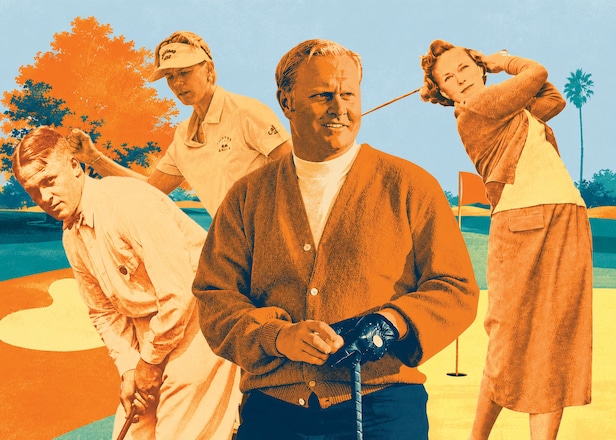
It’s a testimony to the men, you might say, that Jack Nicklaus and Bobby Jones don’t really figure in any mulligan debate. The same could be said of Mickey Wright and Annika Sorenstam. You’d be hard-pressed to identify a single shot or decision any of them needed to play over that would have improved their storied careers. Gods have no regrets. They simply made more right decisions and hit more shots flush in the clutch than any golfers in history. In the words of a poker player, you can still hear them say, “No, thanks. I’ll play these.”
This article was originally published on golfdigest.com