

Build Canada, the tech-and-business-backed policy platform founded by entrepreneurs, recently caused a stir on X with a pair of infographics on Canada’s entrepreneurial exodus (see here and here). Their CEO, Lucy Hargreaves, called it “a five-alarm fire” for policymakers. She’s right, and it lands at a timely moment.
Finance Minister François-Philippe Champagne is asking Canadians for ideas to improve the tax system ahead of the fall federal budget. His office reached out for recommendations, and it was clear from that conversation that the Carney government sees this exodus as a pressing problem.
Champagne says he doesn’t want to study the issue and considers himself “a man of action.” The bias for action is the right instinct. We need to move quickly on making Canada’s tax system much more competitive.
Canada has endured more than a decade of weak productivity growth, compounded by tariffs, geopolitical volatility, and sluggish business investment. Both capital and talent are voting with their feet.
What follows are tax changes that could move the needle. This isn’t an exhaustive list, and it comes with a caveat upfront: in a country running sizable deficits, these changes must be paid for. Ottawa can fund them by clearing out boutique carve-outs and tax preferences or by restraining ineffective spending. Fiscal discipline shapes the design of tax reform, but it can’t be an excuse for inaction. There’s too much at stake.
Capital gains taxes
Let’s start with capital gains, the area most directly tied to the entrepreneurial brain drain. In 2016, roughly three-quarters of Canadian founders who raised more than $1 million were based in Canada. By 2024, only about a third remained and nearly half had moved to the U.S. Other data reinforces this trend (see here, here, and here).
We can’t change the reality that the U.S. is a much more dynamic economy that attracts ambitious entrepreneurs. The American market is deeper, its venture capital ecosystem is more mature, and its network effects are unparalleled. Ottawa can’t legislate its way past San Francisco. It can, however, stop making the decision to build here harder than it needs to be.
Several Trudeau-era policies—from flirting with a higher capital gains inclusion rate to a higher top marginal rate and changes to the taxation of incorporated businesses—damaged investor confidence, and the damage still lingers.
Two changes warrant immediate focus, both carrying modest fiscal costs because capital gains are only taxed when an asset is actually sold.
View reader comments (7)
First, introduce a broad rollover provision so reinvested gains are not taxed at disposition. Pierre Poilievre campaigned on a version of this in 2025, and given the Carney government’s willingness to adopt practical Conservative ideas, it warrants serious review.
The flaw in the Conservative proposal is its domestic restriction. Limiting the deferral to Canadian reinvestment sounds patriotic, but it restricts capital mobility and creates administrative friction. A broad rollover across all reinvestment frees capital trapped in unproductive assets, allowing it to flow toward the highest return. After all, that’s the whole point.
Second, overhaul the Lifetime Capital Gains Exemption for qualified small business shares (including farm and fishing property), which is currently $1.275 million CAD and indexed to inflation. By contrast, the American Qualified Small Business Stock (QSBS) regime excludes up to $15 million USD in gains per company, or 10 times the investor’s basis, whichever is greater. The gap between the Canadian and American exemptions is massive, and so is the difference in structure.
The U.S. exemption applies per company rather than per lifetime, encouraging serial entrepreneurs to build, sell, and reinvest in new ventures. Canada’s lifetime cap does little to help repeat founders whose later exits blow past it. Matching or beating the American model would send an unmistakable signal to the builders Canada wants to keep.

i
Employees work at a startup in Vancouver, B.C., August 13, 2014. Darryl Dyck/The Canadian Press.
Personal income taxes
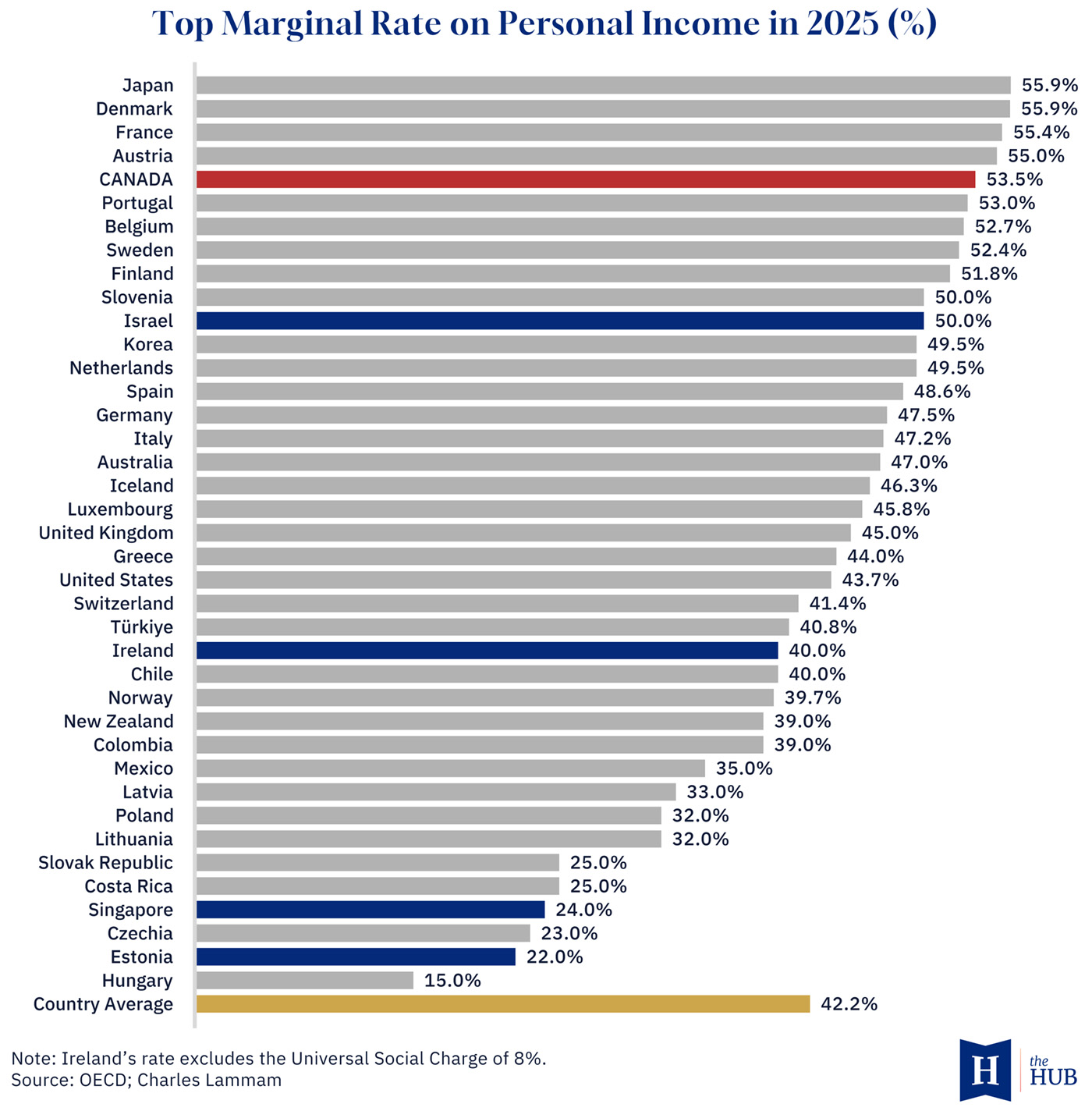
Canada’s combined federal-provincial top rate in Ontario is 53.5 percent, the fifth-highest in the OECD. The simple OECD average is 42.7 percent. The U.S. average sits at 43.7 percent. We are well past the 50 percent line that the Carter commission warned against for reasons that were as much psychological as economic.
This matters for entrepreneurship specifically. A founder who shoulders years of risk only to face a punitive tax rate on success has less incentive to build in the first place.
But the rate is only half the problem. Canada’s top federal rate kicks in at roughly $258,000, about 2.7 times average earnings and among the lowest multiples in the OECD. In the U.S., the top federal bracket kicks in at income earned past $870,000 CAD. We tax our high earners at nearly the highest rate in the developed world, and we start doing it at incomes many countries would consider comfortably middle class.
The first step is to undo the four-point federal increase introduced in 2016, returning the top federal bracket from 33 to 29 percent. From there, Ottawa should work with the provinces toward a combined top rate near the OECD average (approximately 43 percent) and ensure the rate applies at comparable income levels. More ambitious changes belong in a comprehensive reform package with federal and provincial coordination.
Graphic credit: Janice Nelson
Will this gut government revenue? Not likely, if the past is any guide. Lower rates change behaviour. High earners work, invest, and report income differently when less of it is taxed away, and some of that lost revenue comes back through a larger tax base.
The reverse is also true. Research on Ottawa’s own 2016 hike found it would raise only modest revenue for the better part of a decade before the government started collecting less than it would have under the old rate, as the behavioural response caught up with the mechanical gain.
Undoing that increase should work in reverse: some revenue given up on paper, partly recovered through stronger reported income, investment, and retention of high earners who would otherwise take their tax base elsewhere.
Another predictable objection is that lowering top rates and raising income thresholds is regressive. Yet Canada’s system is heavily progressive; nearly half of tax filers receive more in government transfers than they pay in income tax. The top income groups already carry a disproportionate share of the tax burden. Reducing a top rate that remains an international outlier brings a more reasonable balance. Right now, the case for greater efficiency is stronger than the case for holding the line on the existing distribution of income taxes.

Corporate taxes
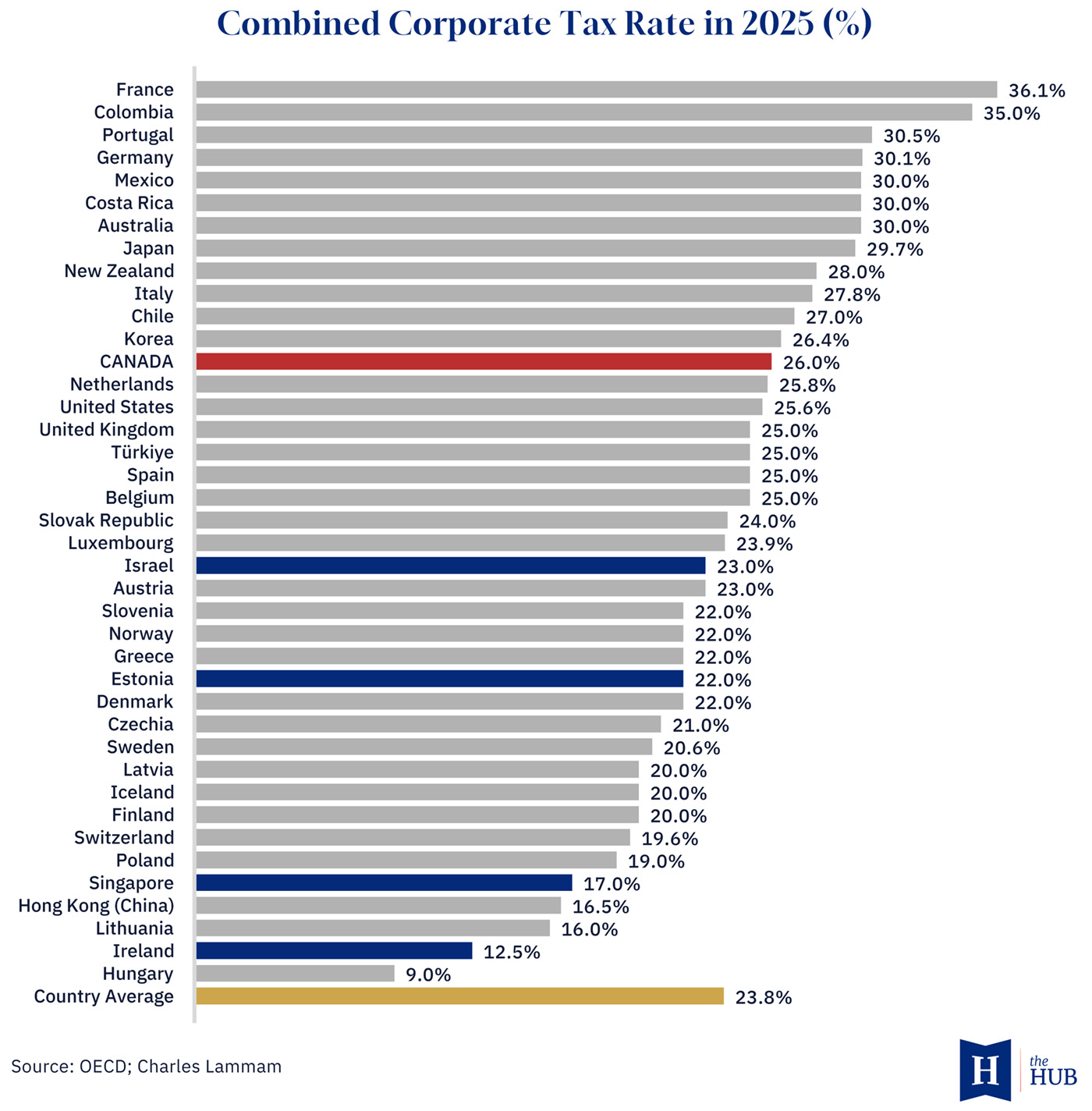
Canada did something genuinely impressive in the 2000s. Federal and provincial governments across party lines cut corporate taxes in tandem, giving the country a distinct statutory advantage. But then we stopped. The combined fed-prov corporate tax rate has hovered around 26 percent since 2012, while other nations cut theirs.
Before 2017, Canada held a clear edge on the statutory rate relative to the U.S. Then, after Trump 1.0’s Tax Cuts and Jobs Act dropped the U.S. federal rate, bringing the combined rate to 25.6 percent, that edge disappeared. Now add tariffs and a general sense that Canada is a difficult place to deploy capital, and the case for a headline rate cut is compelling. Lowering the rate provides a tangible signal that Canada is serious about attracting investment, matching the Carney government’s rhetoric about being open for business.
On where to land, look at the places that are driving strong rates of business formation. Ireland charges a 12.5 percent corporate tax, less than half our combined rate. Estonia taxes distributed profits at 22 percent while leaving reinvested earnings untaxed. Singapore keeps the rate low at 17 percent and the system simple. Canada doesn’t need to duplicate these regimes outright, but the policy direction is clear.
Graphic credit: Janice Nelson
An added benefit from cutting the general rate is that it narrows the gap with the small business rate, reducing the tax penalty growing firms face when crossing the small business threshold.
Two companion measures also belong in this package.
First, allow a full first-year write-off for all forms of capital investment. The current “productivity super-deduction” simply extends what the Trudeau government was already doing and suffers from key flaws. It’s narrow and not neutral, meaning Ottawa decides which sectors get favourable treatment. And it’s temporary, undermining long-term capital decisions. Broad-based full expensing would give Canadian business investment a durable edge over U.S. provisions in the One Big Beautiful Bill Act rather than a partial catch-up.
Second, scrap targeted sectoral taxes, beginning with the 1.5 percent surtax on banks and insurers. Singling out specific industries for punitive treatment is arbitrary, distorts where capital flows, and invites the next government to do it to somebody else.
The political case for a comprehensive package
The political instinct is often to pick one or two piecemeal measures and call it a day. That approach gets the politics of tax reform wrong. Standalone reforms isolate individual measures, handing opponents an easy target. Broad packages can spread costs and benefits widely, building a supportive coalition that outweighs concentrated opposition. Breadth isn’t just better economics; it’s better politics.
Former Finance Minister Michael Wilson demonstrated this in the 1980s. Rather than tinkering at the margins, he advanced a comprehensive overhaul, communicated the direction early, and implemented it in stages. The political costs were real, but the result was a tax foundation that supported Canadian growth for decades. That’s a model to follow, and it makes the case for being bold rather than incremental.

Over to you, minister
Done together and financed responsibly, these reforms would help retain entrepreneurs, improve business investment, and reinforce the government’s economic agenda.
But tax policy alone isn’t sufficient. It sits alongside other key economic policy reform areas, and pulling one lever while ignoring the others won’t get you very far. Canada’s problems run through a long list of policy choices that have nothing to do with the tax code, including burdensome regulation and a lack of competition in key sectors. A competitive tax system is a necessary condition for reversing our entrepreneurial exodus, not a sufficient one.
The upcoming budget is where that work should start. Over to you, Minister Champagne.

Charles Lammam is an economic and policy professional with over two decades of combined experience as a think-tank scholar and thought leader,…
Read more