
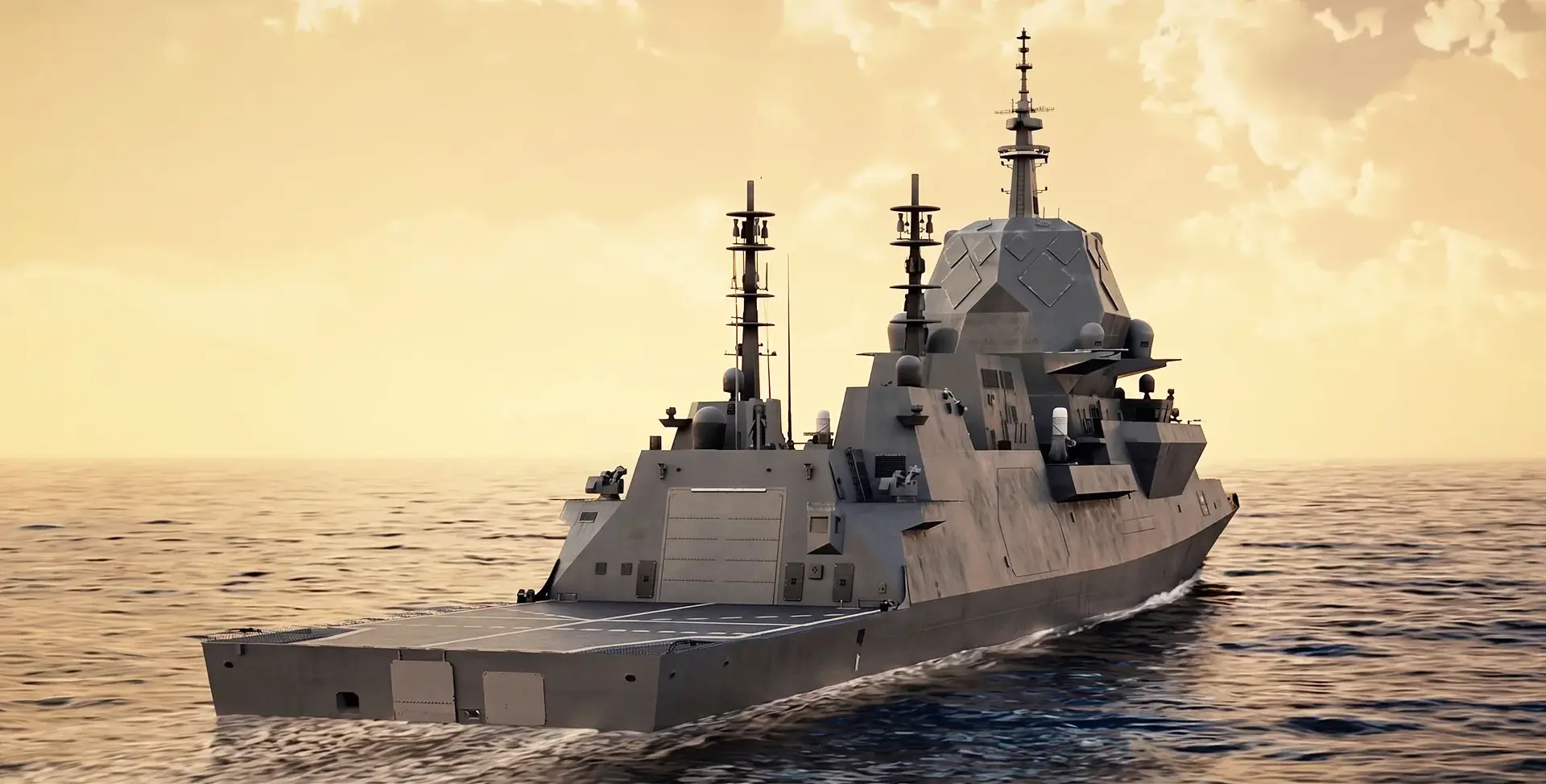
Australia has laid the keel of the first Hunter-class frigate, marking the start of full assembly of the Royal Australian Navy’s new generation of anti-submarine warships. The Hunter design is derived from the Royal Navy’s Type 26 but has evolved into a considerably larger and differently equipped ship.
The keel-laying ceremony for NUSHIP Hunter took place at the Osborne Naval Shipyard in South Australia today. Following naval tradition, a coin was placed beneath two blocks forming part of the keel in the presence of shipbuilders, Defence Industry Minister, Pat Conroy and Royal Australian Navy Chief, VAdm Matthew Buckley.
The two sections will now be joined by further blocks to form the hull. Construction is already well advanced across the ship, with work underway on 59 of the 78 units; these will then be consolidated into the 22 blocks that make up each ship.
The Hunter-class is based on the Type 26 Global Combat Ship, five of which are currently under construction for the RN and Norway on the Clyde. Canada has also selected a substantially modified version as the basis of its River-class destroyer programme (First steel was cut for the lead ship, HMCS Fraser, in April 2025).
Australia originally ordered nine Hunter-class frigates in 2018 under the SEA 5000 programme, but the number was cut to six following the Australian government’s 2024 surface fleet review. The ships are intended primarily for anti-submarine warfare but have been re-designed to have greater air defence capabilities than their RN counterparts.
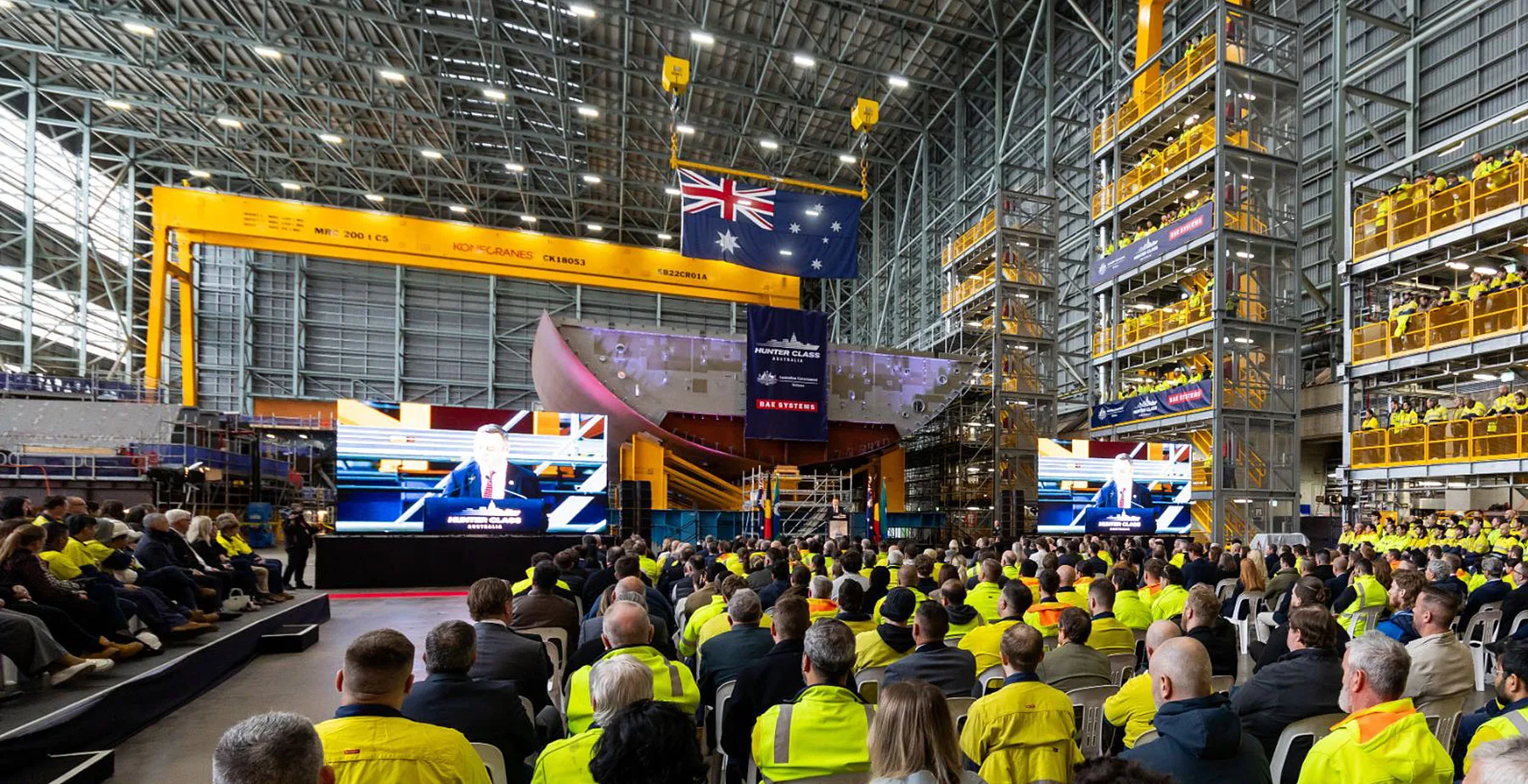 Keel-laying ceremony for NUSHIP Hunter at Osborne Naval Shipyard, Adelaide. Established in 1987, Osborne has previously built the Collins-class submarines and Hobart-class destroyers and is now home to construction of the Hunter-class frigates. The site is also planned to build Australia’s future SSN-AUKUS submarines (Photo: BAE Systems).
Although the basic hull form and propulsion arrangement have their origins in the Type 26, Hunter has diverged considerably from its British cousin. The Australian ships will combine the locally developed CEAFAR2 active electronically scanned array radar with the US Aegis combat management system and an Australian interface developed by Saab. BAE Systems currently lists Hunter at approximately 8,200 tonnes light ship displacement, compared with around 6,900 tonnes light for Type 26. Unverified Australian media reports claim full displacement has now reached about 10,500 tonnes.
The weight growth issue has been a long-running controversy around the programme. There is concern that the delta between the original Type 26 platform design and the Hunter will substantially reduce speed, range and endurance. Hunter retains the Type 26’s Combined Diesel-Electric or Gas (CODLOG) propulsion architecture, which is officially listed as providing a maximum speed of 27kn and range exceeding 7,000nm. Inevitably, growth margins available for additional equipment during the ships’ service lives will also have been reduced.
The first ship is expected to be delivered to the RAN in the early 2030s, with the first three vessels to be named HMAS Hunter, HMAS Flinders and HMAS Tasman. The programme has suffered significant delays and cost growth, mainly driven by the radar-related redesign since the Type 26 platform was selected in 2018, although BAE Systems says construction is now meeting its revised programme.
The keel laying represents an important transition from the manufacture of individual units and blocks to the assembly of a complete ship. It also marks another tangible step in the emergence of the Type 26 design as a family of related warships being built in Britain, Australia and Canada.