
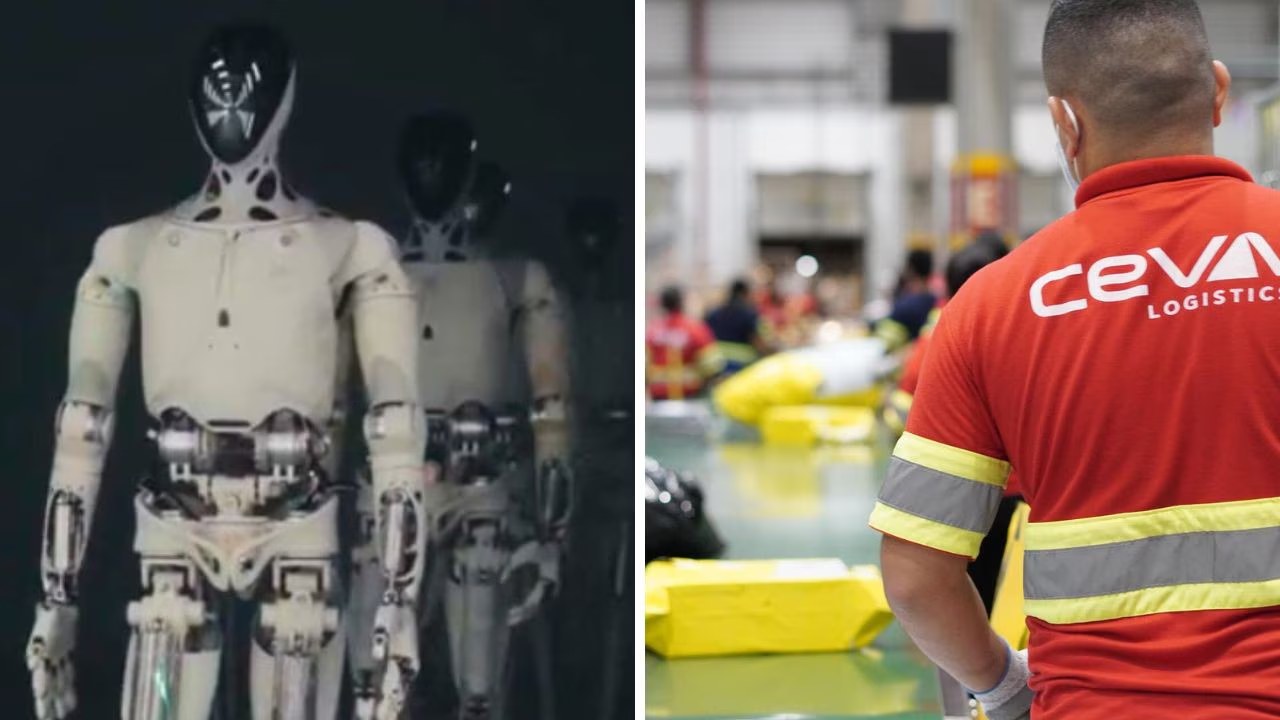
Australian workers are preparing to fight for their future as global logistics giant CEVA develops plans for a high-tech “Warehouse of Tomorrow” featuring humanoid robots.
An internal CEVA document seen by News Corp Australia outlines plans for a “Humanoid Pilots in CEVA Warehouse June” project as part of a broader push into robotics and artificial intelligence.
But the document offers no answers about what the humanoids would do, or what they could mean for workers.
MORE: Chinese car brand prepares robots for Australia
One long-term CEVA employee, who asked not to be named, said they’ve been kept in the dark.
“When we do ask about the new warehouse and what’s in it, we don’t get any straight answers,” he said.
Transport Workers’ Union (TWU) National Secretary Michael Kaine said the prospect of humanoid technology raised serious questions about the future of human workers.
“Humanoid – what does that mean? What is it code for? It means we’re going to get rid of humans from the operation. What’s that code for? You can be sure we’re going to be able to do this cheaper,” he said.
MORE: Chery’s AI-powered robot hits Australia
The worker we spoke with said he was very worried, not just for himself but for the next generation.
“For all the time and effort you put into a company, and they’re looking at replacing you with a humanoid or a cyborg. It’s depressing, it’s concerning and it’s very stressful.”
CEVA said it continuously evaluates emerging warehouse technologies and collaborates with customers, technology partners and academic institutions on research into data systems, automation and artificial intelligence.

The company said its Australian team may participate in research, development and proof-of-concept initiatives as part of the global CEVA network.
The concerns come as more than 650 CEVA workers begin voting on industrial action following a breakdown in negotiations over their next workplace agreement.
The protected action ballot opened on Tuesday and is expected to take a couple of weeks.
If workers vote in favour, they’d then have the right to take protected industrial action if negotiations fail to progress.
“We as a collective of hundreds and hundreds of workers, we can stop your operation if we have to, so that you will agree with us that common sense has to prevail,” Mr Kaine said.
CEVA operates across major supply chains, moving everything from cars and parts to consumer and retail goods.
Significant industrial action could potentially have flow-on effects for businesses relying on the company to move goods, although it’s too early to know how much disruption there could be.

For consumers, the other side of the automation equation is whether a high-tech warehouse, including humanoid robots, could ultimately mean goods move faster. Whether that translates into faster deliveries, lower costs or other benefits remains to be seen.
The TWU wants workers consulted about how automation is introduced, including retraining and alternative roles.
“It’s about levelling the bargaining scales here. It’s about making sure that workers take back their voice,” Mr Kaine said.
CEVA said any implementation of AI and automation technologies in Australia would be undertaken in accordance with CEVA’s established consultation framework, ensuring ongoing consultation with employees and union representatives prior to execution.