

Scientists so far believe a potential cause of the floods could have been an avalanche or landslide caused by an earthquake recorded in the area.
It’s possible a broken part of a glacier temporarily dammed a river, leading to the built-up waters surging ahead when the blockage disappeared.
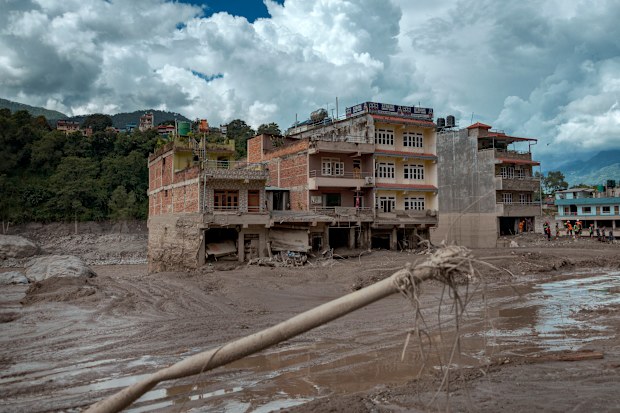
Damaged buildings in Trishuli, Nepal. Ezra Acayan
“A lower part of a glacier has really come off,” said Jakob Steiner, a geoscientist at the University of Graz in Austria who is currently based in Bangladesh.
“If you look at the imagery it’s like someone cut with a huge knife through the whole lower part and it fell off.”
Steiner said a mass of glacial ice dropping from a great height could have felt like a bomb exploding, resulting in the chaos that followed.
Scientists said it is too early to draw a direct connection between global warming and Wednesday’s catastrophe.
However, they said that as Earth’s temperature rises because of human activities such as burning oil, gas and coal, the chances of such disasters increase, especially in the Himalayan mountains, which are warming considerably faster than many other parts of the world.
“We have to be cautious and not draw a connection yet. However, rising temperatures are changing the Hindu Kush Himalaya region and melting glaciers,” said Saswat Sanyal, a disaster risk reduction specialist at the Kathmandu-based climate research group International Centre for Integrated Mountain Development.