
A prominent author and tech activist is warning Aussies that the AI bubble will burst, arguing AI is simply not profitable and marks the biggest money losing endeavour “in the history of the human species”.
Cory Doctorow, the writer who coined the term “enshittification”, believes AI companies have no path to profitability, with companies projected to have made $US50 billion in revenue this year against more than a trillion dollars already spent.
“AI companies have very, very high operating costs. And I think arguably operating costs that grossly exceed what anyone would actually pay to use their services,” he told news.com.au.

Every user who signs up to an AI company costs the AI company money, Mr Doctorow said. The AI company then continues to bleed more money the more the user uses it, with every query costing the company money to address.
“Every generation of AI loses money faster than the previous generation. And so this is very different to the web,” he argued.
“When the web started, it was losing money, but it had good unit economics. New web users
made the web more profitable. New web user sessions increased the profitability of the web.
“And successive generations of the web were more profitable, generation on generation, which is how you ended up with web companies that have right-side-up balance sheets instead of web companies that are just losing billions.”
Mr Doctorow said it was not clear that AI could manage the same feat. He is doubtful AI companies can keep operating costs down low enough to avoid getting stuck in a “trap” of raising costs for users and some users then deciding the product is not worth the price.
“AI switching costs are super, super low. So we saw this when Claude’s new version shifted. It was demonstrably better than ChatGPT. And people just left, and they went over to Claude,” he said.
“You can’t just halt the Red Queen’s race. You don’t really have these defensible moats
around the product.”
OpenAI, Anthropic revenues rise, but profits another story
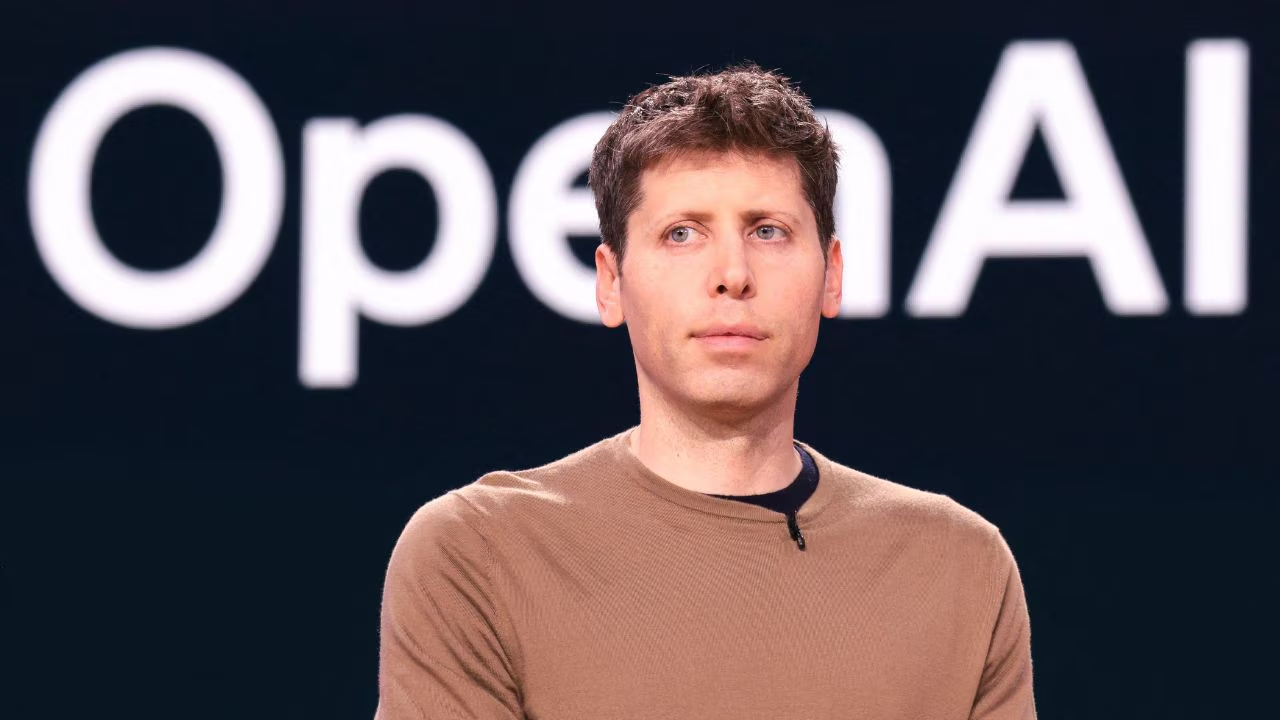
OpenAI, the maker of ChatGPT, told investors its revenue grew by 18 per cent in the second quarter to $US6.7 billion. This was up from $US5.7 billion in the first quarter.
However, The Wall Street Journal reports its operating margin sank further into the red, pushing it further away from profitability ahead of its highly-anticipated IPO.
Audited financial documents obtained by journalist Ed Zitron and independently verified by the Financial Times revealed OpenAI lost $US38.5 billion in 2025.
Revenue reached $US13.07 billion in 2025, up from $US3.7 billion in 2024. But total costs and expenses came to $US34 billion, with two biggest expenses being $US19.18 billion for research and development and $US5.73 billion for sales and marketing, and losses from operations were $US20.92 billion.
OpenAI’s internal documents predict a $14 billion loss in 2026, with the company not expecting to be profitable until the 2030s.
Anthropic, the company behind Claude, reported its first profitable quarter with Q2 2026 revenue hitting $US11.5 billion, according to Bloomberg. This was up from $US787 million the same quarter a year earlier.
However, the figures are preliminary and could be revised.
What could happen if the AI bubble bursts?
While Mr Doctorow expects the AI bubble will burst, he said he doesn’t know when that will happen.
“So there are two precepts of finance that are my alpha and my omega,” he said.
“The alpha is Stein’s Law, which says anything that can’t go on forever eventually stops.
“The omega is the famous quote from John Kenneth Galbraith, which is that the market can remain irrational longer than you can remain solvent.”
If the AI bubble bursts, Mr Doctorow predicts we could see a massive economic vacuum, given the Magnificent Seven tech giants make up roughly 35 per cent of the S&P 500 index.
But he expects we would be left with a lot of hardware that can be bought for 10 cents on the dollar, a lot of skilled technologists, and open-source models that can be optimised so AI will become a “normal technology”.
A famous example is DeepSeek, who reportedly built its AI models in two months with less than $US6 million using Nvidia’s old H800 chips. This led to Nvidia losing $US 600 billion off its share price in a day in January 2025.
Opportunity for Australia to become ‘jailbreaking’ nation
Mr Doctorow said there was a “real opportunity” for Australia to become a “jailbreaking nation”, where we reverse engineer, modify and improve American technology and get our data out of them.
“Australia could look at its real digital sovereignty crisis, which is not an AI crisis,” he said.
“If Donald Trump ordered OpenAI and Anthropic to turn off all of Australia’s chatbots tomorrow, nothing happens. You don’t have a ministry that shuts down. None of your structurally important firms cease to function. At the household level, some kids have to do their homework.
“If Office 365 shuts down in Australia, that’s it. Like Mad Max becomes a documentary. The ministry’s shut down. Your structurally important firms shut down. At the household level, you’re screwed.”
Last year, President Trump issued an executive order against the chief prosecutor of the International Criminal Court for investigating Israel for war crimes. This saw the prosecutor lose access to his Microsoft accounts.
Australia has an anti-circumvention law as part of the Australia-US Free Trade Agreement of 2003, Mr Doctorow said, which means it is a crime to reverse engineer and modify America’s technology without permission.
“The quid pro quo for this was that Australia would get tariff-free access to American
consumers, which Trump has blown up,” he said.
“So you have this gigantic geopolitical risk that you incurred in exchange for something you don’t have anymore.”
Other countries also have similar rules with the US, which Mr Doctorow said meant “every country” was at risk.
He argued Australia could have the relationship to disenshittification that Finland had to mobile phones for 15 years when Nokia was the dominant mobile phone supplier in the world.
“This is a giant economic opportunity. At the same time, you would also be hardening your country against this geopolitical risk,” he said.
“Becoming like the jailbreaking nation is a way to create a lot of fiscal space in Australia, and also to create a lot of export goods in Australia, and also to defend Australia against American aggression.
“It’s a real opportunity. And if Australia doesn’t do it, someone else will.”