
Prime Minister Anthony Albanese took to social media last Monday to celebrate new housing data he declared Australians “really do need to see”.
He told the nation a report had shown his government’s changes to “make housing fairer are working”, citing less competition in the market for first home buyers.
“And importantly, more investors are taking out loans to build new homes than ever before,” Mr Albanese said.

MORE: Every Aus suburb named in home price shock
“With a 27 per cent increase in loans for new builds,” he said, “we’re fixing a broken housing system.”
The catch was, as pointed out in a community note added to his video on X, recent figures also show dwelling commencements were down 11.2 per cent in the month to March.
Australian construction firms are failing at alarming rates while the nation lags almost 87,000 approvals behind an ambitious target for new homes meant to ease the housing crisis, another set of fresh data reveals.
MORE:‘Hard’: Horror spike gives RBA no choice
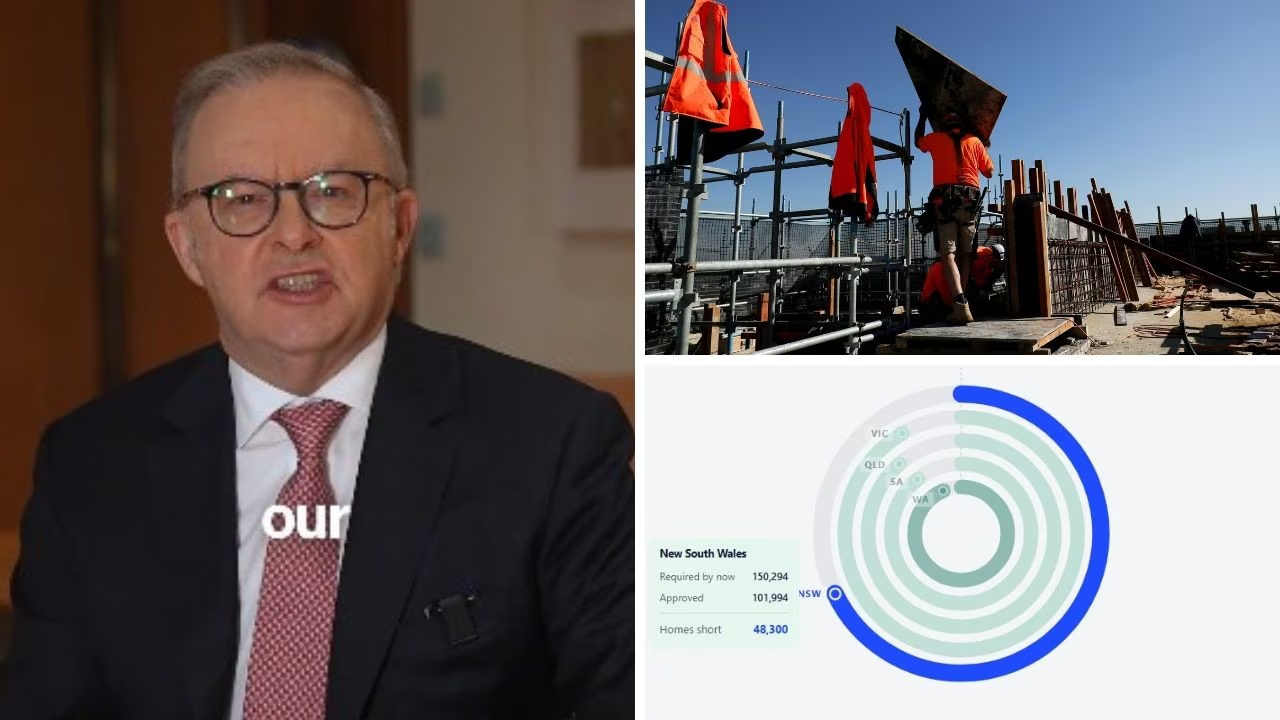
Analysis of home construction data for homeloanrates.com.au by Primara Research, released to news.com.au, shows the county was well behind the 480,000 dwellings needed to be approved to stay on track for the 1.2 million home target over the first two years of the National Housing Accord.
Only 393,193 dwellings have been approved, a shortfall of 86,807, while NSW alone accounts for more than half of that gap.
NSW has completed just under 60 per cent of dwellings it was assigned under the scheme, meaning it was more than 50,000 homes behind schedule.
Primara found the state has approved 6.13 dwellings per 1000 residents, against a national average of 7.52, the lowest rate of any major state.
“NSW is behind at every stage of this pipeline, and it gets worse the further you go,” Peter Drennan, head of research and data at Primara Research, said.
“The state is meeting a little over two thirds of its approvals target and barely three fifths of its completions target.”
‘This is massive’
The mammoth task was magnified this week when major Sydney home builder Bathla Group collapsed into voluntary administration with debts of more than $3 billion.
Bathla stated on its website it had 22,000 apartments and 5000 homes in the construction pipeline across various sites in Sydney and beyond.
Bathla executives partially blamed controversial new tax settings for more uncertainty in the market, and cited “significant increases in construction costs” for its financial woes.
Mr Drennan said Bathla’s pipeline alone accounted for 29 per cent of a full year of NSW’s approvals in annualised form.
“That’s a meaningful share of the state’s housing pipeline now sitting in administrators’ hands,” he said.
Separate business data shows construction companies made up 27 per cent of total firms placed into external administration in the nine months to March 2024.
In the 2025-2026 financial year, NSW alone lost 1522 construction companies including prominent players like Beechwood Homes, Novati Constructions and Built Lifestyles.
Arjun Paliwal, founder and chief executive of InvestorKit Group, said the collapse of a firm like Bathla was hugely significant.
“Firstly, we’re already behind,” he said.
“And then on top of that, this isn’t a major luxury builder. This is an affordable volume builder.
“So if an affordable volume builder goes under like that … this isn’t an eastern suburbs luxury (firm) that had three projects a year. This is massive.”
Taxes ‘inextricably linked’ to supply
Tom Devitt, the senior economist at the Housing Industry Association (HIA), said the housing target shortfall was gaping even before the tumultuous economic conditions seen in 2026.
“We weren’t forecasting virtually any state or territory to be meeting its housing targets,” he said.
“Our forecasts were basically around a million (of the 1.2 million target), so almost a 20 per cent shortfall that we were forecasting this year.
“Given the fact that we’ve had three interest rate hikes and fuel prices go through the roof and some negative announcements out of the federal budget around … investors, that has softened our forecasts for this year and next year a little bit.”
Mr Devitt noted the federal government conceded in its May budget the recent changes to property investments tax settings would lead to 35,000 less homes built.
He said the reforms to ban self-managed superannuation funds from borrowing to buy residential housing could also hit the supply of new properties.
“If you make it harder and more expensive to invest in housing, you get less housing,” he said.
“Even if you … specifically targeted just the established market rather than the new market. It’s the same market. They’re inextricably linked. So what you do to one affects the other.”
Mr Paliwal said government and business taxes were a major issue in the industry, saying they often made up a third of the cost of building a home.
He said many of the pressures on construction firms were “internally caused” in Australia and could not be blamed on external forces like wars overseas.
“We can control the investment into our future workforce. We can control the regulation, the red tape. We can control the release and the build on land,” he said.
The federal government maintains building approvals were moving in the right direction, with 205,249 approved in 2025-26, up 9.2 per cent on last year and the highest since 2020-21.
Australian Bureau of Statistics (ABS) home loan data for the June quarter showed $7.6 billion in new investor loans for the construction and purchase of new dwellings – up 26.3 per cent over the year, the figure celebrated by Mr Albanese.
Red tape, labour shortages
One of the biggest issues facing the home building sector was chronic labour shortages that have dragged on for several years across key trades, both men agreed.
“And ever since the pandemic began, they (worker numbers) have essentially been worse for every trade … especially bricklaying and tiling and roofing and carpentry,” Mr Devitt said.
“The shortages of those trades have been worse than any time pre-2020.”
Skilled migration programs and a boost to apprenticeships were needed to address the workforce problem in a country that “favoured white collar workers and university students more than the actual hands-on trades that we’re very much in need of now”.
Mr Paliwal said the raft of big public infrastructure projects were also proving more attractive to builders due to more secure work and pay, taking momentum out of homebuilding markets.
There was also a subdued sentiment in the building industry since the Covid-19 pandemic, which saw huge numbers of businesses go under.
In the 2024 financial year, 2900 construction companies became insolvent, and that figure increased to 3500 the following year. The preliminary figures show some improvement to June 2026, but Mr Paliwal said they were still well above pre-Covid years.
“I don’t see this getting any better anytime soon,” he said.
“When you add up the major core factors … plus this sentiment factor in one paragraph, you’re basically saying – not enough skilled workers, not much confidence, very complex to build and lots of taxes and costs that aren’t helping.”
The ‘paradox’ of Aussie homes
Despite the failures, ABS data shows the number of construction companies operating in the country was up 3.4 per cent in the past financial year.
“So the total number of businesses across construction has been increasing pretty much at the same rate as the rest of the businesses and in other industries,” Mr Devitt said.
“There’s just been quite a lot of turnover in the industry.
“The paradox of the Australian housing industry is that at a fundamental level, things are pretty good. With population growth and low unemployment, you’d think that would be the makings of a busy and prosperous homebuilding industry.
“But because of all these other constraints, it’s actually made it really, really difficult for the industry.”
Long-term, Mr Devitt believed the “number one constraint on homebuilding is land”.
“And it’s the lack of land that is both zoned for homes to be built on it and provided with all of the infrastructure that need to be in place before anything can commence.
“So all the all the transport and utilities and telecommunications, all of that infrastructure needs to be in place before construction can even begin.
“And that just takes too many years, sometimes over a decade, to get a piece of zoned farmland into a shovel-ready state.
“Once construction starts, once our home builders have poured a concrete slab, they complete it and someone moves in within 100 days.
“They’re very, very efficient. The problem is everything that happens before the commencement, all that, planning and approvals and land preparation.”
Flow on effect
Mr Paliwal said one thing that should be considered about the collapse of a major construction firm is the impact it has for staff, subcontractors and the supply chain.
It could leave thousands of people without work, or with less work, and continues a negative public image of conditions in the industry.
“This will impact many other builders, their margins, their sales processes, their ability to convince (prospective clients). And so then eventually will hurt them.”
He said Bathla’s situation where it was in significant debt to private creditors could also make it harder for other companies to secure lenders.
The federal government maintains there are green shoots, and says its $47 billion Homes for Australia Plan was forging a plan for the future.
It has invested $6.5 billion in critical infrastructure needed to unlock new housing blocks, offered tax cuts for build-to-rent projects and incentives for tradie apprenticeships.
A spokesperson for Housing and Homelessness Minister Clare O’Neil said the collapse of any business in the industry “is devastating for workers, subcontractors and families who were counting on their new home”.
“We are monitoring the situation closely,” she said.
“We inherited a housing and construction sector run down by a decade of underinvestment, and we are not going to fix that overnight. But approvals data shows the pipeline is strengthening, not weakening.
“There is a myriad of factors that influence construction, including the situation in the Middle East, which is hitting the building sector.
“We’re seeing a general increase in operating costs and materials which is being felt around the world.”
Got a tip? Email: heath.parkes-hupton@news.com.au
Read related topics:Anthony Albanese