
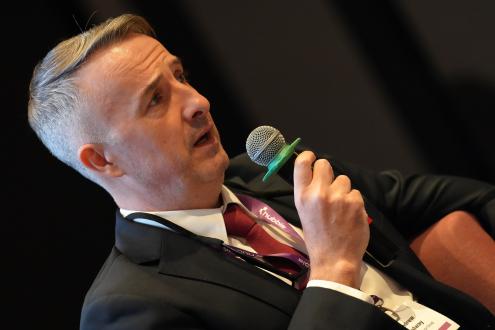
Andrew Galway, a Managing Director at Sovereign Group based in Singapore, was the third fiduciary provider to take the microphone during the “In The Hubbis Hot Seat” session at the Hubbis India Wealth Management Forum 2026 in Mumbai, and he acknowledged the fact with characteristic dryness.
“As a third trust in the hot seat, it kind of cuts the chase a little bit, while it’s good to see competitors,” he said.
Rather than restate a proposition the room had already heard twice, Galway used his five minutes to raise a question that cuts across the entire trust and succession industry, including his own firm. Structures are being established in growing numbers. Family offices are proliferating. And yet, by his account, families themselves do not feel ready. His argument was that the gap lies not in the legal architecture but in the conversations that are supposed to sit beneath it.
Key Takeaways
Establishing a trust, foundation or family office does not mean a family is ready for succession; the underlying governance arrangements must also be workable.
Succession plans often stall because families avoid difficult conversations about decision-making, control, disagreement and the founder’s eventual withdrawal.
Legal structures can allocate ownership, but they cannot independently determine how family members will exercise power or resolve conflict.
Trustees and advisers can serve as neutral conveners, creating a platform for sensitive discussions that family members may struggle to initiate themselves.
The scale of the coming intergenerational wealth transfer in India makes governance readiness increasingly urgent.
Long-standing adviser and trustee relationships provide the trust and continuity needed to address sensitive family, business and succession issues.
Geographically dispersed families need governance arrangements that connect domestic assets, GIFT City holdings and international wealth within a cohesive plan.
Domestic Indian advisers and international providers must collaborate more closely, as no single adviser may have complete visibility across every relevant jurisdiction.
Successful succession ultimately depends on combining appropriate structures with clear family decisions, prepared beneficiaries and agreed processes for the future.
The Problem Is Not the Structure
“One of the things we’re here in India to explore more is collaboration and to discuss governance,” Galway said. “So, it’s not just in India, but globally, there does seem to be an issue with getting trusts and succession planning and legacy plans over the line.”
The evidence, he suggested, is contradictory on its face. Families are having the discussions. Trusts are being set up. Singapore has seen a substantial build-out of family offices, a figure he put at around 2,000, and the United Arab Emirates (UAE) has seen strong take-up of foundations, an area in which he said the firm’s Gulf operations have been busy.
“But the surveys nonetheless state that families just don’t feel as if they’re ready,” he said. “They don’t feel that they’ve basically got their governance in place to allow for the next generation to come and take over.”
That disjunction, between visible activity in structuring and a persistent sense among families that they are unprepared, was the organising theme of his remarks. A trust deed allocates legal ownership. It does not, on its own, tell a family how decisions will be made once the founder steps back, who holds influence, or what happens when siblings disagree.
The Questions Families Avoid
Galway was direct about what is going unaddressed. “It’s these important questions about decision making, about power, about what happens if there’s disagreements,” he said.
These are not technical questions, and they are not comfortable ones. They touch on hierarchy within families, on the relative standing of children and their spouses, on whether the next generation actually wants the responsibility being prepared for them, and on the founder’s own willingness to relinquish control. They are the sort of questions that are easy to defer indefinitely, particularly in families where the founding generation remains active and healthy.
Galway’s contention was that the professionals in the room, and trustees in particular, are unusually well placed to create the conditions in which such conversations can happen. “I think this is where everybody in this room and the trustees often sit at the top of this discussion is create a platform for families to be able to have difficult discussions and really to allow these discussions to happen,” he said, “because at the moment they’re not happening and this is an issue.”
It is a notable framing of the trustee’s function. On this account, the trustee is not simply an administrator of assets and a signatory to documents, but a convener: a party with sufficient standing and sufficient distance to put questions on the table that family members may struggle to raise with one another.
Scale Gives the Issue Urgency
Galway anchored the point in the scale of what is coming. Citing an estimate, he noted that in India alone something in the order of USD1.5 trillion is expected to pass from one generation to the next over the coming decade. “Unless these discussions take place, it’s going to be difficult for families,” he said.
Figures of this kind are necessarily approximate and should be treated as indicative rather than precise. But the direction of travel is not seriously disputed, and the practical implication holds regardless of the exact number. A very large volume of family wealth is approaching a transition point, and the readiness of the recipients, in governance terms rather than legal terms, appears to lag well behind the readiness of the structures.
He illustrated the practical dimension with an anonymised example from his own client base: a non-resident Indian (NRI) family he works with in Singapore, with family members also in the United States and the United Kingdom, holding a substantial pool of assets in India and uncertain about how to deal with it across those jurisdictions. The details of any such case are specific to the family, but the shape of the problem is now common. Families are geographically dispersed in ways that their existing arrangements were not designed to accommodate, and the question of how domestic assets connect to internationally resident beneficiaries frequently has no obvious answer.
Continuity as a Qualification
On the question of why a family might turn to his firm for this work, Galway made an argument about longevity rather than capability.
Sovereign, he noted, has been in business for around 40 years and is a family-owned business, a characteristic he suggested positions it well to work with families. More striking was his point about tenure. “Most of the people at Sovereign are 20 to 30 years working with the same clients and they have the continuity of developing these relationships with clients, which mean these important, difficult discussions can take place,” he said.
The logic is that the conversations he is advocating cannot be conducted by a stranger. Asking a family how power will be distributed after the founder’s death, or what happens if two branches fall out, requires a level of trust that is accumulated over years rather than established in a pitch meeting. Continuity of personnel, on this reading, is not a service-quality nicety but a precondition for doing the work at all.
He also endorsed a formulation offered by an earlier speaker at the forum, who had suggested that a trustee should be thought of as a family member. “I did like what he said earlier about think of the trustee as a family member, and that’s it,” Galway said.
A Case for Working Together
The final and perhaps most pointed part of Galway’s pitch was directed at the relationship between international providers and the domestic Indian advisory community. He was in Mumbai, he said, alongside a colleague from the firm’s UAE office, specifically to meet like-minded people and explore that ground.
“There’s a lot of Indian professional advisors based in the UAE, based in Singapore, but a lot of our clients are having these issues, these domestic issues, and we want to come here and meet like-minded people that we can discuss,” he said.
His conclusion was explicit. “I think that the offshore international advisers and the local domestic advisers need to work closer together,” he said. As those bonds strengthen, he argued, the two sides can better help families “to harmonize their governance domestically and internationally to try and prepare themselves for passing the family business, domestic assets, the GIFT City assets, the international assets, all of these assets to the next generation in a cohesive and structured way.”
The reference to Gujarat International Finance Tec-City (GIFT City) alongside domestic and international assets was telling. Indian family balance sheets increasingly span three distinct regimes at once, and no single adviser sitting in one of them has full visibility of the others. Governance that is coherent in Mumbai but silent on Singapore, or vice versa, is not governance a family can rely on when it is tested.
The Underlying Message
Galway’s five minutes contained no product and, in truth, very little about his firm’s technical offering. His argument was simpler and, for an audience of advisers, more uncomfortable: that the industry has become efficient at building structures while remaining much less effective at helping families do the human work those structures depend upon.
“But this is it,” he said. “It’s having these conversations to get things over the line.”