
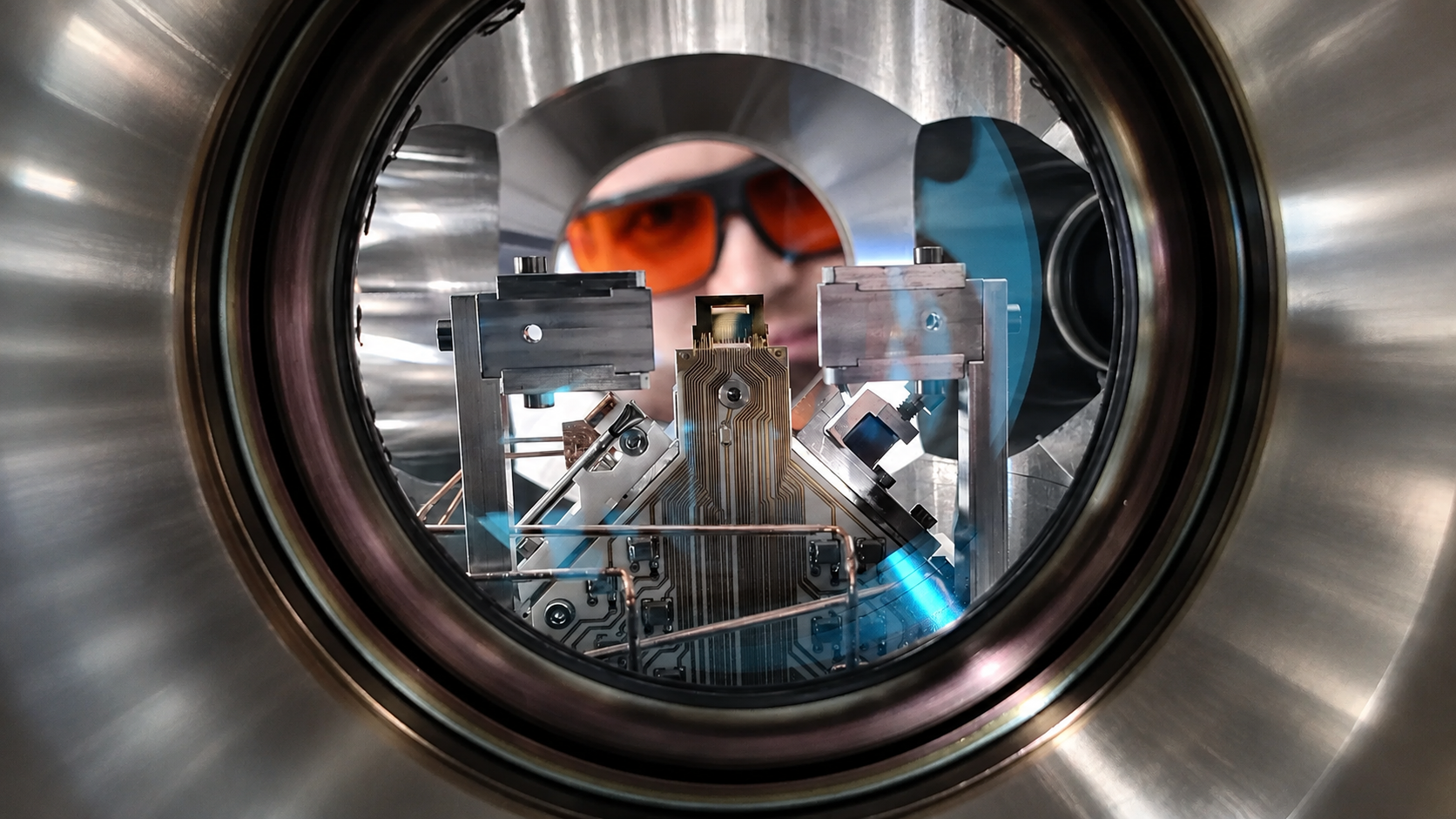
Physicists have directly observed the optical Magnus effect for the first time by mapping how a tightly focused laser interacts with a single trapped calcium ion.The strongest atom-light interaction shifted sideways by several hundred nanometers instead of occurring exactly at the laser beam’s center.The effect could create unwanted errors in laser-controlled qubits, but the same forces may also provide a new way to connect qubits during quantum computations.
A spinning table tennis ball can veer sharply across a table even when its forward motion seems to point elsewhere. The same basic phenomenon helps bend football shots and curve baseballs. Physicists call it the Magnus effect, a sideways force produced when a rotating object moves through a surrounding medium.
Now an international team has observed an optical counterpart at the scale of a single trapped ion. Instead of watching an atom curve through space, the researchers found that a tightly focused laser interacts most strongly with the ion slightly away from the beam’s center.
The finding matters because tightly focused lasers are increasingly used to manipulate individual quantum bits, or qubits. A shift of only a few hundred nanometers can change how precisely those laser beams control trapped particles. The same effect, however, could also provide a useful force for linking qubits during quantum operations.
Linear polarization. Spatial profiles of the normalized quadrupole couplings. (CREDIT: Philip Leindecker et al, Physical Review Letters) When the center moves off-center
A laser beam might seem simplest at its center, where its intensity reaches a maximum. That expectation works well when light is treated as an idealized beam traveling in one direction. But tight focusing changes the structure of the electromagnetic field.
Near the focus, the beam develops longitudinal electric-field components and strong polarization gradients. Those changes alter how the light interacts with an atom or ion. The strongest interaction can move sideways from the geometric center of the beam, with the direction depending on the relevant quantum transition.
That displacement is the optical counterpart of the Magnus effect. In the familiar sporting version, rotation changes the forces on a moving ball and bends its trajectory. Here, spin-orbit-like coupling within the light produces a transverse shift in the atom-light interaction.
A single ion becomes a microscopic sensor
To detect such a tiny displacement, the researchers used a single positively charged calcium-40 ion. Electromagnetic fields held the ion almost motionless inside a linear Paul trap, while cooling brought it close to its motional ground state.
The team then scanned a 729-nanometer optical tweezer beam across the ion. The beam was focused to a diameter of about 2.6 micrometers. Two crossed acousto-optic deflectors moved it with sub-100-nanometer positioning resolution, allowing the ion to serve as an exceptionally sensitive probe of the laser’s spatial structure.
Phase of the quadrupole coupling. (a) Simulation of the signed Rabi frequency of the Δmj=+1 transition with ϵ^⊥B⊥k as a function of tweezer position x, showing that the two lobes have opposite phase. (CREDIT: Philip Leindecker et al, Physical Review Letters)
“Our ion acts like a tiny sensor that we can use to feel out the structure of the laser light,” Leindecker said. “This makes it possible to measure a shift of just a few hundred nanometres.”
The researchers measured how strongly the laser drove several components of a quadrupole transition in the calcium ion. Those transitions respond differently to the light’s spatial and polarization structure, letting the team map where the interaction became strongest.
The measurements match a striking prediction
With linear polarization, the measured separation between two shifted profiles for one pair of transitions was 240 nanometers, with an uncertainty of 16 nanometers. Theory predicted 232 nanometers. For another pair, the measured separation reached 463 nanometers, with an uncertainty of 20 nanometers, compared with a predicted 464 nanometers.
The team also tested circularly polarized light. The measurements again showed sideways displacement, although some values differed more from simulations. The researchers attributed those deviations to factors including reduced spatial resolution, imperfect polarization and mechanical or thermal drift.
The experiment revealed more than a shift in position. Tight focusing also produced transverse polarization gradients and, for some transitions, two distinct lobes in the coupling pattern. Measurements showed those lobes had opposite phases, confirming a field gradient at the beam center.
Experiment layout. A laser beam is tightly focused on a trapped Ca+40 ion confined in a linear Paul trap. (CREDIT: Philip Leindecker et al, Physical Review Letters) A possible source of quantum computing errors
That detail could prove especially important for quantum computing. Trapped ions can serve as qubits, and lasers can change their internal quantum states or couple those states to the ions’ motion. Precise control is essential because unwanted coupling can create errors.
The optical Magnus effect creates transverse gradients even when an ion sits at the nominal center of the laser beam. At the available laser power, the researchers calculated that such a gradient could produce significant unwanted coupling between a qubit and its motion during a single-qubit gate if the effect went uncompensated.
Careful calibration offers a way to suppress that problem. Knowing exactly where the ion sits relative to the shifted interaction profile would allow researchers to account for the displacement rather than treating the beam center as the point of maximum coupling.
The same effect could become a quantum tool
The same physics can also be turned into a tool. “The forces it generates could be used to couple qubits to one another, enabling more complex computations,” Leindecker said.
In particular, the researchers found configurations where the ordinary carrier coupling vanishes at the beam center while a nonzero field gradient remains. Their simulations indicate that such gradients could reach magnitudes comparable with those already used to implement two-qubit gates.
Ion drifts. Drift of the center-of-mass position of the ion along x and y, measured by a separate electron-multiplying CCD. (CREDIT: Philip Leindecker et al, Physical Review Letters)
The forces are also transverse, acting perpendicular to the direction in which the laser travels. That geometry could simplify some quantum-gate approaches compared with schemes that depend on the laser beam’s axial direction.
The measurements also confirmed a notable prediction: the scale of the optical Magnus displacement depends on the wavelength of the light rather than simply on how tightly the beam is focused. For the 729-nanometer transition used in the experiment, the observed shifts closely approached the wavelength-based theoretical values.
Tiny shifts could matter as quantum systems grow
Practical challenges remain. Small polarization errors, optical aberrations and beam-pointing drifts can change where important features of the interaction occur. Those issues could become particularly relevant in integrated photonic systems, where tightly focused beams may be built directly into surface ion traps and cannot easily be steered after fabrication.
The experiment nevertheless turns a theoretical optical effect into something that can now be measured and engineered. What looks like a tiny sideways offset, only a few hundred nanometers across, may become another parameter quantum-computer designers must control. It could also become one they deliberately use.
Dig deeper into the optical Magnus effect, trapped ions and quantum gates
These resources explore the theory behind Magnus-like optical forces, polarization gradients in tightly focused beams and their growing role in controlling trapped-ion quantum computers.
Related Stories