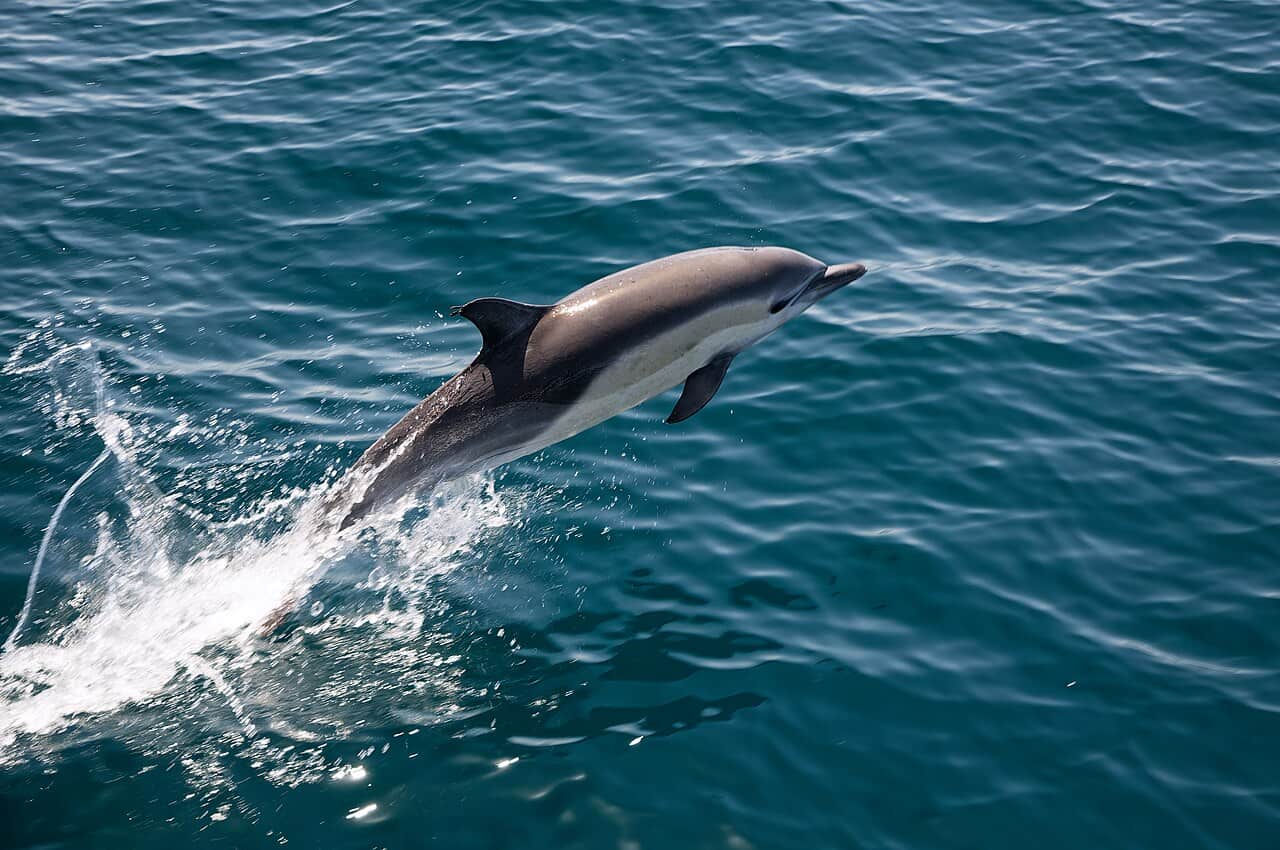
 The dolphin found near Goolwa was a common dolphin, like the one in the image. Credit: Wikimedia Commons
Australia spent years preparing for the highly contagious H5N1 to arrive. The virus mainly affects birds, causing a type of influenza that is extremely fatal. That moment finally came in June, when migratory seabirds along the country’s southern coast tested positive for the virus. In a little more than two months, H5N1 has already moved beyond birds, infecting fur seals, a fox, and now a dolphin.
The common dolphin was found dead near Goolwa, about 70 kilometers south of Adelaide. Tests confirmed H5N1, making it Australia’s first documented case in a dolphin. The discovery is yet another warning that an outbreak that began in birds is becoming a broader wildlife problem.
Australia confirmed its first case of the globally circulating H5 strain in June 2026, in a migratory brown skua in Western Australia. By September 1st, the country had recorded 446 positive wildlife events, according to the federal government’s latest H5 bird flu data. An “event” can involve one or more animals. H5N1 has still not been detected in Australian poultry or other livestock, and officials say the risk to people remains low.
“To have one here so soon is very shocking for me and very worrying,” Mike Bossley, a cetacean researcher, told ABC News. “It’s spreading to other species than birds really, really quickly. There’s not much we can do about it. It’s terrible.”
Bird Flu Isn’t Always Just for Birds
How does a bird virus reach a dolphin?
South Australia’s chief veterinary officer, Skye Fruean, said the animal may have eaten an infected bird or interacted closely with one. Dolphins do not normally hunt birds, but the two often converge on the same schools of fish. Bossley noted that dolphins sometimes follow feeding seabirds, which can spot fish from above.
“We know that dolphins are highly susceptible, which means they are at risk,” Fruean told ABC News.
The case is unusual, but not unprecedented. In 2022, researchers detected H5N1 in a common dolphin that died in Peru during an outbreak among seabirds and sea lions. The finding was later described in a Nature Communications study of the Peruvian outbreak. Another team found H5N1 in a harbor porpoise in Sweden that developed severe brain inflammation.
×
Thank you! One more thing…
Please check your inbox and confirm your subscription.
 (A) Map of Peru showing positive locations of animals sampled in the Peruvian study. (B) Photographic record of animals sampled, including common dolphin, South American sea lion, sanderling, Guanay cormorant, Peruvian booby, and Peruvian pelican. Credit: Nature Communications
A 2024 study of a bottlenose dolphin in Florida likewise found the highest viral load in the brain.
Fruean said preliminary testing of the Goolwa dolphin found high levels of virus in its brain, though the full post-mortem examination was not yet complete.
For now, there is no evidence that dolphins—or other mammals—are passing H5N1 to one another in Australia. Infection after contact with a bird is just a spillover; sustained mammal-to-mammal transmission would indeed be highly concerning.
Scientists have seen evidence for such transmission elsewhere. In 2023, H5N1 swept through southern elephant seals in Argentina, killing an estimated 17,000 animals. A 2024 study of the event found epidemiological and genetic evidence consistent with transmission among marine mammals.
Potential Wildlife Crisis
Australia’s immediate concern is what happens when H5N1 repeatedly enters ecosystems packed with vulnerable animals.
Long-nosed fur seals have already tested positive in South Australia. Seals and sea lions worry officials because they gather in dense colonies, creating opportunities for larger outbreaks. A federal risk assessment rated common dolphins at high risk, meaning outbreaks could potentially cause severe population declines.
Farther south, the Australian Antarctic Division (AAD) plans to withdraw 24 researchers from Macquarie Island before the seal breeding season. Bird flu has not been detected there, but authorities fear a major mortality event among elephant seals. In Tasmania, officials also found a large number of dead little penguins on King Island. The carcasses were too decomposed to test, so no link to H5N1 has been established.
 Expeditioners live and work around local wildlife on Macquarie island. Credit: AAD
For people, there is no evidence that the current strain spreads from person to person, and Australia’s poultry industry remains free of H5N1. But for wildlife, the dolphin at Goolwa is another sign that a virus Australia kept out for years is wasting little time finding new hosts.