

Stade Francais enters the Top 14 2026-27 season having already answered one of the biggest questions surrounding the club. Paris is relevant again. After spending 2024-25 fighting to remain in the Top 14, Stade Français surged to third in the 2025-26 regular season and reached the semifinals.
The turnaround was emphatic. Stade Français scored 869 points and 113 tries, turned Stade Jean-Bouin into one of the league’s most difficult places to visit and demolished La Rochelle 45-5 in the barrage. Montpellier eventually ended the season with a 25-15 semifinal victory, but Paris had traveled a remarkable distance in 12 months.
Now comes the harder part. Paul Gustard has retained most of the core behind that revival while Stade Français made targeted rather than transformational additions. The question entering 2026-27 is no longer whether Stade Français has recovered. It is whether last season established a new standard or represented one extraordinary rebound.
What Happened To Stade Français In 2025-26?
Stade Français finished third in the Top 14 with 79 points and a 15-10-1 record, one year after finishing 12th. Paris scored 869 points while allowing 664 for a plus-205 differential and finished with 113 tries against 83 conceded.
Only Toulouse scored more regular-season points.
Jean-Bouin became the foundation. Stade Français went 11-1-1 at home, with Toulouse’s 13-9 victory in February the only regular-season loss there. Paris beat Clermont 64-20, Toulon 51-24 and Bordeaux-Bègles 28-7 among its statement home victories.
The road exposed a different team. Stade Français finished just 4-9 away despite impressive wins at Bordeaux and Toulon. A 44-7 loss at Montpellier and 47-20 defeat against Racing illustrated the inconsistency that kept Paris from becoming a more complete championship threat.
Then came the postseason performance that showed the ceiling.
Stade Français overwhelmed La Rochelle 45-5 at Jean-Bouin, scoring seven tries as Romain Briatte produced a hat trick. Montpellier stopped Paris 25-15 six days later in the semifinal, when indiscipline repeatedly allowed Montpellier to turn infringements into territory and points.
Europe offered another warning. Stade Français went 3-1 in its Challenge Cup pool but suffered a 36-31 home loss to Dragons RFC in the Round of 16.
The third-place Top 14 finish means Stade Français returns to the Champions Cup in 2026-27, creating a significantly more demanding European workload.
What’s New For Stade Français In 2026-27?
Stade Français did not respond to its semifinal season by tearing apart the roster. Instead, Paris largely preserved its core while trying to replace specific losses and deepen positions that will be tested across the Top 14 and Champions Cup.
Alivereti Duguivalu is arguably the headline addition. The 29-year-old center/wing arrives from Perpignan after more than 100 professional appearances and gives Gustard power and positional versatility following Joe Marchant’s departure for Sale Sharks.
Ihaia West provides experienced cover behind Louis Carbonel at fly-half. Rufus McLean adds wing and fullback depth, while Thomas Bué, Tomasi Maka and Petero Mailulu strengthen a younger group of forwards. Stade Français also added 21-year-old wing Israel Leota as a developmental option.
The losses matter.
Marchant leaves after 73 Stade Français appearances, while lock Baptiste Pesenti departs for Pau after 88. Brad Weber’s move to Japan changes the scrum-half depth chart, Zack Henry leaves at fly-half, Charles Laloi departs for Agen and Andy Timo joins La Rochelle.
The result is a roster that looks different rather than dramatically stronger. Carbonel, Léo Barré, Tawera Kerr-Barlow, Paul Gabrillagues, Briatte, Yoan Tanga, Sekou Macalou, Peniasi Dakuwaqa, Jeremy Ward and Giacomo Nicotera remain.
Gustard also remains in charge, with Morgan Parra overseeing the attack, Perry Freshwater the forwards and Rory Kockott the defense.
Continuity should be one of Paris’ advantages. Whether that is enough with Champions Cup rugby added to the schedule is another question.
Stade Français Projected Starting XV And Bench
This is a projection of Stade Français’ strongest available 23 based on the current roster, 2025-26 usage, the playoff team and offseason changes. It is not an officially announced lineup.
Projected Starting XVMoses Alo-Emile — Loosehead propGiacomo Nicotera — HookerGiorgi Melikidze — Tighthead propPaul Gabrillagues — LockPierre-Henri Azagoh — LockSekou Macalou — FlankerRomain Briatte — FlankerYoan Tanga — No. 8Tawera Kerr-Barlow — Scrum-halfLouis Carbonel — Fly-halfSamuel Ezeala — WingTani Vili — CenterAlivereti Duguivalu — CenterPeniasi Dakuwaqa — WingLéo Barré — Fullback
Projected bench options: Lucas Peyresblanques, Thomas Bué, Paul Alo-Emile, Petero Mailulu, Tanginoa Halaifonua, Paul Abadie, Ihaia West and Jeremy Ward.
Center could produce the most interesting selection battle. Ward, Vili, Noah Nene and Duguivalu offer Gustard several combinations, while Nene’s late-season development gives Paris another option after Marchant’s departure.
The back row also has competition. Halaifonua played an important role during the playoff run, while Macalou enters the final year of his contract following an injury-disrupted 2025-26 season.
Stade Français Players To Watch In 2026-27Louis Carbonel
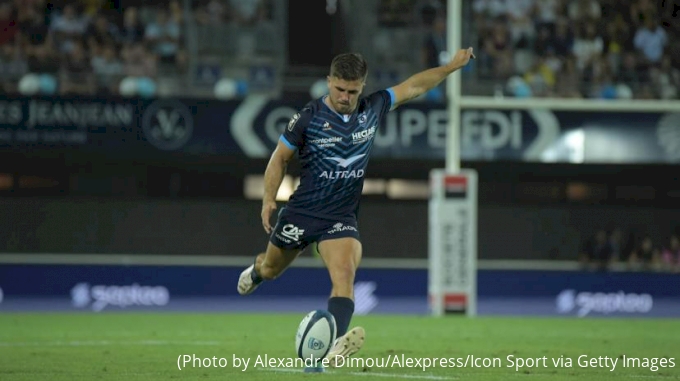
Louis Carbonel remains the statistical centerpiece of Stade Français rugby. The fly-half started all 24 Top 14 matches he played last season, logged 1,936 minutes and scored 288 points. He finished second in the league scoring race by seven points.
 Léo Barré
Léo Barré gives Paris something different from fullback. He scored 12 Top 14 tries and 62 points last season, and his ability to play fullback or fly-half provides Gustard with additional flexibility.
Paul Gabrillagues
Paul Gabrillagues becomes even more important following Pesenti’s departure. The experienced lock made 20 starts in 24 Top 14 appearances last season and remains a central figure in the pack and lineout.
Romain Briatte
Romain Briatte might not command the attention of some of Stade Français’ bigger names, but his playoff performance represented the team’s identity at its best. His hat trick against La Rochelle came during a match Paris controlled through relentless physical pressure.
Noah Nene
Noah Nene is the breakout candidate worth remembering. He earned meaningful responsibility late last season, started the barrage against La Rochelle and was dangerous again during the preseason comeback victory over Clermont. Marchant’s departure creates a clearer path to significant minutes.
Duguivalu, Dakuwaqa and Macalou could all prove equally influential, illustrating the number of important variables Gustard has across his Stade Français roster.
How Stade Français Plays
The easiest description is forward pressure first — but no longer forward pressure only.
Stade Français built its 2025-26 success around a powerful scrum, disruptive lineout, collision dominance, breakdown pressure and aggressive defense. The 45-5 destruction of La Rochelle was perhaps the purest demonstration of that identity.
What changed was what happened after Paris established that platform.
Stade Français scored 869 points and 113 tries, demonstrating an attack capable of doing far more than simply grinding opponents down. The basic formula was highly effective: create pressure through the pack and set piece, turn that pressure into territory and penalties, allow Carbonel to accumulate points and attack narrowed defenses with Barré, Dakuwaqa, Ezeala and the centers.
Kerr-Barlow provides experience controlling matches at scrum-half, while West gives Gustard another established option at No. 10.
The problem was portability.
An 11-1-1 home record compared with 4-9 away is a massive split. Stade Français proved it could produce elite performances away from Paris, particularly at Bordeaux and Toulon, but it could also lose control of territory, defense and discipline.
That last issue deserves particular attention. Paris conceded 16 penalties and received three yellow cards in one defeat at Toulouse, while infringements again proved costly in the semifinal against Montpellier.
A team designed to control territory cannot repeatedly give that territory back.
Stade Français’ Biggest Strength
Stade Français has a playoff-grade forward pack capable of producing points rather than simply possession.
At its best, Paris can dictate scrums and lineouts, win collisions and apply breakdown pressure before allowing Carbonel and an increasingly dangerous backline to convert those advantages.
The statistics reinforce the point. Stade Français scored 869 regular-season points and 113 tries. Barré scored 12 tries, Dakuwaqa had 10 and Carbonel supplied 288 points.
Jean-Bouin amplifies everything. Going 11-1-1 there before beating La Rochelle 45-5 in a home playoff gave Stade Français the kind of home platform around which another postseason run can be built.
The Biggest Question Facing Stade FrançaisCan Stade Français make last season repeatable under more difficult circumstances?
Going from a relegation fight to third place in one year was extraordinary. Repeating it while playing Champions Cup rugby, replacing Marchant and Pesenti and attempting to improve a 4-9 away record may be more difficult.
The recruitment strategy looks designed to reinforce rather than reinvent. West adds meaningful fly-half depth, Duguivalu could immediately help compensate for Marchant’s departure and young forwards such as Mailulu and Bué bring upside.
That puts pressure on internal development. If Nene, Mailulu, Bué and others progress, Paris may have enough depth for two demanding competitions.
If they do not, the Champions Cup could expose the difference between a very good starting group and a roster capable of surviving an entire season near the top of French rugby.
Stade Français’ History Still Shapes The Club
Few French clubs carry an identity quite like Stade Français Paris.
The original Stade Français was founded in 1883, while the present club emerged from the 1995 merger of the Stade Français and CASG rugby sections. The club has won 14 French championships, most recently in 2015, along with the 2017 Challenge Cup.
Its history stretches from dominance around the turn of the 20th century to the modern revival driven by Max Guazzini. Stade Français became French champion again in 1998 and developed one of rugby’s most recognizable identities.
The pink jersey introduced in 2005 became central to that identity, while the club also helped demonstrate how French rugby could be marketed as major entertainment in Paris. A Stade Français-Toulouse league match at Stade de France drew 79,502 in 2005.
The rivalry with Racing stretches back even further, with the Paris derby traced to 1892. Yet Stade Français failed to beat Racing in either 2025-26 league meeting, drawing 20-20 at Jean-Bouin before losing 47-20 away.
That history creates expectations, but the most relevant part of the Stade Français story now is happening at Jean-Bouin, where last season’s 11-1-1 regular-season record gave the modern club a formidable home identity.
What Should We Expect From Stade Français In 2026-27?
The top six should be the standard.
Stade Français returns most of a team that collected 79 points, finished third and reached a semifinal. Duguivalu and West address important needs, while enough of the pack and attacking spine remain to make another playoff appearance a realistic expectation.
The best-case scenario is another semifinal followed by a genuine opportunity to reach the Top 14 final. Paris showed against La Rochelle that its best knockout performance can overwhelm a high-level opponent.
The most likely outcome is another playoff-caliber season, though assuming another third-place finish would underestimate the challenge ahead.
The floor is considerably lower if Champions Cup demands expose the depth, Marchant proves difficult to replace and the road and discipline problems continue. Under those circumstances, Stade Français could find itself battling around the playoff line rather than comfortably inside it.
Europe adds another variable. Stade Français moves from the Challenge Cup into a Champions Cup pool featuring Cardiff, Bath, the Bulls, Montpellier and Northampton. Managing that workload while sustaining a Top 14 challenge will test the depth Gustard and his staff have built.
Stade Français enters 2026-27 looking roughly as strong as the team that finished last season, perhaps with better depth in several areas but without enough obvious improvement to call Paris a proven championship favorite.
Last season established that Stade Français has recovered.
This season will establish whether it has truly returned to the French elite.
How To Watch FloRugby
FloRugby is available through a FloSports subscription. Subscribers can watch live rugby matches, full-match replays, highlights, original programming and exclusive coverage across multiple competitions. Stream on your computer at FloRugby.com or through the FloSports app on supported mobile devices and connected TVs.
Can You Watch Replays On FloRugby?
Yes. FloRugby subscribers can watch full-match replays after live events conclude, along with match highlights, interviews and other on-demand content. Replays allow fans to catch up on matches they missed or revisit key moments throughout the season.
Can You Watch FloRugby On TV?
Yes. FloRugby is available on many popular streaming platforms through the FloSports app, including Roku, Apple TV, Amazon Fire TV and Android TV. You also can cast from a compatible mobile device to supported televisions using Chromecast or AirPlay.
Can You Watch FloRugby On Mobile?
Yes. The FloSports app is available for iOS and Android devices, allowing subscribers to stream live matches, watch replays and follow rugby coverage from virtually anywhere with an internet connection.
What Rugby Competitions Are On FloRugby?
FloRugby streams a wide range of rugby competitions throughout the year, including major domestic leagues, international matches, European club competitions and select age-grade and collegiate events. Available competitions vary by region and broadcast rights, so check the FloRugby schedule for the latest listings.
Where Can I Find Rugby News, Schedules And Results?
FloRugby provides year-round rugby coverage, including breaking news, match previews, lineups, rankings, transfer news, schedules, results and standings.
Join The Rugby Conversation On FloRugby Social