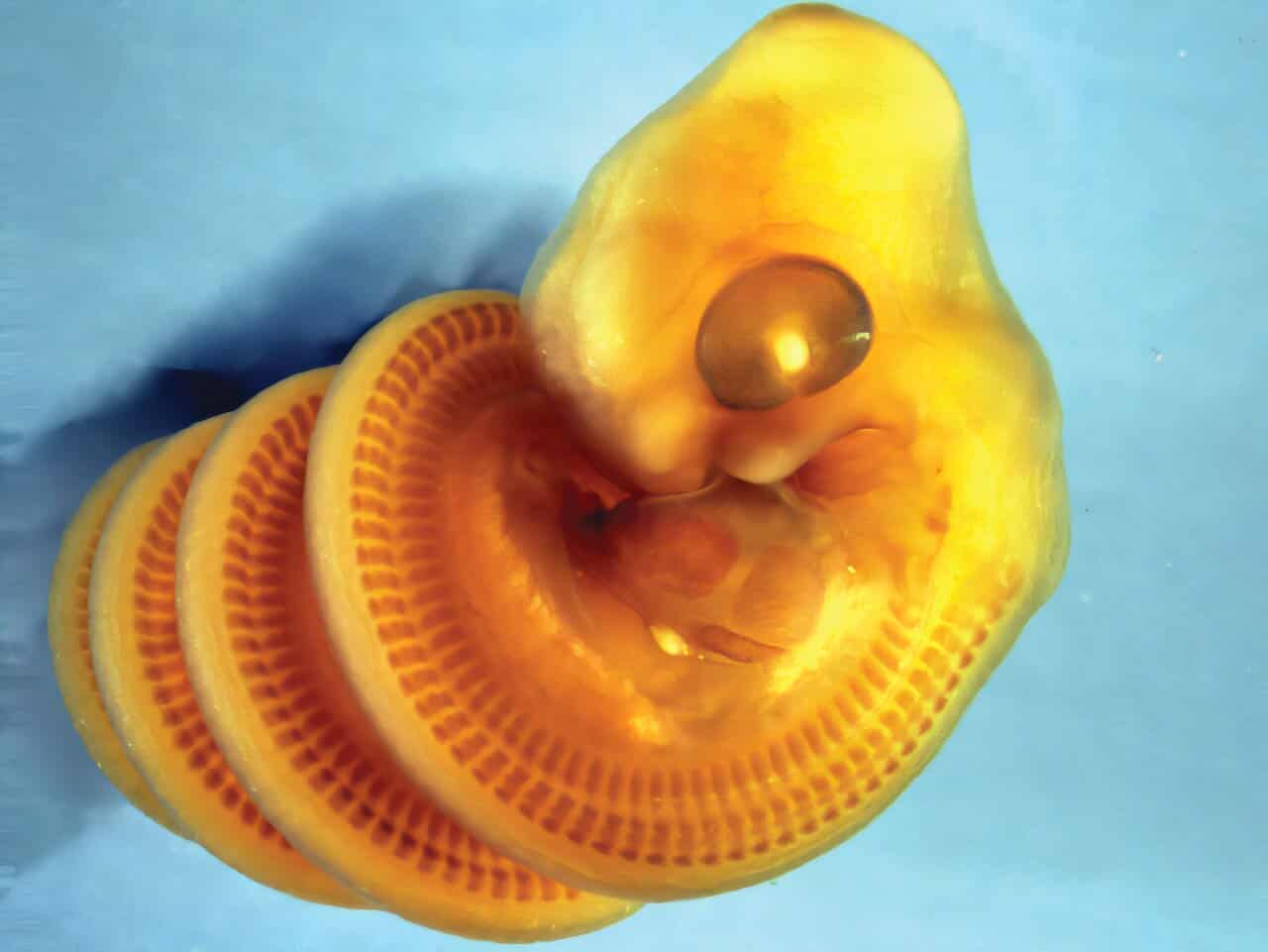
 An embryo of Cape house snake (Boaedon capensis) stained to show developing muscle blocks in the trunk. The embryo shows right-handed coiling. Credit: Raul Diaz, California State University Los Angeles.
Can a snake be left-handed or right-handed? We’re not talking in the same way you or I would favor a hand, of course. But before a snake is even capable of moving, its body shows a striking kind of handedness. Inside the egg, developing snake embryos overwhelmingly coil in the same direction: to the right.
Researchers who examined hundreds of embryos found that this bias appears remarkably early, before the snakes have functioning muscles that could deliberately twist their bodies. This got them thinking. If it’s not the muscles, then what’s twisting snakes?
A study of over 900 snake embryos now has an answer, and it’s all about the egg mechanics.
A mystery hidden in old embryo photographs
The discovery began during the COVID-19 lockdown in 2020, when evolutionary biologist Tetsuto Miyashita of the Canadian Museum of Nature needed a project that students could tackle without entering a laboratory or museum.
He looked at all sorts of ideas, then started to realize that there was something odd in published photographs of developing snakes. Their coils seemed strangely consistent. He asked students to investigate.
 An embryo of an African house snake (Lamprophis sp.), showing right-handed coiling. Credit: Joy Richman, University of British Columbia.
So, Alexandra Weber, then an undergraduate at Carleton University, and some of her colleagues began hunting through scientific papers and museum collections. They eventually assembled images of more than 900 embryos representing 39 species of snakes and other limbless squamates, the reptile group that includes snakes and lizards.
The pattern was clear as day. During early development, the embryos overwhelmingly formed what biologists call a dextral, or right-handed, spiral when followed from head to tail. This was especially puzzling because the embryos were doing it before they had sufficiently developed muscles to deliberately twist themselves into position.
The strange geometry of a snake
“At these stages, the embryos don’t have muscles to move with, so different forces are making them coil right-handed,” Weber said in a Canadian Museum of Nature release. “But we didn’t know what’s making them do that.”
To look inside the coil, the researchers turned to CT scanning. Raul Diaz of California State University Los Angeles scanned snake embryos in three dimensions and revealed an anatomical arrangement the team had not appreciated before.
The embryo temporarily has an asymmetric layout while it is developing.
The body itself is broadly symmetrical, but inside the egg the embryo does not sit in a perfectly symmetrical environment. The important asymmetry is the yolk, which lies on the embryo’s left side during this stage. Meanwhile, the gut forms a relatively short “visceral pillar” through the middle of the growing coil.
×
Thank you! One more thing…
Please check your inbox and confirm your subscription.
 A cut-away view of a CT-scanned image embryo of Cape house snake (Boaedon capensis), revealing the ‘visceral pillar’ — a newly discovered trait unique to snake embryos. The gut is separated from the body axis, as the latter begins to rapidly grow and buckle into coiling form. The gut becomes integrated again later when its growth catches up with the rest of the body. Credit: Raul Diaz, California State University Los Angeles.
As the snake’s body axis lengthens much faster than the gut, the body buckles around that tether. Because the yolk occupies the left side, the growing body is pushed toward the opposite side, biasing the resulting spiral to the right.
“There is a touch of mystery to spirals and we are only beginning to understand how these shapes are produced in animals, such as our looping intestine, snail shells, and now these beautifully coiled snake embryos,” says lead author Alexandra Weber, now a graduate student in zoology at the University of British Columbia.
Basically, it’s not the snakes’ body, but the yolk that decides how they grow.
But snakes don’t stay right-handed
 Embryo of a Cape house snake (Boaedon capensis), one of the more than 900 specimens that were part of the study on snake coiling. Credit: Raul Diaz, California State University Los Angeles.
There’s one final twist. Snake embryos do not remain locked into their right-handed coils.
As development continues, the yolk gets smaller and the embryo gains more room inside the egg. Its muscles also mature, allowing the young snake to wriggle and reposition itself. By the time hatching approaches, the strong bias has disappeared: roughly half of the embryos coil to the right and half to the left.
So, snakes aren’t really “right-handed” animals. What the researchers discovered is a temporary handedness that appears during a particular stage of development, when the growing body is still constrained by the gut and yolk.
Miyashita thinks the same approach could help researchers understand other spirals in nature, from looping intestines to shells. “We are now opening the possibility to further develop this model to explain other spiral forms in nature,” he said in a Canadian Museum of Nature release.
There’s also something satisfying about how the researchers arrived there. The project began with little more than scientists scrolling through old photographs and asking a deceptively simple question. Sometimes, that’s how the best science starts out.
“This all started out with a curiosity to see if snakes are ‘handed,’” Weber said. “It was exciting to follow it to deep insights into their evolution.”