
MSFT stock fell below $500 as massive infrastructure spending, an Outlook outage and intensifying competition raise concerns over whether its costly AI expansion can generate sufficient returns.
Written by:
Skerdian Meta
•
Wednesday, September 2, 2026
•
4 min read
•
Last updated: Thursday, September 3, 2026
Add an article to your Reading List
Register now to be able to add articles to your reading list.
” aria-hidden=”true”>
MSFT stock fell below $500 as massive infrastructure spending, an Outlook outage and intensifying competition raise concerns over whether its costly AI expansion can generate sufficient returns.
Microsoft Stock Retreats Below $500 as AI Costs Mount
Microsoft stock is facing renewed pressure after falling below the psychologically important $500 level. The decline comes as investors reassess the enormous cost of the company’s infrastructure expansion and question whether future returns will justify its increasingly aggressive spending.
Microsoft remains a major beneficiary of cloud computing and AI demand, with Azure, enterprise software and its relationship with OpenAI supporting the long-term growth story. However, the market is becoming increasingly focused on what that growth costs.
Microsoft Stock Faces Pressure Below $500
The retreat below $500 has placed MSFT stock under renewed scrutiny after its recent gains. Investors are increasingly questioning whether Microsoft can maintain its premium valuation while committing tens of billions of dollars to data centers, processors, networking equipment and electricity.
According to a fundamental review published on September 1, Microsoft deployed approximately $41 billion in capital expenditure during its fiscal fourth quarter, including $5.6 billion through finance leases. Around two-thirds was directed toward processors, GPUs and other shorter-lived AI-related equipment.
Operating cash flow reached $55.4 billion, while free cash flow stood at $19.6 billion, highlighting the intensity of the infrastructure build-out.
The spending could strengthen Azure and Microsoft’s competitive position, but the returns remain uncertain.
Outlook Outage Adds Another Concern
Microsoft is also dealing with a widespread Outlook disruption that affected thousands of users.
The outage began on August 31, with Downdetector recording more than 6,000 reports at its peak. Microsoft said an authentication component was contributing to the problem while engineers worked on a resolution.
A temporary outage does not fundamentally change Microsoft’s financial outlook. However, the disruption creates another negative headline while investors are already examining the reliability, scale and cost of the company’s technology infrastructure.
For a company whose cloud and software ecosystem supports a large portion of its valuation, operational problems can attract significant market attention.
AI Infrastructure Spending Raises Questions
The larger concern is the enormous amount of capital Microsoft is committing to AI infrastructure.
The company is expanding data-center capacity and increasing access to NVIDIA and AMD processors to meet expected demand. Its involvement in a $9.7 billion cloud agreement with IREN further illustrates the scale of infrastructure commitments required.
Microsoft has also approved Horizon 1, representing the first quarter of IREN’s planned 200MW deployment.
These investments could support Azure growth if demand remains strong. But if utilization disappoints or customers resist paying enough for AI services, Microsoft could be left carrying an increasingly expensive infrastructure base.
Hyperscaler Economics Become More Important
Morgan Stanley has raised concerns about the creditworthiness of major hyperscalers and the growing gap between AI infrastructure costs and revenue generated from those investments.
That warning strikes directly at Microsoft’s investment case.
Advanced AI services require continuous spending on processors, data centers, power and networking. As adoption increases, revenue may rise, but infrastructure costs can increase simultaneously.
The critical question is whether Microsoft’s incremental revenue will grow faster than its incremental costs.
AMD Partnership Provides Limited Relief
Microsoft’s expanded partnership with AMD gives it another option for diversifying its computing infrastructure.
Using multiple suppliers could reduce dependence on NVIDIA and provide greater flexibility across Azure. It could also help Microsoft manage hardware costs and secure additional computing capacity.
However, supplier diversification does not remove the underlying problem.
Microsoft still needs to spend enormous amounts of capital regardless of whether the hardware comes from NVIDIA, AMD or internally developed systems. Investors ultimately need evidence that these investments can produce attractive profits.
AI Revenue Must Catch Up
Microsoft continues expanding Copilot and other AI-powered products across its software ecosystem. The potential market is enormous, but monetization remains critical.
If customers accept higher prices for AI services, Microsoft could eventually generate substantial returns from its infrastructure investments.
If adoption develops more slowly, however, the company could be left with a costly infrastructure base that fails to generate sufficient revenue.
Competition makes the challenge harder. Alphabet, Amazon and Meta are also investing heavily, creating the possibility of a prolonged infrastructure spending race.
MSFT Stock Weakness – Microsoft Reverses Lower
Microsoft shares soared above the critical $500 level as they rebounded strongly in the last 2 months, climb above $517 on Friday but has slipped below again. This area represents both psychological and technical resistance where a number of moving averages stand, making it an important line in the sand.
MSFT Chart Daily – Testing the 200 SMA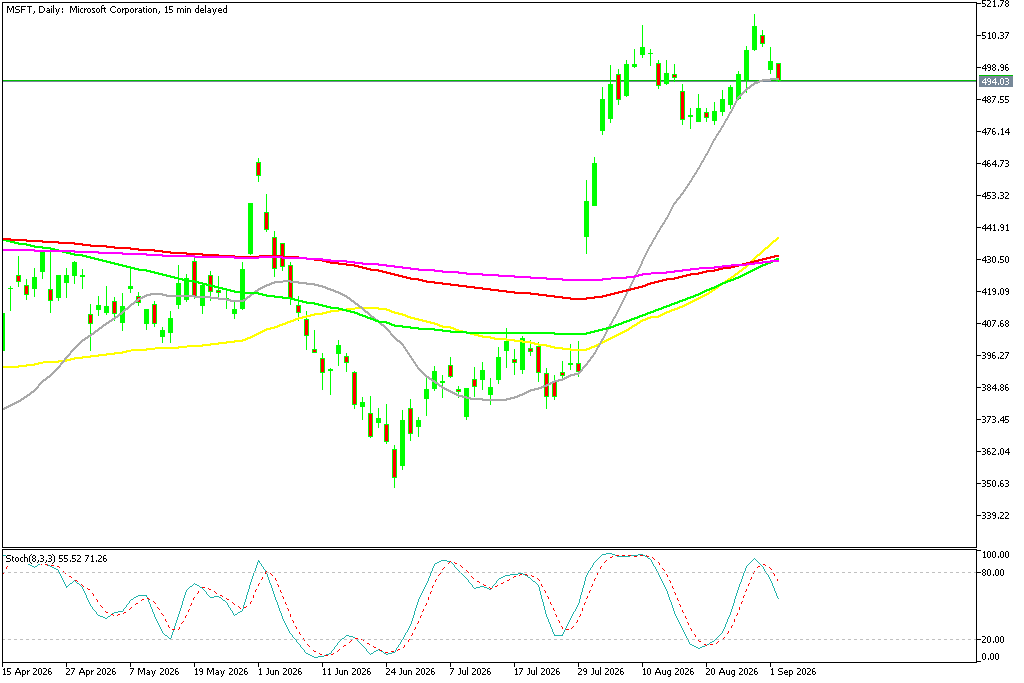
Microsoft’s stock has undergone a notable repricing in recent months, signaling a broader reset in how investors are assessing mega-cap technology leaders. After peaking above $555 in October, shares retreated sharply, shedding around $200.
However the 50 monthly SMA (yellow) held as support once again and we saw a strong rebound in April and May. But, buyers gave up and sellers returned and MSFT stock failed to push above the 50 SMA which opened the door for further declines.
MSFT Chart Monthly – Breaking Below the 50 SMA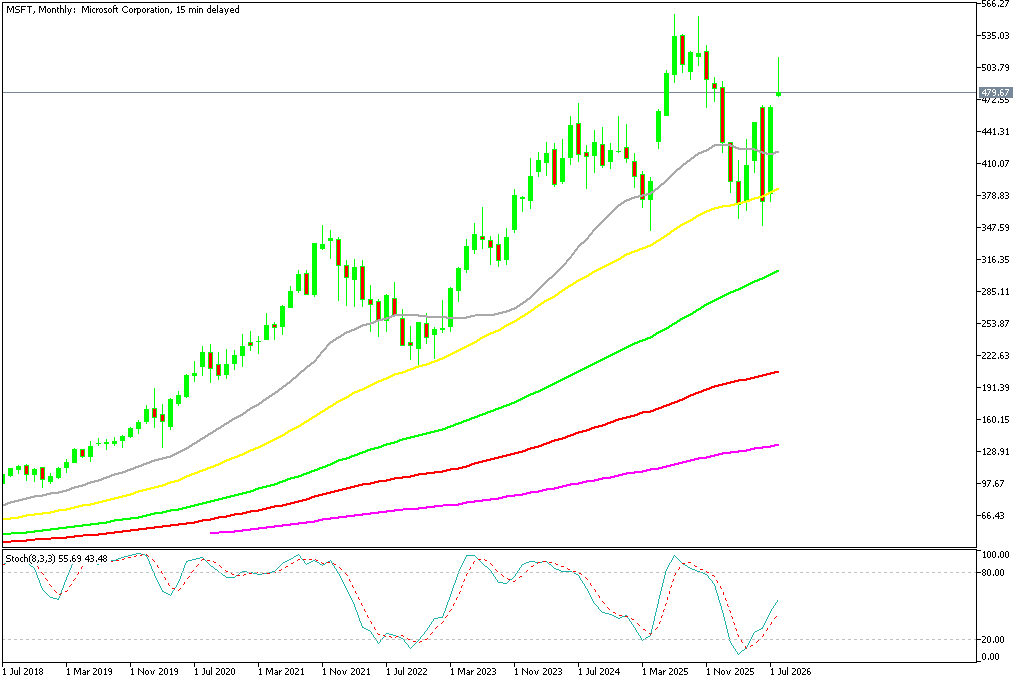
OpenAI and Regulatory Risks Remain
Microsoft’s relationship with OpenAI remains an important part of its AI growth narrative, but competition among cloud providers is intensifying.
Alphabet, Amazon and Meta are developing competing AI ecosystems and infrastructure. Regulatory scrutiny also remains a potential risk as the largest technology companies expand their influence across cloud computing and AI.
Meanwhile, Microsoft’s growing capital requirements could gradually change the economics of a business historically known for highly predictable software revenue and strong margins.
$500 Becomes a Critical Test
The move below $500 gives Microsoft stock an important technical and psychological test.
A recovery above the level could restore confidence in the company’s long-term growth strategy. However, sustained weakness could signal that investors are becoming more concerned about capital expenditure, valuation and the time required for AI investments to generate returns.
Microsoft remains a technology giant with powerful software, cloud operations and substantial cash generation. Yet its investment case is becoming increasingly demanding.
The company must prove that its massive AI infrastructure spending can translate into stronger revenue, durable margins and sustainable free cash flow.
Until then, rising costs, competitive pressure, regulatory uncertainty and operational disruptions could leave MSFT stock vulnerable to further volatility.
Microsoft Q4 Earnings
Microsoft reported fiscal fourth-quarter 2026 earnings on July 29, 2026, beating expectations with an adjusted EPS of $4.74 (vs. $4.24 expected) and revenue of $90.01 billion (vs. $87.62 billion expected), driven by strong Azure cloud growth and AI demand. You can read the official filings via Microsoft Investor Relations.
Financial Highlights
Revenue: $90.01 billion, up 18% year-over-year
Net Income: $35.8 billion, up 31% on a GAAP basis
Earnings Per Share: $4.74 adjusted (beating estimates of $4.24)
Azure & Cloud Growth: Azure revenue grew 43%, pushing annual cloud revenue past key milestones
Productivity and Business Processes: $37.8 billion (up 14% year-over-year), helped by growth in Microsoft 365 Copilot passing 30 million paid seats
More Personal Computing: $12.9 billion (down 4% year-over-year)

Skerdian Meta
Lead Analyst
Skerdian Meta Lead Analyst.
Skerdian is a professional Forex trader and a market analyst. He has been actively engaged in market analysis for the past 11 years. Before becoming our head analyst, Skerdian served as a trader and market analyst in Saxo Bank’s local branch, Aksioner. Skerdian specialized in experimenting with developing models and hands-on trading. Skerdian has a masters degree in finance and investment.