
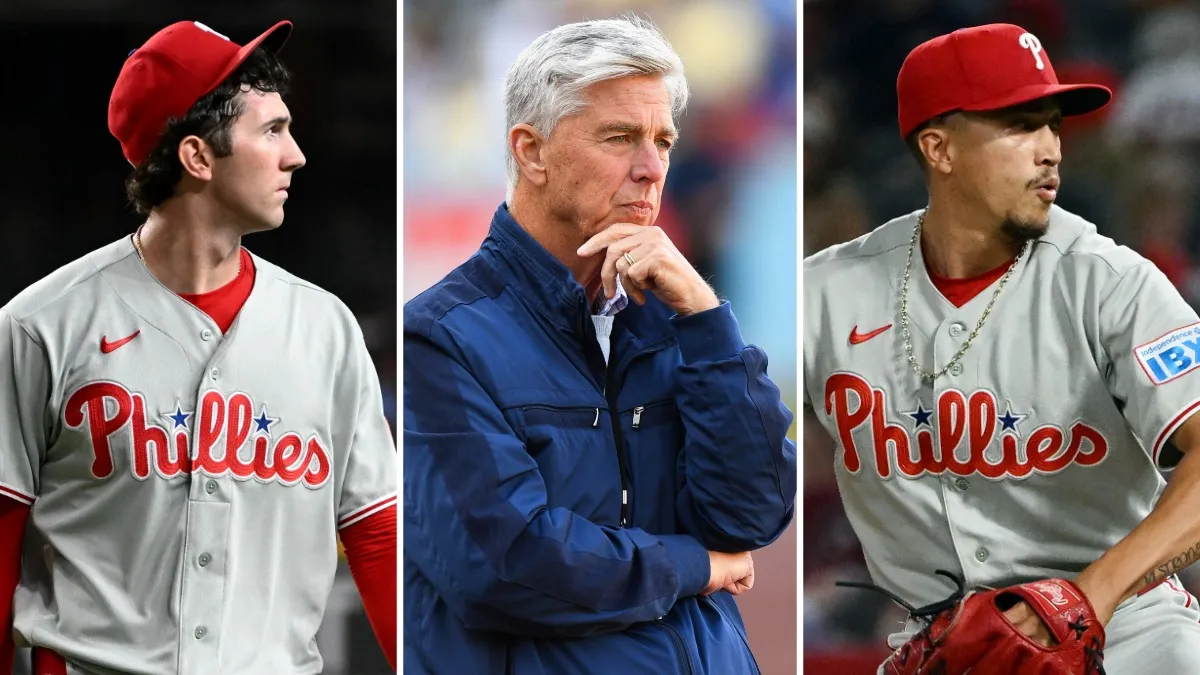
The much-maligned Phillies’ farm system is having a pretty good run.
The big club has won 15 of its last 18 games to firm up its playoff chances, with a wild-card berth a likelihood and a third straight National League East title still a possibility heading into a Labor Day weekend showdown with the division-leading Atlanta Braves.
Rookie center fielder Justin Crawford, a recent product of the farm system, had a strong month of August, hitting .306 with a .358 on-base percentage.
Andrew Painter, also homegrown, has come back from a recent makeover at Triple A and pitched to a 3.12 ERA in seven starts. He pitched seven walk-free, shutout innings in a 1-0 loss at Arizona on Wednesday.
The Phillies’ bullpen, always looking for someone who can get outs, has recently received a lift from hard-throwing Alex McFarlane, also homegrown, who has begun his major-league career with 10 1/3 innings of one-run ball and a very big strikeout of Nolan Arenado on Monday night.
Some of the farm systems recent contributions haven’t been as direct, but there’s no doubting their significance. Luis Arraez came at the trade deadline for a pitching prospect from the system. The team has fed off his energy and selectivity at the plate in going 19-8 since his arrival. Bryce Harper, rising on the NL MVP watch list, has been an on-base demon with Arraez hitting behind him.
On the mound, Jesus Luzardo and Jhoan Duran have been forces, one of the best starters and one of the best closers, respectively, in baseball. Both arrived in not-so-long-ago trades for players from the farm system.
The Phillies’ farm system is widely viewed as one of the 10 worst in baseball by the outlets and organizations who dedicate time and expertise to ranking every system in the game. The criticisms are fair. The system is not deep and does not have even close to the potential star power of some other organizations.
But, as the aforementioned names attest, it has made contributions to the cause here in 2026.
Interestingly, these contributions have come at a time of some change in the player development system. Luke Murton, who oversaw all of player development the past couple of years, was recently moved back into his previous role as overseer of all things hitting. The move, which on the surface sounded like a demotion, comes with an elevated title – assistant general manager for hitting.
Dave Dombrowski, the team’s president of baseball operations, said he understands how the move could be viewed as a demotion, but added, “It’s definitely not that.”
Dombrowski went on to say that changes in the game, specifically industry-wide advances in pitching, prompted the organization to examine its minor-league hitting program and create a position that oversees it from an assistant GM’s position.
“We have felt that pitching in the game is ahead of the hitting and how do you approach trying to get up, not just with us, but with everybody in general,” Dombrowski said. “What can you do to try to address that as much as possible?
“Luke’s specialty has always been hitting, that’s been his expertise. He did a solid job with us as our director of player development but we were also cutting him very thin. He was doing a lot of different things. I mean, he was involved in not only running the farm system for us, but he’d go cross-check hitters for (scouting boss) Brian Barber. So if there were tournaments, he’d be at those at times. He’d be at the MLB Scouting Combine in Arizona. He’s looking at video for us signing players in Latin America.”
With input from general manager Preston Mattingly, it was decided that Murton would focus on just hitting.
“We wanted to try to set a philosophy for hitting from top to bottom, what we’re looking for from amateur players on up from the minute they’re drafted. Two-strike approach, contact and on-base skills, power development, strike-zone discipline. With so much information that you have these days from analytics to the videos, we thought it merited a full-time job, and that’s what it came down to. It was not dissatisfaction with player development.”
The Phillies will hire a new director of player development. That person will run day-to-day operations of the system and make decisions on when to move players up or down a level. But individual leaders in the pitching and hitting programs will have autonomy to work with and direct players on everything from pitch grips to swing adjustments. Big-league pitching coach Caleb Cotham sets much of the overall pitching direction and philosophy. He is tightly aligned and in regular contact with Casey Weathers and Travis Hergert, who oversee the minor-league program.
“For a while, we’ve had the pitching aligned philosophically, from who we’re looking to draft, we talk about arm action, spin rates and things we think we can improve on,” Dombrowski said. “We think we’ve got a real good pulse on that top to bottom. Hitting has been a little behind, and I’m not sure it isn’t just the industry being behind. But we felt we needed to do the same with hitting.”