
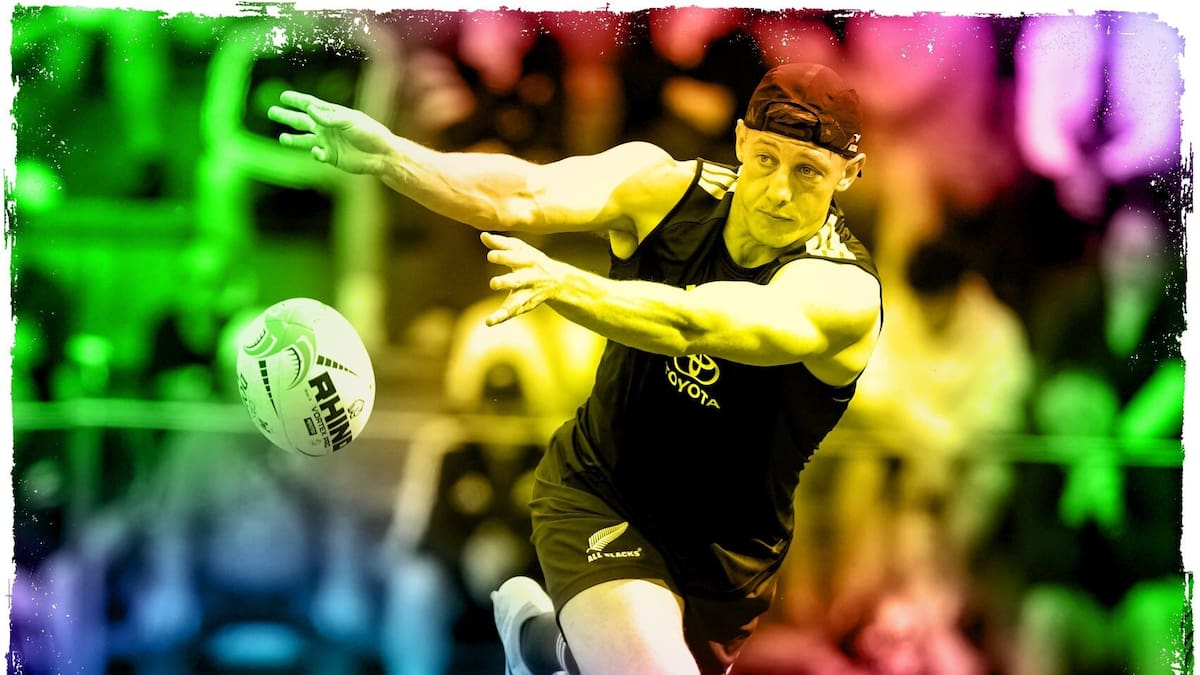
STH uses its relationship with NZR to offer exclusive elements such as getting to see the All Blacks train, hence its rationale for wanting access to unofficial groups to be blocked.
Some lucky fans watch on during the All Blacks’ captain’s run in Cape Town. Photo / John Cowpland, action press
NZR is the ultimate gatekeeper – in consultation with the All Blacks – as to who is and isn’t allowed in to see the team train. And depending on where the training is being held, the All Blacks are usually quite relaxed about unofficial tour parties being granted access.
But the logistics in Cape Town became challenging and security risks had to be managed.
There are close to 1500 people following the Rugby’s Greatest Rivalry matches in South Africa on official packages – all of whom had an expectation they could attend – plus there were sponsors, clients and other guests already locked in.
Also, the training was being held at a school where there was limited room to accommodate large numbers of spectators, all of which meant the number of people had to be controlled.
Worse was to come the following day for the unofficial parties when match tickets – that had been guaranteed and paid for – were not secured.
Initial reports said anything between 2000-4000 fans had been affected, but NZR believes the number of people who missed out and didn’t get a ticket was likely between 250-300.
NZR says that it had people on the ground who gave any spare match tickets – there were some – to unfortunate Kiwis who had been misled by the third-party South African agents who weren’t able to procure the numbers of tickets they said they could.
Security concerns
An unappreciated risk with having large groups of people watch the All Blacks train is the danger of intel – however small or seemingly worthless – leaking out and being picked up elsewhere.
In South Africa, security is a big deal. There is the obvious issue: the high crime factor.
But the All Blacks have also been warned by their security team to wipe down all the whiteboards in their hotels if they had any team strategy-sensitive information on them, to be wary about what hard-copy documents they leave lying around or throw out and to be conscious at all times about who might be within earshot.
This is because the prospect of hotel workers being able to capture and then sell information is real.
The security concern with the captain’s run is the prospect of pictures/videos (not that it would contain any high-value intel) ending up in the wrong hands.
Everyone who attends is briefed that they can’t film or photograph anything and the All Blacks have a security team that polices the session to ensure the rules are followed.
But the larger the spectating group becomes, the harder it is to police. Guests coming to the training run last Friday had also been vetted by artificial intelligence (AI) to see if there were any red flags raised about possible connections or links back to the Springboks or leading figures in South African rugby.
There have been specific incidents over the past 15 years to suggest this is not unfounded paranoia on the part of the All Blacks.
In 2014, when the All Blacks were in Johannesburg going through their last full training session on the Thursday before playing at Ellis Park, they were surprised to see that former New Zealand coach John Mitchell was present at the far end of the ground, explaining to about 50 AIG employees what the team were running through.
Former All Blacks coach John Mitchell. Photo / Photosport
Neither NZR nor the All Blacks knew that Mitchell – who was coaching the Lions at the time and had a direct line to then Springboks coach Heyneke Meyer – was going to be there as a guest of the team’s principal sponsor.
Later that same year in Edinburgh, official tour party guests had access to the Thursday session before the team played Scotland and, because All Blacks manager Darren Shand was at a World Cup meeting in London, there appeared to have been no briefing to not film nor any policing of the 100 or so guests who were at Peffermill.
The session was intense as a number of personnel changes were made, many players were effectively being asked to prove why they should go to the World Cup the following year and some of the language used by the coaching group was colourful.
If clips of some parts of that session had been filmed and posted in isolation without context, there would have been a viral blow-up.
Ted talks his way in
One unofficial tour party who did gain access to the captain’s run was the group being led by Sir Graham Henry and his wife, Lady Raewyn Henry.
Ted, as he is universally known, had agreed to lead a party long before he was invited by All Blacks head coach Dave Rennie to return to the fold this year as an independent selector.
As he’s directly linked with the All Blacks, it would have been a tough decision by NZR to tell him that his tour party were not able to come in to watch the team train.
The issue of Henry not being with an official party highlights the awkwardness that exists in this area of sports tourism, as the former All Blacks coach is by no means the only rugby luminary with strong connections to the national body leading unofficial tour parties in South Africa.
Former All Blacks coach Sir Graham Henry has been escorting a tour group during the Rugby’s Greatest Rivalry series in South Africa. Photo / SmartFrame
Former All Blacks captain Ian Kirkpatrick is also here, as is 1987 World Cup-winner Joe Stanley and Herald columnist Ant Strachan, who was part of the successful 1996 tour, was leading a group until he returned home last week.
In an ideal world, NZR would rather these high-profile figures were in-house, working for STH, but All Blacks tourism is a growing business and Rugby’s Greatest Rivalry has been a red-hot ticket.
The market is highly competitive, which is why the official partner has been protective of the exclusive rights and access that it can offer.
The official tour groups have also had access to major events the night before each test, with All Blacks coaches Dave Rennie, Neil Barnes and Jason Ryan being interviewed on stage at major functions.
This direct link to the team and ability to get clients inside the tent have become the major differentiators on this trip between the official and unofficial operators – that, and the certainty that match tickets have been successfully procured. The frustrating thing for NZR about Kiwi fans missing the match is that (through NZR’s joint-venture partnership in Rugby’s Greatest Rivalry) STH had unlimited access to test tickets through official channels – and so could have supplied tickets to the unofficial groups who missed out.
The flyover that got swatted
Much has been made of the Cape Town flyover before kickoff last week, with New Zealanders seemingly outraged by how low the two planes were flying.
Following the hysterical reaction, Airlink (the airline responsible for the flyover) cancelled its plans to repeat the trick for the third test in Soweto.
The official explanation for the cancellation was the “unfavourable weather forecast”, but undoubtedly the way the story has been covered in New Zealand – with what in my opinion was an element of fear-mongering and pious outrage – has not helped encourage Airlink to fly three planes over FNB Stadium as planned.
The contrast of mood in South Africa – where there is less concern about health and safety, and less fretting about rules and regulations – could hardly be more different. Here, the decision to cancel the Soweto flyover is being viewed as a victory for the Fun Police.
The 55,000-strong crowd at DHL Stadium loved seeing two planes fly just 12m above the stadium roof. The reaction in New Zealand has been viewed as over the top, misplaced and indicative of a nation that is so enslaved to bureaucracy and administrative pedantry that it has lost all sense of how to enjoy itself.
The Airlink aircraft did a flyover in Cape Town ahead of the second test.
The different way South Africa has delivered the tests and the other Rugby’s Greatest Rivalry games has been an eye-opener, too, for NZR chief executive Steve Lancaster and some of his executive team.
They have noted how there is greater freedom for sponsors and vendors around games and stadiums, and how that has enabled a more vibrant atmosphere at tests than the typical game in New Zealand.
Lancaster wants to see what New Zealand could adopt from the South Africans in terms of delivering big tests, generating a better sense of occasion and building higher fan engagement.
He’s also noted how the whole country is more visibly invested in the Springboks than New Zealanders are in the All Blacks.
The South Africans have what is known as “Bok Friday”, where school children, office workers, civil servants – pretty much everyone – are encouraged and allowed to wear a Springboks shirt of some kind the day before a test.
There is also a much closer and maintained relationship between the South African Rugby Union and the highest places of government, with President Cyril Ramaphosa thought to keep in weekly contact with rugby union president Mark Alexander.
The reason they talk so often? Because the state of rugby – and the success of the Springboks – is a major influence in determining the mood of the nation.
The sponsor’s product
Airlink, a regional-based carrier, was never supposed to be a commercial partner, as Qatar Airways was lined up to be the title sponsor of Rugby’s Greatest Rivalry, until earlier this year and the outbreak of the conflict in the Middle East.
That meant Qatar put its deal on hold and in came South African Breweries to fill the gap, using the lager Castle Double Malt as the title sponsor.
The Heineken-owned Klipdrift – pre-mixed cans of brandy and cola – is also a sponsor and having two alcohol brands as major sponsors of the series has been both good and challenging for NZR and the All Blacks.
NZR has moved away from alcohol associations and the relationship with Steinlager has changed from being a sponsorship to a naming-rights agreement – with the iconic beer lending its name to the July test series.
Because Rugby’s Greatest Rivalry is a joint venture, the All Blacks have had to do promotions for both Castle Double Malt and Klipdrift, which has been challenging as players have to be over 25 and willing to do it – as they have the right, under the players’ collective agreement, to conscientiously object.
Again, the situation in New Zealand couldn’t be any more different to South Africa where a giant beer can with a picture of Springboks legend Pieter-Steph du Toit on it was carried by a drone into DHL Stadium to celebrate his 100th cap.
Springboks coach Rassie Erasmus has a post-match beer at a press conference. Photo / Photosport
Springboks head coach Rassie Erasmus also came to the post-match press conference drinking a Castle Double Malt – something that an All Blacks coach would never do, even if it was the product of an official sponsor.
It wasn’t a great look when Erasmus began ranting and using the F-word in retaliation to comments made by All Blacks coach Dave Rennie about the legality of the Springboks scrummaging.
In comparison, when an All Black plays their 100th test, typically the commercial response will be for Adidas to make the player a pair of commemorative boots, stitched with an inscription of their choice.
Last year, when Ardie Savea played his 100th at Eden Park, he asked for the word Jesus to be stitched in and Adidas refused. He instead got a local artist to paint a symbolic depiction of his wife and children on to his boots.
What NZR has seen in action these past two weeks is how well the South African Rugby Union activates its sponsors and how well the union interacts with fans.
This is the value of working with retail consumer brands: Klipdrift has run a doppelganger competition where people with a great physical resemblance to any of the All Blacks have had their faces mass-produced on cans.
What the strong link between fans and sponsors has done is intensify NZR’s desire to build more consumer brands into its sponsorship portfolio.
Gregor Paul is one of New Zealand’s most respected rugby writers and columnists. He has won multiple awards for journalism and written several books about sport.
Listen to Elliott Smith’s live commentary on Newstalk ZB Sport and iHeartRadio, or join the Alternative Commentary Collective on iHeartRadio and Radio Hauraki.