
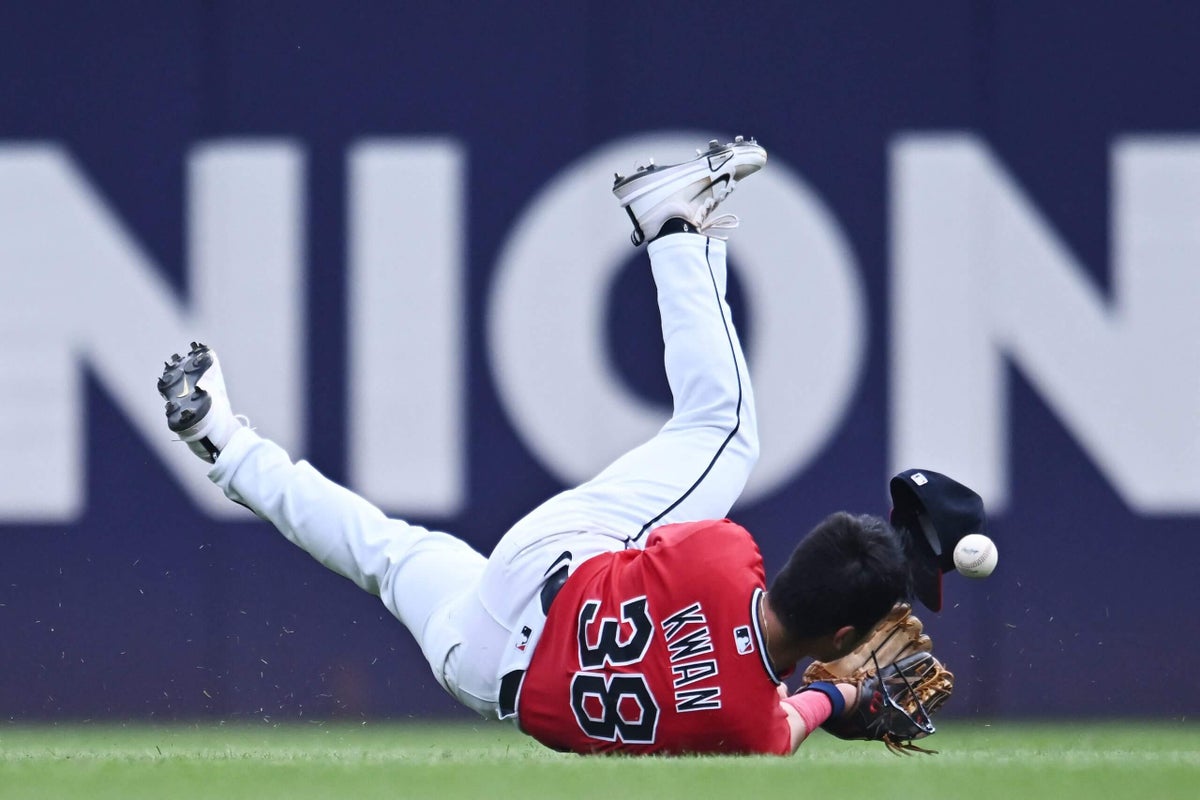
Welcome to the backward world of the American League, where a first-place team fired its general manager, the reigning pennant winners are in fifth place, a team in the thick of the playoff hunt traded away its Cy Young-winning ace, and the Cleveland Guardians are once again acting as agents of chaos.
In a year the gap between the National League and American League feels wider than ever, the possibility of at least one sub-.500 team making the playoffs looms large. This has never happened in a non-shortened season, an indictment of the AL’s quality but also of the expanded playoff and altered schedule that has helped create a jumbled mess on the junior circuit.
The irony in all of that? The weakest teams in the playoff hunt may have the best path to postseason success. The league could be careening toward a potential postseason crisis: a bracket in which qualifying with a worse seed is obviously preferable — a world where the relatively strong New York Yankees, Tampa Bay Rays and Boston Red Sox must fight one another to advance, while whoever survives among the Chicago White Sox, Houston Astros, Guardians or another barely-.500 team limps its way into the American League Championship Series.
“The American League has been interesting, to say the least, this year,” Guardians manager Stephen Vogt said.
The league is filled with teams that have underachieved (Detroit Tigers, Toronto Blue Jays) and others that seem caught in identity crises (Houston Astros, Texas Rangers, Baltimore Orioles).
Perhaps no team has been more frustrating than the Seattle Mariners, who were one win away from reaching the World Series last season and returned a loaded rotation, plus positional star power in Julio Rodríguez and Cal Raleigh. In August, though, the Mariners went 11-16. They lost a game in part because of a bizarre play on which a pitcher did not apply a tag at home plate after a wild pitch. They also got thumped by scores of 11-0, 22-0 and 19-2.
The Mariners’ woes have put manager Dan Wilson on the hot seat and cast more ire toward president of baseball operations Jerry Dipoto. Dipoto happens to be the man who uttered one of the most infamous quotes from baseball’s executive class in recent years, the “54 percent” comment that has been the subject of so much scorn.
“If you go back and you look, in a decade those teams that win 54 percent of the time always wind up in the postseason,” Dipoto said in 2023. “And they more often than not wind up in the World Series. So, there’s your bigger-picture process. Nobody wants to hear the goal this year is, ‘We’re going to win 54 percent of the time.’ … But over time, that type of mindset gets you there.”
The comment once served as a reflection on a deeper issue in the sport. A perception exists that some teams are not trying to win as many games as possible each year. Rather, efficiency has become their god. Clubs could game the system, limit their spending and do the bare minimum needed to get into the postseason.
A couple of years later? Well, a .540 winning percentage would look good on the Mariners, who sit eight games below .500. It would also represent an upgrade for all but three teams — the Rays, Yankees and Red Sox — in the American League. Only Tampa and New York are on pace to win 88 or more games.
So as we enter the season’s stretch run, the dismal state of the AL has created a sluggish hunt in which teams are hopping in a sack race toward the finish line.
Some of this feels like a referendum on the league’s divisional structure. Particularly in the Central and West divisions, there is no spending behemoth upping the ante for the rest of the division. With the resurgence of the Orioles and Blue Jays, the last-place team in the AL East might end the season with a better record than the winner of the AL West.
MLB’s move to an expanded playoff in 2022, paired with the expansion of interleague play, partly created this conundrum. Rather than spurring action because more teams are in the race, clubs have acted more cautiously. The bar for a playoff berth is lower. Fifty-four percent will do just fine.
Because the teams elbowing for playoff spots are playing each other only on occasion, the number of interleague games creates the possibility of a sub-.500 team making the playoffs. The AL is 45 games under .500 against the NL this season.
Everyone wants to play in October. But the possibility of a losing team in the postseason raises a pertinent question: If you get into the playoffs with a sub-.500 record, does it still feel like an accomplishment?
“We would not apologize,” Guardians president of baseball operations Chris Antonetti said.
If the American League playoffs started today, the top three records in the league would all reside on one half of the bracket, with the Rays awaiting the winner of a wild-card series between the Yankees and Red Sox.
On the other side, the Chicago White Sox (who only two years ago lost a modern-record 121 games) would receive a bye to face the winner between the Astros (72-69) and the Guardians (70-70).
It could look even worse by the end of the season. FanGraphs currently projects Chicago to win the Central with 84 wins, Cleveland to claim the final wild card with 82 and Houston to win the West with 82. Those would be three of the six worst records to ever qualify for the postseason in a full season; one would be guaranteed a spot in the ALCS.
“In terms of the wins and losses, the group competing for that last wild card is different than it’s been historically,” Antonetti said. “But in terms of how it feels, I’m not sure it feels that different to us.”
It all presents an interesting quandary: Might some team benefit from losing more games down the stretch? It has happened before in other sports.
For nearly three decades, the NHL used the same four-team format. The top seed would meet the third seed. The second seed battled the fourth seed.
In 1971, the Chicago Black Hawks finished 20 points ahead of the second-place St. Louis Blues. For a team like that season’s Minnesota North Stars, finishing fourth instead of third — and earning about $2,000 more for each player by beating the Blues in the first round — would have been preferable.
And so a North Stars team that hadn’t lost more than two games in a row all season dropped the final four games of the season — three to teams out of playoff contention, the last to the Philadelphia Flyers at The Spectrum that final Saturday.
The plan worked: No. 1 seed Chicago swept No. 3 Philadelphia in the first round of the playoffs, while No. 4 seed Minnesota upset No. 2 St. Louis before bowing out in the next round to Montréal. Every North Star got an extra $2,000 for that effort.
The next season, the bracket was changed: No. 1 would play No. 4 and No. 2 would play No. 3.
Just as in 1971’s NHL, getting the last wild card is preferable to getting one above it. That’s how it’s played out in the first four years of MLB’s current playoff format: Teams seeded sixth have won 10 playoff series — more than every other seed except No. 1.
The teams ostensibly harmed by this format say they can’t waste time thinking about any potential inequities at this stage.
There is money tied to this format through playoff broadcasts, and any change would have to be collectively bargained between the league and MLBPA.
“I don’t like to get too far ahead,” Red Sox interim manager Chad Tracy said this week when asked about the potential dilemma. “I like to focus on what the task at hand is. Like, win games. When you get closer to (the playoffs), you can start dealing with it.”
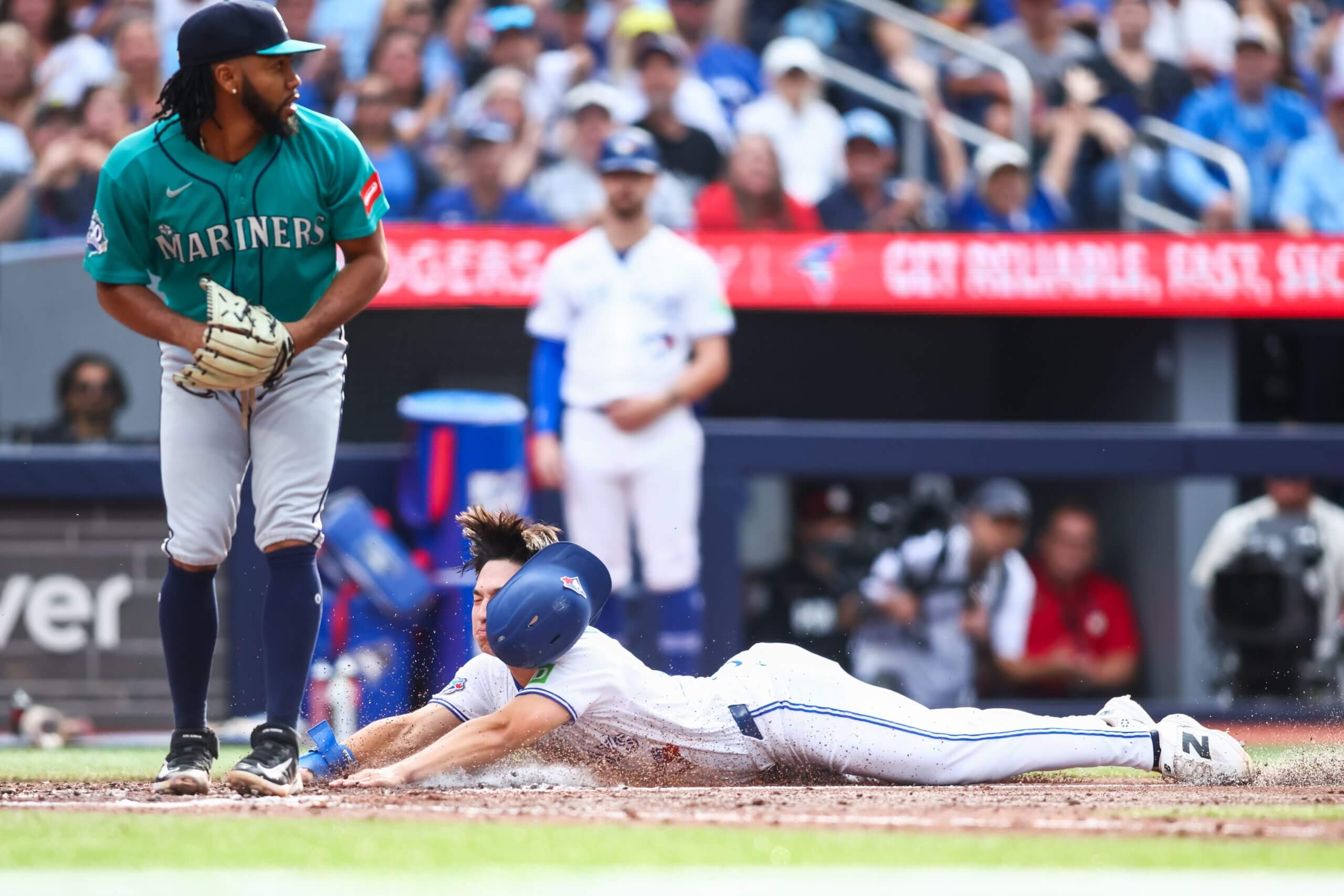
Brett Bateman of the Toronto Blue Jays scores on a wild pitch against the Seattle Mariners. These disappointing teams met in the ALCS last year. (Cole Burston / Getty Images)
With so many clubs still in the mix, even scoreboard watching can induce a headache. Before play Thursday, there were still six AL teams within six games of the final playoff spot.
“There’s a lot of moving parts, with a lot of different teams,” Blue Jays manager John Schneider said. “Half the time I look up (at the scoreboard), and I’m like, ‘I don’t really know about that one, but that one’s good.’”
This season has featured so many oddities. The Houston Astros led the AL West with a 65-66 record the day they fired general manager Dana Brown. Despite an aging roster, a barren farm system and a minus-38 run differential, the Astros remain in position for their 10th playoff berth in 12 years. In the 60-game 2020 season, Houston made the playoffs with a 29-31 record.
“Outside of that, I’ve never been in a season where so many teams are in competition,” manager Joe Espada said. “You win five, six games in a row and you can separate yourself and that could be the difference. It’s strange, I think, but the way we’re looking at it is we just have to take care of our business.”
The Detroit Tigers were only 2 1/2 games out of a playoff spot the night they traded ace Tarik Skubal to the Los Angeles Dodgers. But injuries, sloppy play and a leaky bullpen had cast serious doubts about the team’s World Series hopes. So the Tigers traded their best player and kept a few other veterans, leaving one eye on winning. Shortly after the trade deadline, Tigers closer Kenley Jansen leaned back in his chair and talked about reasons for hope.
“I’ll be honest,” Jansen said. “The American League is not that great this year. Everything is wide open.”
The Tigers lost 13 of 16 to close out August, falling closer to the league’s basement than its ceiling. Despite being one of only five AL teams with a positive run differential (plus-47), Detroit’s playoff odds are down to 0.8 percent.
Meanwhile, the Orioles traded Adley Rutschman to the Red Sox, seemingly signaling a desire to reshape an underachieving roster. Yet here they stand, only one game out of a wild-card berth.
Those same Red Sox who acquired Rutschman fired manager Alex Cora in April before going on to a torrid summer under Tracy as interim manager. They’re still looking up at a Rays team with the American League’s second-highest groundball rate but also the best OPS.
So why is this year so strange? And what does it say about the state of the game?
“I get into these debates with my buddies,” Tigers manager A.J. Hinch said.
In Hinch’s view, many American League teams present more difficult matchups than their records might suggest. The Mariners and Rangers boast formidable starting pitching. Despite an offense that ranks No. 28 in runs, the Guardians remain a thorn in everyone’s side.
But there’s no denying the entire league is operating within an abnormal existence.
“It’s been a weird year,” Hinch said. “When you look at the West or the Central, it’s been a weird year. The East in its own right is always a beast.”
In 2023, the fifth-seeded Rangers and sixth-seeded Diamondbacks met in the World Series, raising early questions about the competitive consequences of the expanded playoffs.
“If the die was cast — meaning, that if I win 100 in the regular season, I’m going to win the World Series — I don’t think that’s as interesting as what we have witnessed over the last month,” MLB commissioner Rob Manfred said in 2023.
Even if the chance of reverting to a slimmer postseason field is unlikely, perhaps the schedule could be altered or some other solution could arise in negotiations this coming winter.
Or maybe this is simply the game’s new reality, an American League where nothing makes sense, and where winning games is hardly a prerequisite for playing in October.
“I think once the dust settles and teams go back to 0-0, you’re going to find that the American League has some pretty difficult teams to beat,” Hinch said.
— Chad Jennings contributed to this report.