
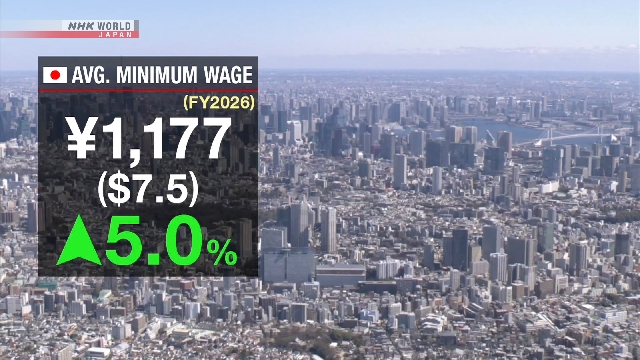
Japan’s average hourly minimum wage for fiscal 2026 has marked its second-highest hike in history, reflecting rising commodity prices. All 47 prefectures have raised their minimum wage levels.
The national average hourly minimum wage will be 1,177 yen, or about 7.5 dollars, starting next month. That’s up 56 yen, or 5 percent, and slightly above the benchmark the government panel suggested.
Surging commodity prices, correcting regional disparities and a sense of crisis regarding population outflow are believed to be among the factors pushing up minimum wages.
But inflation, driven by surging food prices and a weaker yen, is outpacing pay raises. Inflation-adjusted real wages have fallen for four straight years since 2022.
Professor Yamada Hisashi, Hosei University’s Graduate School of Business Administration says Japan’s minimum wage levels are low by international standards.
He said: “Wages have yet to rise compared to price increases. It is necessary to raise wages in order to secure human resources amid a labor shortage. “
He added that this is a necessary cost. The government should also keep up its efforts to convince employers of this fact.