
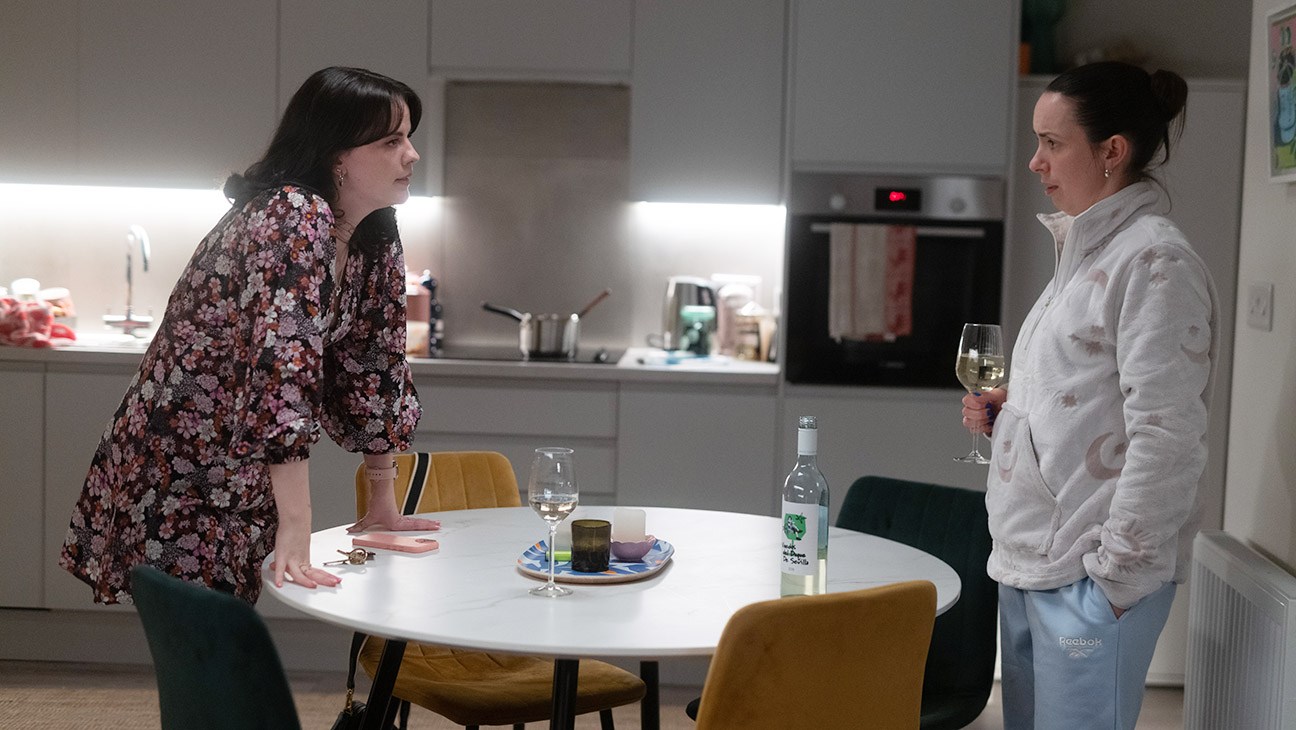
A drama dotted with laughs (or a comedy blotted with pain?) in which everyday problems are confronted, and avoided, over steaming cuppas and brimming glasses of white wine, Tender Loving Care explores friendship, family dynamics and England’s fraying social safety net. In other words, it’s a Mike Leigh film, and a lovely one at that.
If it ends up being his last, as the 83-year-old writer-director has indicated, it’s a fitting and stealthily powerful way to go out — a low-key mic drop of sorts. The movie is warm and inviting, filled with giggles and gossip and gentle gallows humor; it’s also wrenching, with a topical urgency simmering just beneath the jovial surface. While Leigh’s left-wing politics inform the story, the filmmaker, unlike his contemporary Ken Loach, mostly avoids playing ventriloquist; the chit-chatting, chortling, sobbing, seething souls who populate his work tend to be too complicated, too insistently human to serve as mere spokespeople for their creator’s ideas.
Tender Loving Care
The Bottom Line
A lovely addition — and likely conclusion — to an exceptional career.
Venue: Telluride Film Festival
Cast: Marion Bailey, Paul Jesson, Kate O’Flynn, Alice Bailey Johnson
Director-screenwriter: Mike Leigh
1 hour 47 minutes
In Tender Loving Care, those ideas concern compassion, solidarity and support — what it means to look out for one another at this (angry, angering) point in history, specifically in a country whose public services have been eroded by an ethos of self-reliance codified by Thatcher and further cemented, or perverted, by Brexit. As is often the case in Leigh’s films, the thematic framework is conspicuous; characters, on occasion, turn subtext into text, delivering mini-disquisitions on the failures of the state and the isolation of urban life today.
Those statements might register as distractingly didactic if they didn’t sound wholly believable coming out of these particular people’s mouths; two of the four central figures, childhood BFFs Amy (Kate O’Flynn, Widow’s Bay scene-stealer) and Rosie (Alice Bailey Johnson), are overextended, underappreciated social workers — and seasoned compartmentalizers, lest the despondency they witness daily on the job pull them under.
Amy and Rosie, as well as Amy’s kindly parents Birdie (Marion Bailey, Leigh’s longtime partner) and Geoff (Paul Jesson), arrive onscreen fully formed, alive with personal and relational histories we can intuit beyond what’s in the frame. If it feels like we’ve known these folks forever — from Amy and Rosie’s mutual hype sessions to Birdie and Geoff’s puttering and banter — that’s a credit to Leigh’s legendary rehearsal process, during which he and his actors build the characters from scratch through weeks of improvisation and discussion.
Nothing and everything happens over the course of Tender Loving Care. Unceremoniously dumped by a boyfriend who’s gone back to his wife and child, Amy moves in with single-and-mingling Rosie. Birdie frets about Amy’s romantic and reproductive prospects, though she and Geoff console themselves with their certainty that she’s better off sans her ex. Amy and Rosie endure stressful days on the job (Amy works mainly with children, Rosie with the elderly), retreating to their flat in the evenings to swap horror stories or decompress over girl talk, dance-offs and other bursts of booze-infused silliness. Geoff’s health takes a sudden turn for the worse.
The tone here is mellower, the pitch less heightened than in Leigh’s more volatile domestic tragicomedies, like Secrets & Lies and Life Is Sweet, to say nothing of the bludgeoning All or Nothing. That’s in large part a reflection of the new film’s main quartet, who sit at the opposite end of the temperamental spectrum from Pansy, the ferocious protagonist of Leigh’s previous effort, 2024’s Hard Truths. Amy, Rosie, Birdie and Geoff are indeed among the most amiable characters Leigh has ever created, their darker feelings — loneliness, jealousy, rage, dread — tucked safely beneath chipper smiles and cheerful pleasantries.
But Leigh has never been one to flinch at life’s cruelties. The simplicity of Tender Loving Care’s narrative, the sweetness of the people it portrays, and the ticklish good vibes they generate belie a toughmindedness about both the private disappointments and the larger societal injustices that shake our respective worlds. When moments of anguish arrive — a neighbor’s tormented account of her husband’s funeral; a tirade by a paranoia-gripped hoarder Rosie is assigned to visit; a hard-drinking mother’s fury at the foster care system for which Amy is assessing her — they have a rawness and force that slice right through the movie’s congeniality.
The film is in direct conversation with Hard Truths, as well as Leigh standouts Another Year and Happy-Go-Lucky, in its consideration of what determines happiness — the degrees to which choice, disposition, luck and broader structural or socioeconomic forces play a part. Like so much of Leigh’s work, Tender Loving Care ponders how people of different circumstances and constitutions coexist: how we make each other feel and act, how our perception of each other’s lives shapes our perception of our own.
It’s also about how we proceed with the business of living amid hardships both mundane and momentous. Like Ozu, a clear influence, Leigh is one of the medium’s great observers of human behavior, from the small talk that drowns out the terror of our worst anxieties to the self-delusions that sustain us during our most vulnerable moments to the way we accept or refuse help — the latter sometimes misguidedly. “I can’t put it on them,” Amy tells Rosie, explaining her reluctance to let her parents know of her break-up. Like all the film’s principals, Amy is an expert practitioner of Britain’s famed stiff upper lip, but here she’s sparing Birdie and Geoff a burden they’re more than ready to share.
O’Flynn is an expressive marvel, her kooky lightheartedness periodically clouding over with a melancholy that cuts to the bone. The swirl of conflicting emotions that play out across Amy’s face as she gulps champagne while listening to her mother reminisce about her courtship with Geoff is astonishing — a piercing pantomime of the oft-cited notion that millennials are the first generation to have fewer opportunities than their parents.
Bailey Johnson, a casual charisma bomb, makes Rosie so radiant and grounded and fun that you may realize only late in the film — when she reveals she no longer speaks to her own mom and dad — that her generosity toward the other characters is more symbiotic than selfless. Rosie is the very definition of a ride-or-die, but she needs Amy and her family as much as they need her.
The beautifully synced Bailey and Jesson, meanwhile, offer a duet of endearments, confidences, worries and innocuous shit-talk, conjuring the ineffable mix of intimacy and distance that makes a long-term marriage. When the rhythm of their relationship is disrupted in the film’s second half, the effect is devastating.
Visually, Tender Loving Care is characterized by Leigh’s typical unfussiness, with Lucy Bristow taking over DP duties from frequent Leigh collaborator Dick Pope, who died in 2024. As usual, there’s mastery in how the filmmaker uses facial close-ups to add notes of tension, encouraging the viewer to locate truths undisclosed by the dialogue. Ditto in how he deploys a single overhead shot — serene but conspicuous — to foreshadow an unlucky swerve in the story.
A touching penultimate scene feels like a natural conclusion to this portrait of people devotedly closing ranks when crisis strikes. But Leigh doesn’t stop there, instead punctuating his film with a final image of uncommon bluntness and despair. At first impression, it seems an incongruously — if not unjustifiably — hopeless way to go out. Yet given the dogged humanism that is the throughline of Leigh’s extraordinary filmography, perhaps a less pessimistic reading is due: Leigh is ending his movie, possibly his career, with a plea for individuals to lift up those they know and love, of course, but also to fight for a society that lifts up those they don’t.