
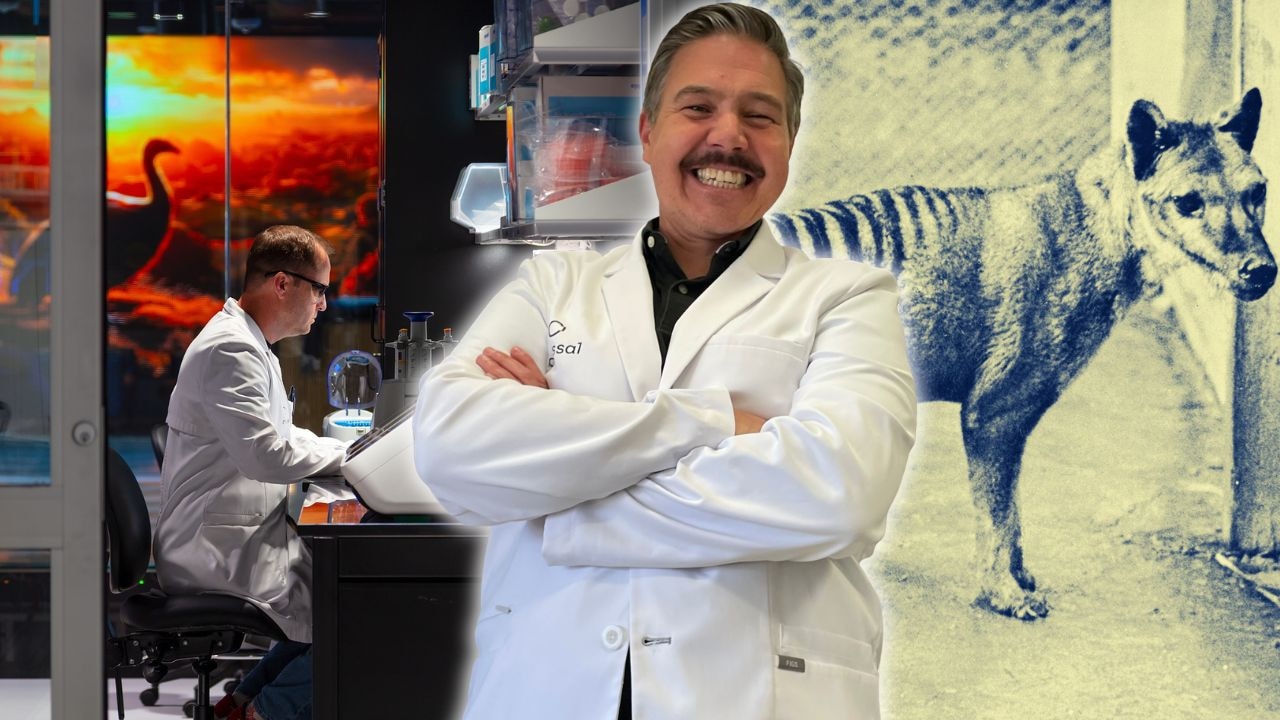
The grainy black and white footage of the last Tasmanian tiger pacing back and forth in a cage is seared into the collective memory of Australians as the heartbreaking final chapter of the creature hunted to extinction by humans.
Ninety years later in a plot reminiscent of a Jurassic Park film, Colossal Biosciences is working on an ambitious project to rewrite the thylacine’s sad fate and rebalance the ecosystem still suffering from the loss of the crucial apex predator.
In laboratories in Texas and Victoria, efforts are underway to bring the Tasmanian tiger back from the dead along with other extinct species like the woolly mammoth and the dodo.
After early success de-extincting the dire wolf, the Australian scientist leading the thylacine mission predicts Tasmanian tigers will be brought back from extinction and repopulated throughout the island state within our lifetime.
“We have all of the tools that we need to do it, it’s just doing it at a scale that hasn’t been done before,” Professor Andrew Pask said.
“It’s a matter of when we get there, but certainly not if. We will have it in our lifetime.”
MEET THE WOOLLY MOUSE
In a hi-tech laboratory on the outskirts of Dallas two impossibly fluffy red mice chase each other around a glass cage.
These tiny critters are paving the way for the return of the woolly mammoth – the tusked elephant-like creatures that weighed up to eight tonnes and roamed the cold tundras of Europe, North America and Asia until they went extinct 4000 years ago.
Scientists created them by modifying seven genes in ordinary short-haired grey lab mice to mimic the woolly mammoth’s coat and metabolic profile that allowed it to thrive in freezing Ice age conditions.
Ultimately the mammoth will be recreated by editing genes of the Asian Elephant which shares 99.6 per cent of their DNA.
Given the elephant’s endangered status and lengthy 22 month gestation, testing in mice with their 21-day gestation offers a more practical way to test early edits.
Colossal hopes to birth a woolly mammoth by the early 2030s using an Asian elephant as a surrogate, but they’re also working on an artificial womb as an alternative option to gestate species. It’s technology that could one day be used for humans.
Similarly, they’ve developed an artificial egg system to support the revival of the Dodo – the large flightless birds native to Mauritius that went extinct around 1680, and New Zealand’s giant moa bird that grew up to 3.6m tall.
EYE OF THE TIGER
Australia’s last Tasmanian tiger died in captivity at a Hobart Zoo on September 7, 1936.
The loss of the apex predator left a gap in the food chain that sparked an overpopulation of pests that overgraze bushland, and allowed the spread of disease in native species like the Tasmanian devil.
“It’s this incredibly unique marsupial mammal,” Prof Pask said.
“We brutally hunted the poor thing to extinction in a very short time frame.
“It was absolutely critical for maintaining that ecosystem in Tasmania. So we’ve thrown that whole balance off in that area.”
Colossal hopes to replicate the success of the reintroduction of grey wolves to Yellowstone National Park after they were eliminated by hunters.
Their reintroduction reversed decades of severe ecological damage, reducing overpopulation of species like elk which in turn stopped overgrazing, and promoted growth of plants like aspen and willow which in turn reduced erosion.
For 25 years, Prof Pask has dreamt of bringing back the thylacine.
“For a long time, nobody would give me any funding for thylacine extinction because I sounded like a lunatic,” he said.
“And then it was really when I met Colossal that this whole trajectory changed.”
Founded by tech billionaire Ben Lamm and renowned geneticist George Church, the company has attracted investment from the likes of the Hemsworth brothers and entered into a partnership with Leonardo DiCaprio’s Re:wild conservation group.
Prof Pask splits his time between Colossal’s Texas headquarters and its first international research lab that opened at the University of Melbourne last year.
To bring back the thylacine, scientists are editing the genes of its closest living relatives – the tiny mouselike fat-tailed dunnart. The first edits focus on reshaping the mouse skull to make it more like a wolf, and then scaling the overall size to more closely resemble the much larger tiger.
“On our current timeline, hopefully within five to 10 years we’ll have a thylacine that will be born,” Prof Pask said.
“Then it’ll probably take about the same – five to 10 years of really intensively studying that animal in the landscape in Tasmania in fenced areas of progressively larger enclosures to make sure it’s having this really positive impact on the environment before we would think about releasing it across the entire island.”
ENDANGERED AUSTRALIA
Australia holds the unenviable title of the world’s highest mammal extinction rate and has the sixth most species listed as endangered and critically endangered.
Beyond the thylacine project, scientists are using gene-editing technology to save other species like the northern quoll which has suffered a dramatic population decline caused by cane toads.
Researchers can edit a single letter of code in the quoll genome to make them completely resistant to the toad poison killing them off.
Similarly with the Tasmanian devil, Colossal scientists are working with the University of Tasmania to help save the endangered creature whose population has been ravaged by a contagious facial cancer.
With gene-editing and vaccine testing, they hope to ultimately eradicate the cancer from the Tasmanian devil population and allow it to thrive again.
JURASSIC PARK
Colossal burst onto the international stage last year, announcing on the cover of Time Magazine that it had de-extincted dire wolves – a species that disappeared 10,000 years ago and became famous for their depiction in the fantasy series of Game of Thrones.
It ignited intense debate over the ethics of de-extinction science and whether the gene editing of modern grey wolves could truly be classed as dire wolves.
“We love the haters because you learn more from them…,” Colossal founder Mr Lamm said, noting critics had fuelled many of the company’s initiatives, including working groups with the communities that would be most impacted by the reintroduction of species.
In Tasmania, Colossal regularly consults with an advisory committee of stakeholders including residents, Indigenous leaders and conservationists to gauge the desire for the thylacine’s return and work through red tape.
It’s hard not to walk through the futuristic laboratory in Texas without drawing comparisons to the classic Jurassic Park franchise in which scientists de-extinct dinosaurs that in each film, inevitably escape their enclosures and hunt humans.
“When we launched we said nope don’t bring up Jurassic Park and now we really lean into,” Chief animal officer Matt James said.
“Everything we do in de-extinction has to start with the why – why is this species important, why do you need to do this, why should we pursue this project?
“If your why is to have giant scaly lizards that millionaires can come see on your Costa Rican island, maybe don’t do it,” he said in reference to the Jurassic Park plot.
“If your why is to protect nature and conservation, then definitely pursue it.”