
KeysQuestions4Explore4
A small British company just hired one of the world’s biggest oilfield contractors to drill into 280-million-year-old Cornish granite — not for oil, but for lithium dissolved in underground water, and the gap between what they found in 2023 and what a nearby well pulled up changes everything about whether this project makes sense.
That neighboring well logged over 340 parts per million of lithium — more than triple what Cornish Lithium’s own borehole returned — and in brine extraction, that difference isn’t a footnote, it’s the entire business case.
If the deeper water turns out richer, this no-pit, no-evaporation-pond extraction method could quietly reshape where Europe sources one of the most critical materials in every EV battery you’re considering buying.
Ask The Box →
Ask The Box:
SummarizeContextWhat does it mean?Related
Energy
A 22-micrometer strip of nickel-titanium shortens on its own when a 266-degree plate warms it, and it yanks a second strip that snaps back 4 degrees colder than the room. The cooler built around the pair has no motor in it and moves 2.79 milliwatts
2 hours
Energy
Britain is dropping 14 modules of 17.6 tons apiece and a 60.6-ton gantry crane into the building that replaces the filter cleaning its most hazardous nuclear site, now three quarters built — the old one was designed for 25 years, has run 41, and nothing takes over until 2030
19 hours
Energy
A 62,900-ton bulk carrier crossed 8,500 nautical miles from Singapore to Ghana on 24 percent less oil, after a hydrogen rig went on in two weeks with the ship still floating and nothing in the hull or the engine touched
22 hours
Energy
A well 19,448 feet long, drilled straight down into Utah and then turned sideways for 7,500 feet of it, is pushing water into rock at 460 degrees and taking it back out at more than 400, on rigs and pumping spreads that came out of the oil patch. There is no oil under it
24 hours
AI-generated summary from reviews, comparisons and articles by AutoNotion
Say the word Halliburton and most people picture Texas, fracking, and a couple of decades of political arguments. The company has been drilling wells since 1919 and booked $22.2 billion in revenue last year doing it. So it got my attention when a small British mineral company said on August 25 that it had hired Halliburton to sink two holes into Cornwall.
Nobody down there is looking for oil.
So what are they drilling for?
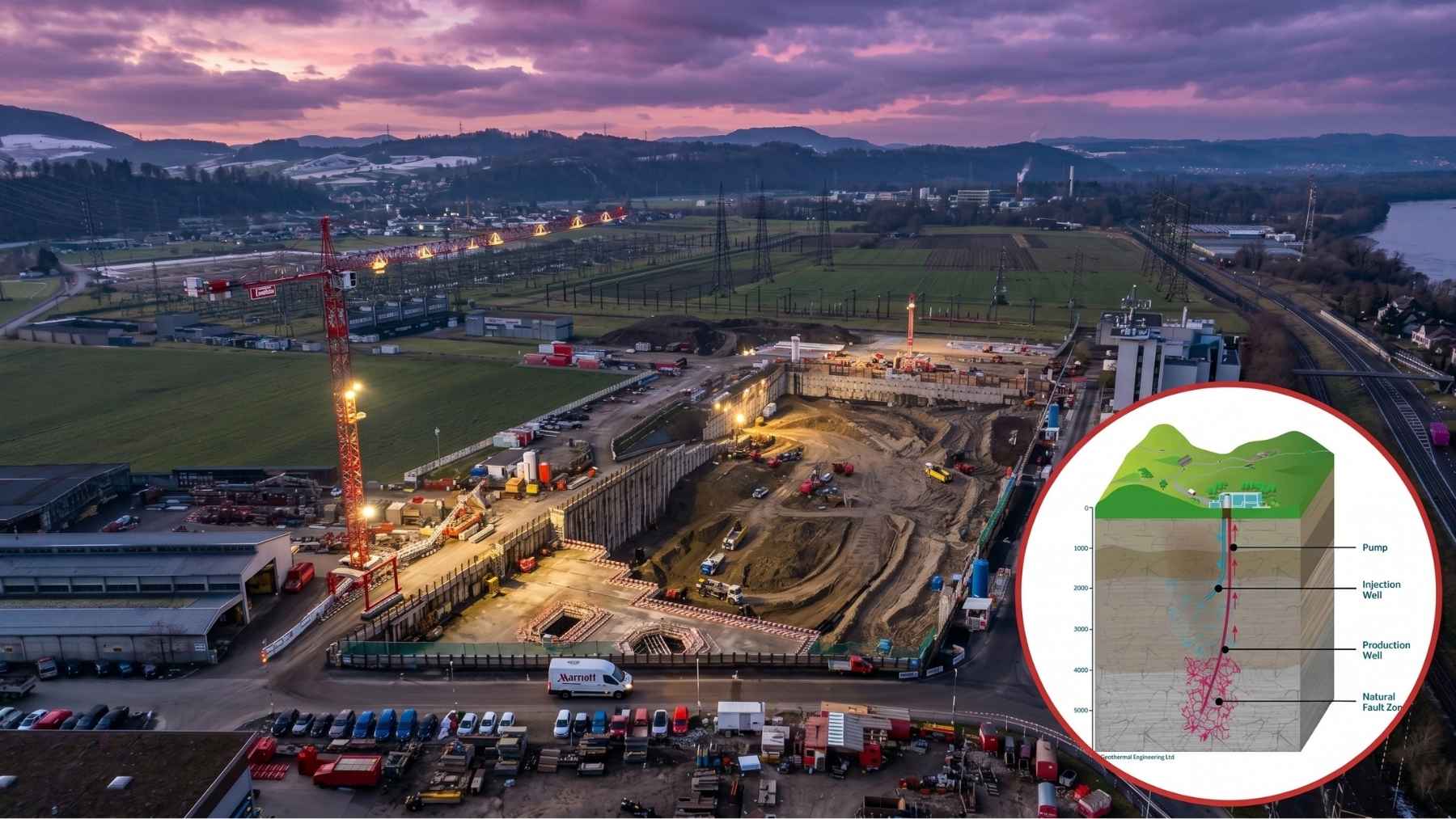
Cornish Lithium wants to know how much lithium is dissolved in the hot water circulating under its Cross Lanes site, near Chacewater in the far southwest of England. The plan is two wells of roughly 6,560 feet (2,000 meters), drilled from a single pad. One pulls brine to the surface. The other puts it back.
The rock down there is the Cornubian Batholith, a slab of granite that formed around 280 million years ago and runs under most of Cornwall and Devon. Water circulating through its fractures picks up lithium on the way. Nobody is proposing to dig any of it out.
The process everybody keeps calling DLE, or direct lithium extraction, works like this. Brine comes up the well, passes through a sorbent material that grabs lithium ions and lets the rest of the water through, and the stripped water goes back down the second hole. No open pit. No turquoise evaporation ponds baking in the sun for a year and a half. Cornish Lithium will run a modular demonstration plant on site to show its chosen version of the process holds up at something close to real scale.
Under the contract, Halliburton handles subsurface modeling, well engineering, and the equipment and services to drill and test both wells.
How much lithium is actually down there?
That is the whole point of the exercise, and the honest answer today is that nobody knows. Cornish Lithium drilled an exploration borehole at Cross Lanes back in 2023, took it to about 2 km, and found water at 158°F (70°C) carrying lithium at 100 parts per million. The company called that promising. I would call it thin, and the readings from the neighbors are the reason why.
At United Downs, also in Cornwall, Geothermal Engineering Ltd measured over 340 parts per million in its own deep water, which GEL says is among the highest recorded in any well drilled anywhere. In Arkansas, Standard Lithium’s South West Arkansas project models an average of 481 milligrams per liter. Cross Lanes came in at 100 ppm.
Autonoción Newsletter
No spam. Unsubscribe anytime. Privacy policy (opens in new window)
Grade drives everything in brine chemistry. Weaker water means you pump and process more of it for the same ton of lithium, and that shows up in the power bill, the size of the plant, and eventually the price you can sell at. Two commercial-scale wells and a three-month flow test are how Cornish Lithium finds out whether the deeper water is richer than that first hole suggested. The 2023 borehole is one data point from one depth in one spot, and you cannot build a business on it.
WELL DEPTH
6,560 FT
Target for each of the two wells (2,000 meters), drilled from one pad.
MEASURED IN 2023
100 PPM
Lithium in the Cross Lanes exploration borehole, at 158°F (70°C).
RUNNING
NEXT DOOR
99.3%
Purity of the lithium carbonate GEL is now producing at United Downs.
DRILLING BUDGET
$19.6M
£14.5 million program, half of it a UK government grant, half matched.
Cornwall is already selling the stuff
On September 2, Geothermal Engineering announced that independent analysis put the lithium carbonate coming off its United Downs plant above 99.3% purity. That is what the trade calls technical grade, it clears the purity spec battery producers ask for, and it means GEL can sell the material without paying anyone else to refine it first. Skipping that step is a real saving, given that Britain is still building its first big lithium refinery on the Tees. GEL puts the reference price at roughly $22,000 per metric ton as of August 20, citing the Shanghai Metals Market.
The plant is tiny. It has been running since February and makes 100 metric tons a year, which at that price comes to roughly $2.2 million of product annually. GEL’s own forecast is about 2,000 metric tons a year at United Downs by 2029, and 30,000 across all its sites by 2033, against a UK government target of at least 50,000 tons of domestically produced lithium carbonate by 2035.
We covered United Downs in June, when GEL’s 3.3-mile well was pulling up water hotter than 374°F and spinning a turbine for about 10,000 homes. The lithium in that water was a bonus nobody designed for. Cornish Lithium is now trying to do the reverse: design the lithium in from the start, on its own patch of the same granite.
Why hire an oilfield company?
Because a geothermal lithium well is an oil well with a different product at the bottom. You still need subsurface modeling, well engineering, casing, a rig, and people who can flow-test a hole for weeks without wrecking the reservoir. That is the day job at any oilfield services company, and it is the reason this contract went to Houston rather than to a mining contractor.
Halliburton’s senior vice president for Europe, Eurasia and Sub-Saharan Africa, Jean-Marc Lopez, pointed to more than 70 years of company experience in geothermal and said his teams would run the program “safely and efficiently”. Martin Geissler, who runs lithium in geothermal waters for Cornish Lithium, said Halliburton’s people were proactive through the tender, according to the announcement carried by Global Mining Review.
You see the same crossover in the US. The Smackover Formation under Arkansas and East Texas is being opened up with the same brine-and-well toolkit, by companies whose grandparents drilled for crude. Germany is pulling lithium out of a gas field it has been producing since 1969. Everyone has worked out that the cheapest hole is the one somebody already knows how to drill.
Arkansas is well ahead of this
On August 31, Smackover Lithium, a partnership between Standard Lithium and Equinor, signed a binding take-or-pay agreement to supply LG Energy Solution with 8,000 metric tons of battery-quality lithium carbonate a year for a decade. That follows a similar deal with Trafigura in March. The partnership is targeting a final investment decision this year, with first commercial production in 2029.
Arkansas has customers locked in for lithium that does not exist yet, from brine it has already characterized in detail. Cornwall is two wells away from knowing what it has to sell. If you want a single sentence on why the Halliburton contract matters, that is it: the drilling is the part that turns a resource everyone suspects is there into a number a bank will lend against.
The rig has not spudded yet
The drilling and testing program costs £14.5 million, about $19.6 million. Half of that is a £7.2 million ($9.7 million) grant from DRIVE35, the UK government’s automotive program run with the Advanced Propulsion Centre and Innovate UK, and Cornish Lithium matches it pound for pound. Cornwall Council cleared the first phase in 2025. A local firm, WH Bond & Sons, built the access roads and the concrete rig pad early this year, and specialist contractor SCLT finished lining the water lagoon in May, which was the last piece of infrastructure needed before a rig could show up.
Cornish Lithium’s own project page still says the wells will be drilled in summer 2026, and the well services contract went out on August 25. The company has not named a start date for drilling, which is a slightly odd thing to leave out of an announcement about drilling. Three months of testing follow once both wells are down, and that data feeds the final investment decision. There is no FID yet, and there will not be one until the water has been pumped and measured.
If the water tests richer than that first hole, the plan is a network of modular geothermal lithium hubs across the county, with geothermal heat for local homes and businesses as a second revenue line. If it does not, Cross Lanes stays a very expensive science experiment near Truro.
At United Downs, GEL confirmed on September 2 that its carbonate cleared 99.3% purity, out of water in the same granite. Cornish Lithium is drilling to find out whether its own water is worth the same trouble.