
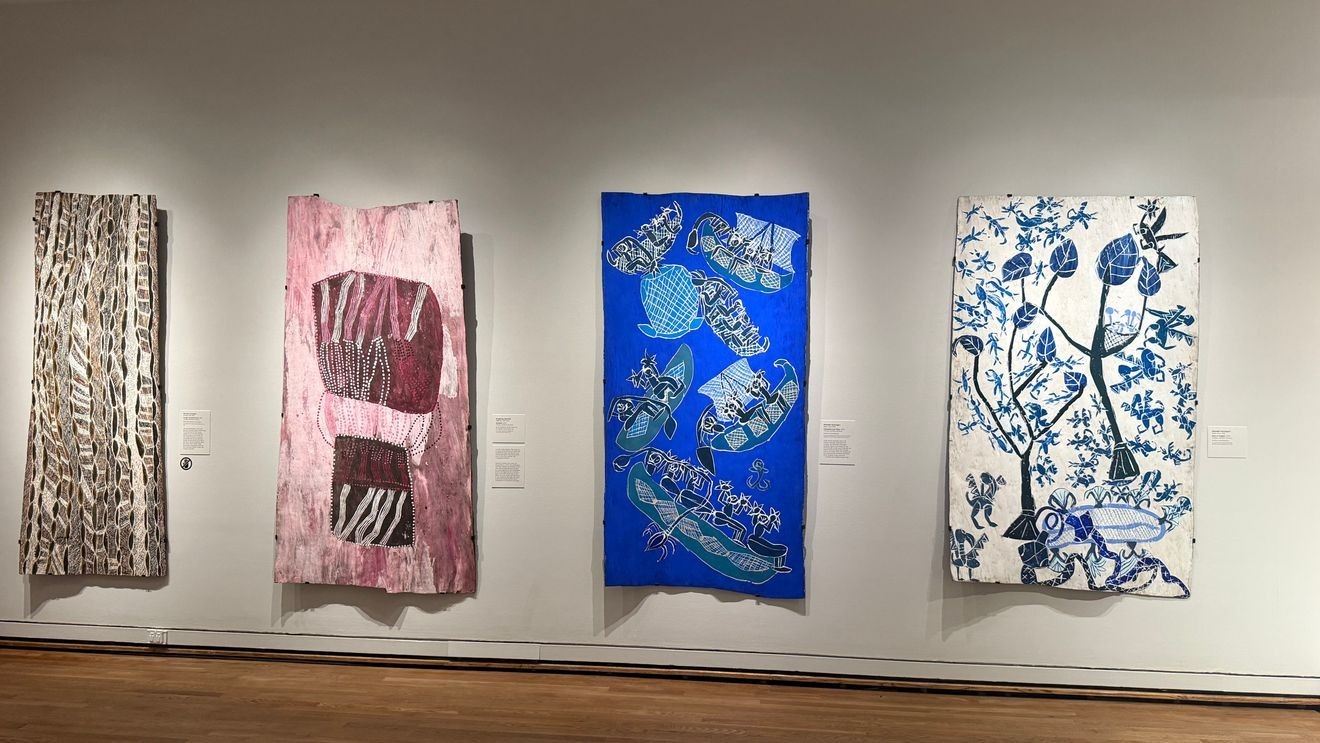
PORTLAND, Ore. (KATU) — The largest exhibition of Aboriginal and Torres Strait Islander art ever presented in North America is coming to Portland this fall, bringing 147 works by more than 100 Indigenous Australian artists to the Portland Art Museum.
The Stars We Do Not See: Australian Indigenous Art will open today, Sept. 5 at the Portland Art Museum and run through Jan. 3, 2027.
The show is the only West Coast presentation of the exhibition, which was organized by the National Gallery of Victoria in Melbourne and the National Gallery of Art in Washington, D.C.
The exhibition is the outcome of a cultural partnership between the National Gallery of Art and the National Gallery of Victoria that will facilitate the global exchange of artworks from the NGV’s permanent collection. Bank of America is the North America tour sponsor.
Organized by the NGV especially for North American audiences, the exhibition draws exclusively from the NGV’s collection and spans pivotal moments in Indigenous Australian art from the late 19th century to the present. The Portland Art Museum said its presentation is designed as a “captivating and multi-layered experience for visitors of all ages,” introducing audiences to Indigenous Australian artists connected to what the museum described as the world’s oldest continuous living culture.
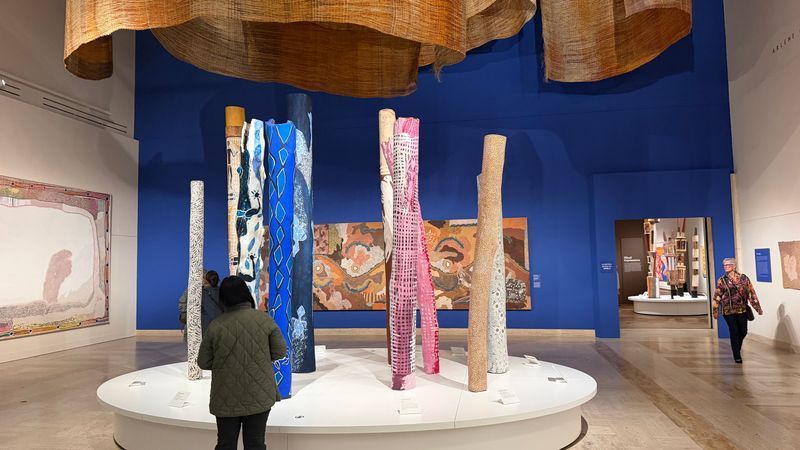
The largest exhibition of Aboriginal and Torres Strait Islander art ever presented in North America is coming to Portland this fall, bringing 147 works by more than 100 Indigenous Australian artists to the Portland Art Museum/Photo via Portland Art Museum
“We’ve been working for years to bring this exhibition to Portland, so it’s deeply rewarding to finally share it with our community,” said Don Urquhart, co-interim director of the Portland Art Museum. “These paintings and sculptures have traveled across the globe to be here, giving our audiences a rare opportunity to experience the depth and vitality of Indigenous Australian art and culture. It’s also simply beautiful—enormous, vibrant, powerful works of art that I know visitors are going to love experiencing in person.”
Kathleen Ash-Milby, the museum’s senior curator of Native American art, said visitors may be surprised by the range of work included.
“I think our visitors are going to be surprised by what they learn about the diversity and range of the work by the artists included in this exhibition, from the depth of emotion and history to the sophisticated use of color and abstraction. The exhibition is a contemporary art exhibition but rooted in thousands of years of culture and expression,” Ash-Milby said.
The museum said the Bank of America generously supported the exhibition’s North America tour.
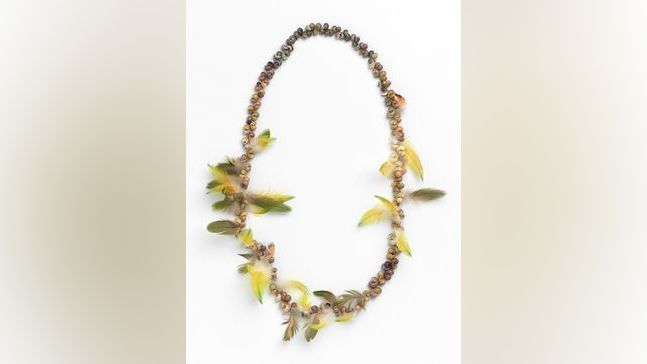
Rose Mamuniny Gurruwiwi. Gälpu born 1944. Mani Mani (Necklace) 1993, welirr (shells), butju (feathers), nylon thread. 30.5 × 21.0 × 5.0 cm (variable). National Gallery of Victoria, Melbourne . Purchased through The Art Foundation of Victoria with the assistance of the Alcoa Foundation, Governor, 1994 (O.168-1994). © Mamuniny 2/ Copyright Agency, 2024. Photo: Heath Warwick / NGV
Marc Compton, Oregon and Southwest Washington president for Bank of America, said the company’s support is intended to broaden access to the arts. “At Bank of America, we know the arts play a vital role in building stronger, more connected communities by creating opportunities for learning, dialogue, and shared appreciation,” Compton said.
“By supporting the North American tour of this landmark exhibition, we hope this rare opportunity for Portland Art Museum visitors to experience the astonishing breadth of modern and contemporary Australian Indigenous art will leave them inspired.”
The exhibition includes conceptual map paintings of the Central and Western Deserts, ochre bark paintings and experimental weavings, along with works by new-media artists using neon, video and photography.
Among the highlights never shown in North America is Emily Kam Kngwarray’s Anwerlarr Anganenty (Big Yam Dreaming) (1995), a monumental painting measuring more than nine by 27 feet that represents an underground network of roots and yams.
The exhibition’s title is inspired by the late senior Yolu artist Gulumbu Yunupiu (1943–2012), known as “Star Lady.” Her works use crosses to represent visible stars and a dense network of dots to symbolize stars that cannot be seen.
Urban-based contemporary artists working in new media are represented throughout the show, with works by Brook Andrew, Richard Bell, Reko Rennie and Maree Clarke.
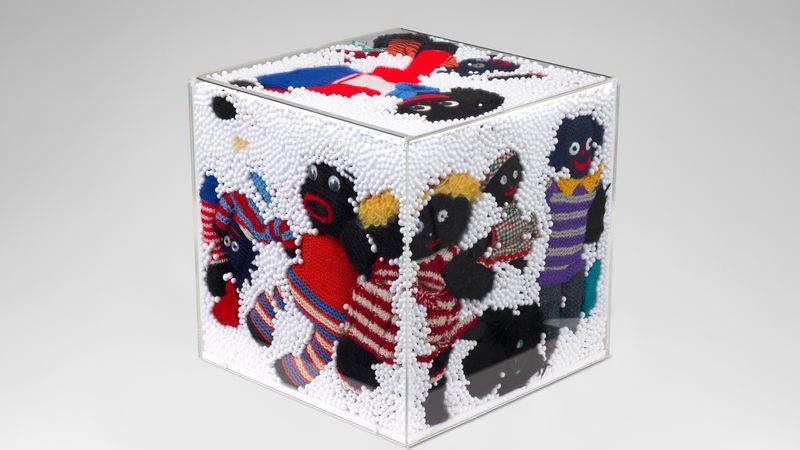
Destiny Deacon. Kuku/Erub/Mer 1957–2024. Snow Storm 2005, dolls, polystyrene, Perspex cube, 40.0 × 40.0 × 40.0 cm, National Gallery of Victoria, Melbourne. Purchased, Victorian Foundation for Living Australian Artists, 2019 (2019.840). © Destiny Deacon/Copyright Agency, 2024. Photo: Christian Markel / NGV
The exhibition also includes Christian Thompson’s Burdi Burdi (Fire Fire) (2021), a four-channel sound installation, and Destiny Deacon’s Snow Storm (2005), which explores how Aboriginal material culture has historically been presented in clinical, museological environments.
The museum said interpretation will focus on making Indigenous knowledges and ideas accessible, including helping visitors understand how what may appear to Western audiences as abstract patterns can function as complex visual maps layered with cultural knowledge, stories and law. The Portland presentation will also include several artwork tactiles placed alongside featured pieces, originally utilized in the Denver Art Museum installation.
A series of public programs is scheduled to begin later this month
On Sept. 27 at 2 p.m., the museum will host an opening public conversation featuring Dr. Jessica Clark, the National Gallery of Victoria’s senior curator of First Nations art, and exhibiting artist Ricky Maynard, moderated by Ash-Milby. A patron and donor reception is planned for Monday, Sept. 28, followed by an Evening for Educators on Sept. 29 from 5:15 to 7:30 p.m.
Additional programming includes film and facilitated conversation. On Free First Thursday, Oct. 1, the Whitsell Auditorium in collaboration with PAM CUT will screen films exploring Indigenous Australian experience and contemporary storytelling, including The Drover’s Wife (2021). The museum will also offer Look With Me sessions on Free First Thursday and select Sundays.
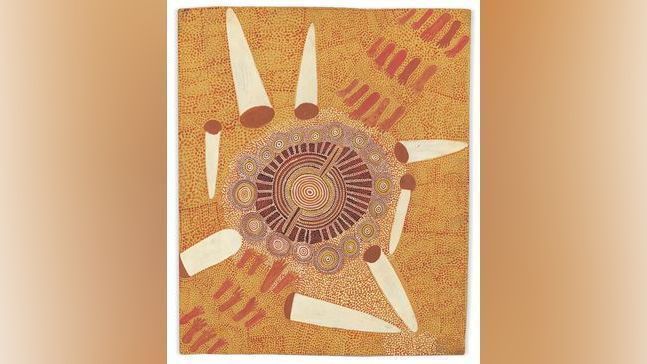
Anatjari Tjakamarra. Ngaatjatjarra/Pintupi c. 1930–92. Big Pintupi Dreaming Ceremony 1972, synthetic polymer paint on, composition board, 51.5 × 43.3 cm. National Gallery of Victoria, Melbourne. Purchased through The Art Foundation of Victoria with the assistance of North Broken Hill Pty Ltd, Fellow, 1987 (O.51-1987). © The Artist/Licensed by Aboriginal Artists Agency Limited. Photo: Christian Markel / NGV
The exhibition was curated by Myles Russell-Cook, former senior curator of Australian and First Nations art at the National Gallery of Victoria.
At the National Gallery of Art, it was coordinated by E. Carmen Ramos, chief curatorial and conservation officer, and Lynn Matheny, deputy head and associate curator of interpretation. In Portland, the presentation is coordinated by Ash-Milby in collaboration with Clark.
The Stars We Do Not See is organized by the National Gallery of Victoria and the National Gallery of Art in association with the Portland Art Museum, the Denver Art Museum and the Peabody Essex Museum in Massachusetts, where the exhibition will finish its North American tour in Spring 2027.
The exhibition is accompanied by a book published by the National Gallery of Victoria and the National Gallery of Art in association with D.A.P./Distributed Art Publishers, featuring more than 100 individual artwork plates by Indigenous Australian artists.