
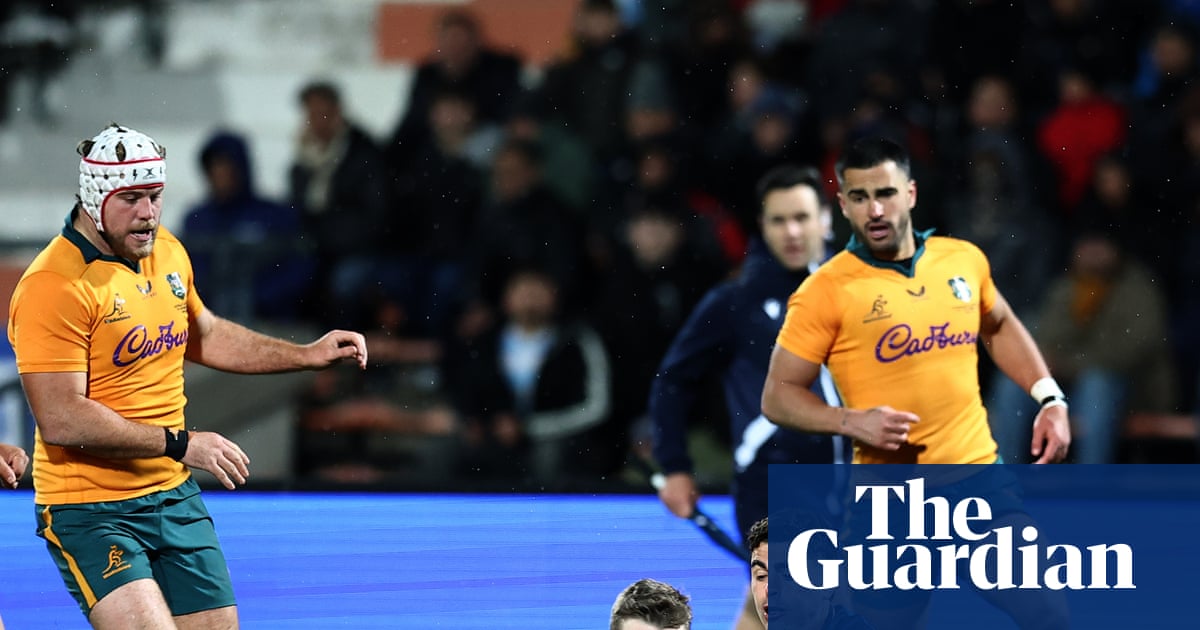
A charitable Wallabies performance handed Argentina their share of the 28-28 draw in Mendoza, ending Australia’s winning run at four. Optimists will point to a first Australian series victory in Argentina, and an unbeaten run for Les Kiss’s hungry side that is now the Wallabies’ longest since 2021.
The truth, however, is less palatable. The Wallabies looked golden for the first half an hour thanks to their hard-working pack, and led 14-0 with five minutes to go in the first half. They were lucky to go into the break at 14-14.
Then, having given up the lead, Australia worked their way back into pole position. With 10 minutes to go, they levelled the score at 28-28 and looked almost certain to win with Argentina down to 13 players due to two yellow cards. But Australia’s poor execution let the home side slither away with a draw.
“In that last 10 minutes, they played the conditions really well, knowing they’re a few men down, it’s a bit slippery on the deck, and they just tried to hold on to the ball for as long as they can,” said Wallabies captain Harry Wilson. “The boys were hurting with the result. We really wanted to win that, and there’s a lot of disappointment.”
The Wallabies now have three weeks until they play in Perth against the Springboks, the standard bearers in world rugby, who defeated the All Blacks this weekend. “We’ve obviously had a few wins in a row, and to get a draw tonight is not ideal,” Wilson said. “But to bring another trophy home, it hopefully brings a bit of momentum and some confidence in the group going to the Springboks.”
Australia’s Carter Gordon reaches for a tackle on Argentina’s Rodrigo Isgró. Photograph: Gustavo Garello/AP
As significant as this trophy is, it has been rare for Australia to tour Argentina until the recent biennial rhythm, and the series has never included more than two matches. Over 18 matches between the two sides in Argentina, just six had been won by the home side. Simply, Australian fans have always been entitled to expect a win against Los Pumas, at home or away.
The Wallabies’ past two visits to Argentina ended in humblings, however, recalibrating expectations for the once proud gold. That 67-27 defeat in 2024 was the most points Australia had ever conceded in Test rugby. With that context, this draw was meaningful.
“The boys are a little bit disappointed that they just didn’t go on with it for sure,” Kiss said. “Mixed feelings in a way, but there is something that we did come here to achieve, and we got that, that’s for sure – the areas of the game, the rugby bit, trying to get some areas of our game a little bit better and a bit more robust. And we’ve got things to work on for sure.”
The usually reliable scrumhalf Ryan Lonergan was short of his best, but head injury assessments left Ben Donaldson and Carter Gordon rotating outside him for much of the match. This whirlwind was made worse when Gordon was unable to finish the game, and he looked in agony clutching his leg after a tackle. Kiss said afterwards the injury was the result of an impact, but would not know the severity until after a scan.
Winger Filipo Daugunu also had a mixed night, including knocking on from the kick-off, as did fullback Tom Wright who produced a wild end to the first half. First he took the wrong kicking option, finding the Argentina winger crossfield to put his team under pressure. Then he casually stepped out when trying a clearing kick, handing the home side a lineout from which they levelled the score. It could have been worse for Australia, when Wright was penalised for elbowing an opponent when the half-time whistle was about to be blown, but the Wallabies escaped to the break with the scores level.
skip past newsletter promotion
Sign up to The Breakdown
The latest rugby union news and analysis, plus all the week’s action reviewed
after newsletter promotion
Australia head coach Les Kiss looks on at Malvinas Argentinas stadium. Photograph: Andres Larrovere/AFP/Getty Images
Kiss said the side must improve its game management. “We’re not going to catastrophise it, but there’s one or two key moments, three moments, that just allows them to stay in the game,” he said.
“The boys are talking about it. They know there’s a little bit more we can improve in terms of establishing how we get our exits properly, how we turn the ball back in front of our forwards at the right time. Two or three moments is all we’re talking about, but that’s Test rugby, it comes back to bite you.”
A strong start to the second half helped the Wallabies regain the lead, but then from the kick-off Lonergan had his clearing kick charged down, pinning Australia in their 22. Within minutes, Argentina were level.
In the yo-yo performance, it was the defensive effort from the Wallabies that laid the platform for what should have been a victory. Kiss praised the team’s improving line speed, and aggression at the edge of defence, but warned it will count for little if their decision-making with the ball does not improve.
“The problem is at times we’re probably not managing the game [to get] away from our third of the pitch enough times. When we get up to the other [attacking] third, we’re definitely making sure we make hay while the sun shines and those opportunities we get up there, we do convert well,” Kiss said. “We’re just probably, two steps, three steps forward and controlling the game,” Kiss said. “And then suddenly … we’re back on our back foot again.”
The Wallabies must address their wastefulness, or else the Springboks will prey.