
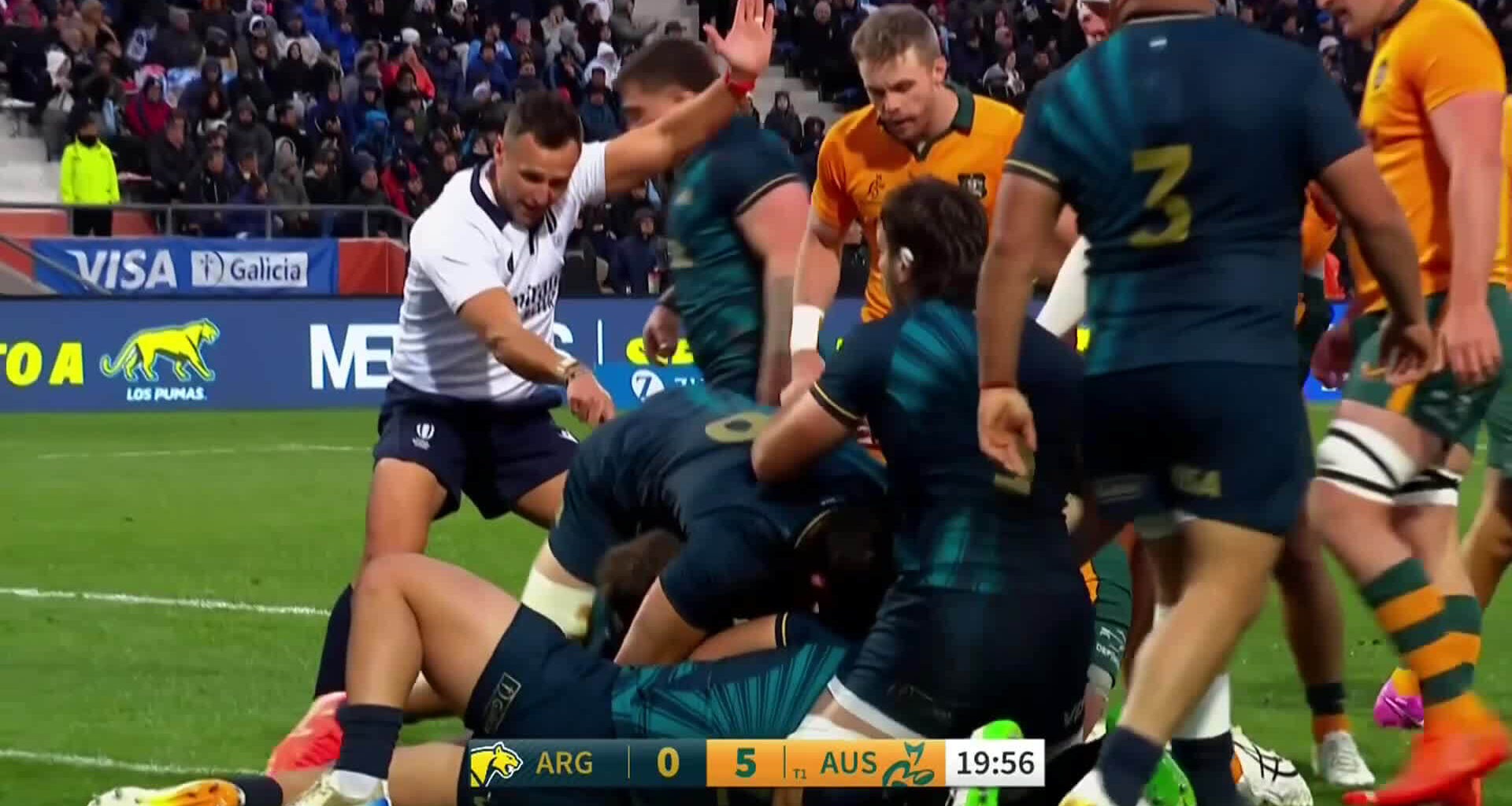
Happy Monday, G&GRs. The Wallabies draw a winnable but arm-wrestling game in Argentina. Let’s take a look at that game before turning our gaze to the Dutch Dirt Farmers and Sheep Shaggers brutal encounter. A bumper edition today, boys and girls. So, pour a big cup of liquid gold☕ and get that into you while we wander into the mad, mad, mad world of Brisney.

Wallabies 28 -Argentina 28 – Draw
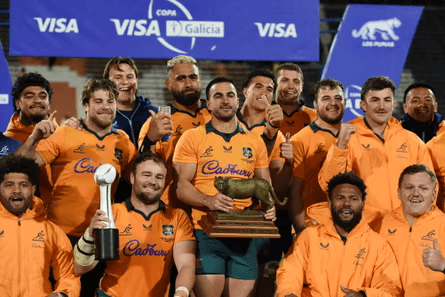
Wallabies manage a draw in Mendoza, but history made with series win over Los Pumas! – Well, nobody said being a Wallabies supporter was going to be easy. Just when it looked like Australia might complete a clean sweep of Argentina on their own patch, the Wallabies somehow managed to turn the final 10 minutes into a chaotic game of “how exactly are we going to win this?”
In the end, they didn’t. But despite being held to a 28-all draw in Mendoza, the Wallabies still walked away with something rather significant: their first-ever series win in Argentina. And importantly, Les Kiss’ honeymoon period continues, with the Wallabies remaining undefeated under their new coach. Not a bad little start, really.
A draw, but it feels like a win – Australia had every opportunity to steal the game late. In fact, Los Pumas did their absolute best to hand them the opportunity. With deliberate knockdowns seeing both Lucio Cinti and Santiago Carreras sent to the naughty chair, Argentina found themselves defending with just 13 men. Carreras’ effort was particularly costly, resulting in a penalty try for the Wallabies. Surely, surely, Australia would find a way through?
Nope. The Pumas dug in, defended as if their lives depended on it, and eventually belted the ball into touch as the Wallabies desperately searched for one final turnover. Cue exhausted Australians staring into the middle distance, wondering how the hell they hadn’t won. Still, a draw was enough to secure the series, and history books don’t generally care whether you win the final match by 30 or draw it after playing against 13 blokes. A series win is a series win.
Captain Harry eventually gets his moment – The Wallabies had spent plenty of the opening exchanges defending before Harry Wilson appeared to have scored the opening try. Initially. A nicely worked short-side movement put the skipper into space, and Wilson crossed, only for the assistant referee to raise the flag.
Referee James Doleman allowed play to continue and awarded the try, before the TMO eventually confirmed Ryan Lonergan had stepped into touch earlier in the movement. No try. But Wilson wasn’t going to be denied for long.
The Wallabies continued applying pressure inside the Argentine 22, and eventually their captain crashed over close to the posts in the 19th minute. Argentina’s defensive discipline then completely unravelled. Four team infringements in roughly two minutes saw Franco Molina heading for the sin bin, and suddenly the Wallabies had momentum, numbers and territory.
Max Jorgensen then took advantage of the overlap to score his second try of the year. At that point, things were looking pretty rosy. Which, naturally, is when the Wallabies decided things were going far too smoothly.
Argentina punch back -Jeremy Williams’ 🧀 brought the numbers back to even, and Argentina immediately found another gear. Los Pumas captain Pablo Matera crashed over to get his side back into the contest before Ignacio Mendy sliced through the Australian defence just two minutes later. Suddenly it was 14-all.
The Wallabies were fortunate not to concede again before the break, with Joseph-Aukuso Suaalii producing a crucial defensive read to shut down another attacking opportunity. It was exactly the sort of moment that can easily be forgotten after the final whistle but can completely change a match. Australia had gone from looking comfortable to hanging on for dear life. Classic Wallabies.
McReight responds, but the Pumas keep coming – Fraser McReight restored Australia’s advantage early in the second half, diving over from close range after sustained pressure. The Wallabies were back in front. For a few minutes anyway. Argentina hooker Ignacio Ruiz responded as Australia’s problems exiting their own territory came back to haunt them. Then came the big moment.
With momentum firmly behind the home side, Matera produced his second try of the afternoon after an extraordinary 23 phases on the Australian line. Twenty-three. At some point during that passage, the Wallabies defence was presumably wondering whether Argentina had accidentally switched to rugby league. Matera eventually crashed over, and Los Pumas had the lead with around 15 minutes remaining. The stadium erupted. The Wallabies needed something special.
Chaos, cards and a missed opportunity – Argentina’s discipline then became their biggest enemy. Cinti was sent to the bin for a deliberate knockdown before Carreras followed shortly afterwards for another cynical infringement. The latter resulted in a penalty try. Suddenly, the Wallabies were back level and playing against 13 men.
Surely this was it. Surely. Australia won a crucial turnover with five minutes remaining and worked their way into attacking territory. But there was another complication. Carter Gordon went off, forcing Ryan Lonergan into the unfamiliar role of directing traffic from number 10. The Wallabies couldn’t find the decisive blow. A late error handed possession back to Argentina, who briefly looked interested in chasing victory before deciding that a draw wasn’t the worst result in the world.
The ball was eventually kicked into touch. 28-all. Job done. Well… mostly. The bigger picture. Yes, the Wallabies will probably look back at this one and wonder how they didn’t win. Playing against 13 men late in the game, with a series sweep on the line, was about as good an opportunity as you’re likely to get.
But let’s not lose sight of what was achieved. Winning in Argentina has never been straightforward for Australian teams. Winning a series there? That’s something entirely new. Les Kiss remains undefeated, the Wallabies have shown they can survive the brutal South American arm wrestle, and there’s a growing sense that this side is beginning to develop some genuine resilience. They’re not perfect. Far from it.
The exit strategy needs work. Discipline remains a rollercoaster. Closing out matches is still occasionally an adventure. But the Wallabies are winning, competing and, most importantly, starting to build a bit of belief. And after the last few years? We’ll take it.
Three Things We Learned
Les Kiss has the Wallabies believing – the undefeated start under Les Kiss isn’t just about results. This Wallabies side looks more composed and resilient than previous versions. They absorbed enormous pressure in Mendoza, fought their way back when Argentina grabbed momentum, and still had opportunities to win late. There are plenty of things to improve, but belief is a powerful weapon, and this team appears to have plenty of it.
The Wallabies still need to learn how to finish – This was the big frustration. Australia had Argentina down to 13 players and had multiple opportunities to attack late, yet couldn’t find the decisive blow. The best teams smell blood in those moments. The Wallabies are getting closer, but game management, particularly when fatigue sets in, and personnel changes disrupt the spine, remains a work in progress.
Fraser McReight and Harry Wilson are becoming genuine leaders – Wilson continues to lead from the front and was rewarded with another important try, while McReight was everywhere once again and grabbed a crucial second-half score. Australia’s leadership group is beginning to look increasingly settled. And if the Wallabies are going to build something meaningful under Kiss, they’ll need players like Wilson and McReight driving standards when things get messy. Because, let’s be honest… With the Wallabies, things are almost always going to get messy.
South Africa 29 Defeated New Zealand 24
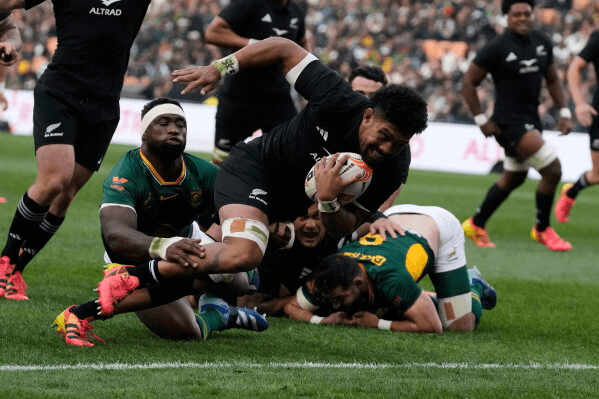
Bokke Bring the Boom as Kiwis Get Second-Half Schooled! – Well, well, well, the old enemy have been given a proper lesson in Johannesburg. Not a hiding. Not a pantsing. But something perhaps even more painful for Kiwi rugby fans: the All Blacks were in the contest, had momentum, looked bloody dangerous… and still got monstered when the big boys decided it was time to go to work.
South Africa have taken a 2-1 lead in the four-match series after a brutal second-half performance saw them defeat New Zealand 29-24 at Soccer City. And if you only looked at the final score, you’d think, “Geez, that was close.” Well, yes and no. It was close in the same way standing in front of a hungry crocodile is close. Technically, you’re still alive, but you’re probably not enjoying where things are heading.
The scores were locked at 12-all at oranges, but the second half belonged to the Bokke. Kurt-Lee Arendse, Jesse Kriel and everybody’s favourite angry human wrecking ball Malcolm Marx crossed the stripe, while the Boks also picked up a penalty try. For New Zealand, Ardie Savea was magnificent, grabbing two tries, while Will Jordan and Samisoni Taukei’aho also crossed.
But here’s the problem for the men in black. You can have Ardie Savea playing like Superman, Batman and the entire bloody Avengers franchise rolled into one bloke, but eventually someone has to help him move the Springbok pack backwards. And on Saturday, that simply wasn’t happening.
The All Blacks Come Out Swinging – To be fair to the Sheep Shaggers, they started as a team possessed. The All Blacks were running hard, playing with tempo and asking plenty of questions of the Springbok defence. Siya Kolisi admitted after the match that the Kiwis had brought some serious early heat. “The All Blacks came hard at us in the first 25 minutes; their lungs were pumping. We did well not to concede more points.” Now, that’s not exactly a ringing endorsement of the Bokke’s first quarter.
The South Africans had already lost Cheslin Kolbe to a head injury, while young fly-half Sacha Feinberg-Mngomezulu had been dispatched to the naughty chair for deliberately knocking down a pass. So naturally, with a man advantage and the Springboks looking a little rattled, the All Blacks struck. Asafo Aumua made a powerful break from a lineout and, when the ball spilled loose, Ardie Savea was there to scoop it up and crash over. 7-0. And suddenly the Kiwi faithful would have been sitting on their couches thinking: “Here we go. We’ve cracked the code.” Ahhhh, bless.
The Boks Remember They’re the Boks – The return of Feinberg-Mngomezulu seemed to flick a switch. South Africa began to build pressure and, before long, Kurt-Lee Arendse was diving into the corner after some good work from Damian de Allende. The conversion was missed, but the Bokke were back in the contest. Then Ardie Savea did it again.
Leroy Carter was held up just short of the line; the ball became loose and Savea, who was seemingly appearing in every second bloody camera shot, picked it up and crossed for his second. 12-5. And again, the All Blacks had their noses in front.
But then came one of rugby’s oldest truths: Never, ever, ever give South Africa repeated scrums five metres from your line. Unless, of course, you enjoy referees standing underneath the posts with their arm raised while your fly-half trudges off for ten minutes. South Africa won a scrum close to the New Zealand line, the Kiwi pack started going backwards faster than an Australian politician answering a difficult question, and referee Nika Amashukeli eventually had enough. Penalty try. Ruben Love yellow card. 12-all. Game on.
The Scrum Wars Nobody Shut Up About – Leading into this Test, both camps had spent plenty of time having little digs at each other’s scrum technique. Basically, everyone was saying: “Their scrum is illegal.” “No, YOUR scrum is illegal.” “Yeah, well your mum’s scrum is illegal.” The usual mature Test rugby discourse.
To Amashukeli’s credit, he appeared determined to referee the thing rather than turn it into an archaeological dig. There were clear instructions to the front rows, and remarkably, the game managed to get through much of the first half without scrums taking longer than the construction of the Sydney Harbour Bridge. Progress. But the pressure eventually told.
And once South Africa started getting the upper hand in the tight stuff, you could almost hear the collective sigh of relief from every Springbok forward: “Right boys, enough of this running rugby nonsense. Time to do some proper work.”
The Second-Half Bok Squeeze – The second half was proper Test rugby. Not pretty. Not free-flowing. Not the sort of thing that would attract people who think rugby should be played entirely between the 15-metre lines with everyone throwing miracle offloads. No. This was big men running into other big men. And occasionally winning. Nutta Porn.
New Zealand still looked dangerous whenever they found space. Leroy Carter was heavily involved in another attacking movement, managing to get a pass away after contact for Will Jordan to cross. The All Blacks were back in front. And again, it looked like they might just have enough. Then Jesse Kriel happened. Carter went from hero to villain in the blink of an eye, failing to stop Kriel as the Springbok centre powered through. Feinberg-Mngomezulu converted.
South Africa 19. New Zealand 17. And from there, G&GRs, the green machine started rolling downhill. Enter Malcolm Marx. Exit Comfort. You know the feeling when you’re watching a horror movie and the music suddenly changes? You know something bad is coming. That’s roughly what Malcolm Marx running at your defensive line must feel like. The Springbok hooker barged over for another try, and suddenly the hosts had breathing room. Feinberg-Mngomezulu added the conversion. Then added a penalty.
And just like that, the Boks had stretched their advantage to 12 points. This was the crucial difference between the sides. New Zealand had periods of momentum. South Africa had periods of dominance. There’s a difference. The All Blacks played plenty of good rugby. The Springboks played plenty of effective rugby. And in Johannesburg, effective wins.
Luke Jacobson summed it up pretty neatly after the match. “We started really well, had momentum, but the Springboks played their game in the second half. They got on top.” Yep. That’s about as accurate as it gets. The Kiwis threw plenty at the Bokke early. But South Africa absorbed it. Hung around. Stayed in the fight. Then slowly began squeezing the life out of New Zealand. It’s the rugby equivalent of being slowly crushed by a very large anaconda wearing green and gold.
A Consolation Try, and a Trip to America – Samisoni Taukei’aho scored a pushover try after the hooter to make the scoreline look a little prettier. But let’s be honest. It was lipstick on a pig. The All Blacks were beaten. Not embarrassed. Not destroyed. But beaten by a side that simply managed the final 40 minutes better. And that’s a worrying sign for the rest of world rugby.
Because the Springboks didn’t need to be brilliant for 80 minutes. They didn’t need to dominate possession. They didn’t need to throw the ball around like they were auditioning for Super Rugby Pacific. They just needed to stay in the fight long enough for their power game to take over. And once it did? Game over.
The final Test of the series will be played in Baltimore, USA, on September 12. Because when you’re trying to finish one of the greatest rivalries in world rugby, the obvious place is… checks notes……Baltimore. Righto then. I’m sure the locals are already brushing up on the difference between a maul and a ruck. Should be bloody interesting.
Three Things We Learned
Ardie Savea Is Apparently Trying to Do Everyone’s Job – What a bloody performance. Two tries, huge carries, massive work rate, and seemingly involved in everything positive New Zealand did. Savea was everywhere. I reckon if you checked the car park after the game, you’d probably find him directing traffic as well. But here’s the problem. Even Superman eventually needs the Justice League. The All Blacks have some magnificent individual talent, but against South Africa you need an entire pack willing and able to go toe-to-toe for 80 minutes. New Zealand did it for 40. South Africa did it for 80. There’s your difference.
South Africa Have the Best “Stick Around, and Then Murder You” Game Plan in Rugby – The Boks are fascinating. They can look vulnerable. They can lose momentum. They can spend 20 minutes defending their own line. And you think: “Yep, they’ve got them here.” Then suddenly it’s the 55th minute. You’ve made 200 tackles. Your lungs are hanging out. Your front row is looking for oxygen. And Malcolm Marx is jogging onto the field with fresh legs. It’s a ridiculous system. It shouldn’t be legal. Someone should probably write a strongly worded letter to World Rugby. But until then, everyone else has to find a way to beat it. Good luck with that.
Baltimore Is Suddenly a Proper Decider – This series is beautifully poised. South Africa lead 2-1. New Zealand have shown they can hurt the Boks. South Africa have shown they can absorb that pressure and come back swinging. The All Blacks will need to find a way to turn their early dominance into more points. Because against South Africa, possession without points is about as useful as a Waratahs fan explaining why this is definitely their year. The Springboks, meanwhile, will keep doing what they do. Win collisions. Kick intelligently. Destroy scrums. Turn breakdowns into crime scenes. And unleash fresh 120kg monsters from the bench. Simple game, rugby.
Anyway, enough of this old second-rower gobbing off. The Bokke have landed a significant blow, the Kiwis have some thinking to do, and Baltimore now has the honour of hosting a series finale that should be an absolute belter.
Have at it.
Stay in the loop with G&GR