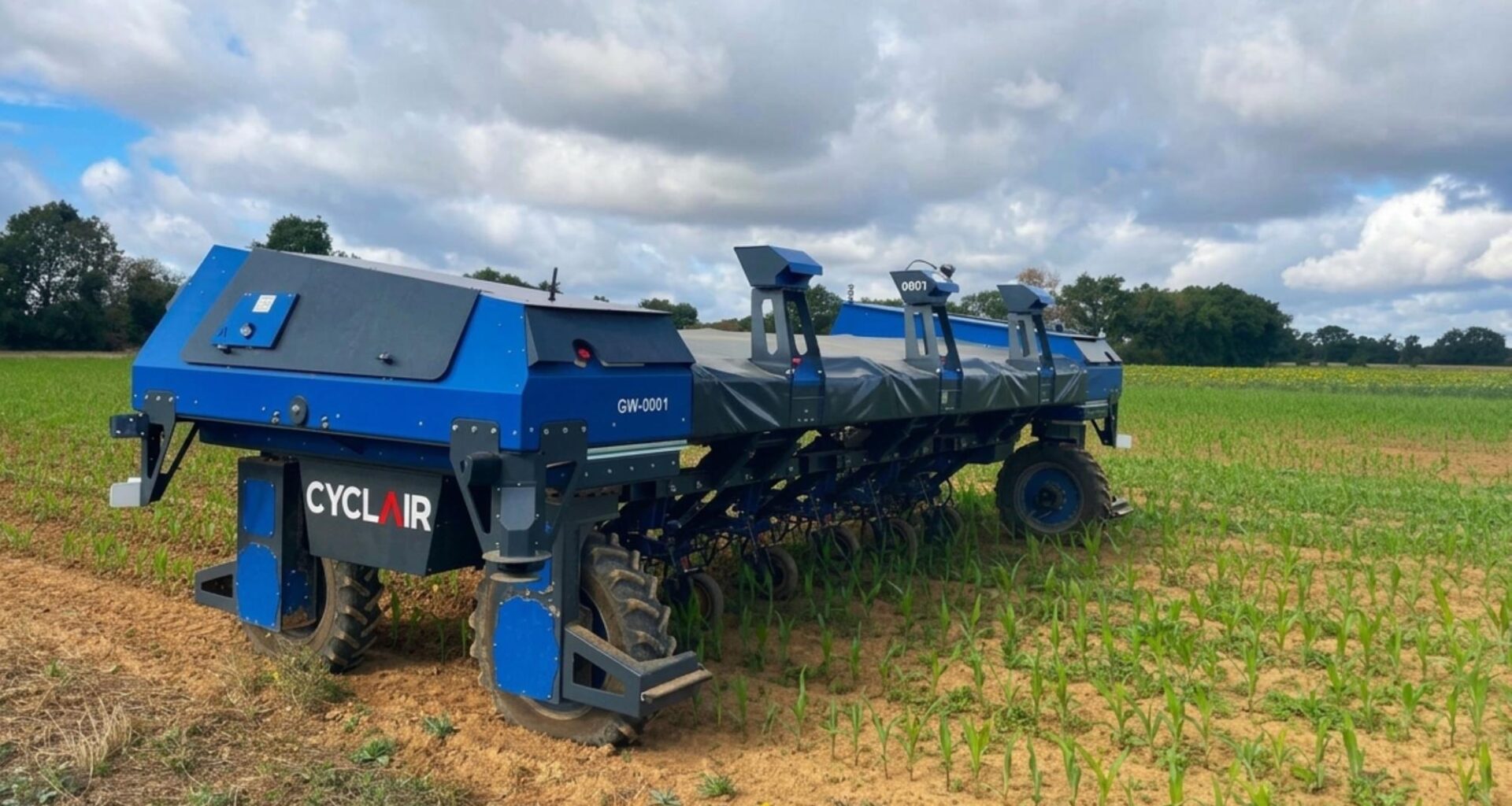
 The robot currently covers maize, sunflower, and rapeseed, with extensions to cereals, open-field vegetables, and specialty crops planned. Photo: Cyclair
French agricultural cooperative group Océalia has acquired a minority stake in startup Cyclair, backing the autonomous weeding robot developer as part of its Cap 2030 strategic plan. The investment, announced earlier this year, positions Cyclair’s mechanical weeding technology as a concrete alternative to chemical herbicides for Océalia’s cooperative members across the French region Nouvelle-Aquitaine.
The robot is currently available in Western and Central Europe, North America, and Australia. Cyclair is already working on what comes next. Its development roadmap includes the addition of an electric weeding module, a crop health sensor, and a soil sensor – expanding the platform from a weeding tool into a broader agronomic data collection system.
For Océalia, the deal sits within its Sillon Responsable (Responsible Furrow) sustainability framework, which treats technology adoption as a long-term driver of commercially grounded, environmentally responsible farming. The cooperative is looking for solutions that reduce herbicide use without compromising farm profitability – and the economics of mechanical weeding at scale are central to that ambition.
Cyclair was founded in Pressac, in the Vienne department of France, by three partners with backgrounds in industry, robotics, and agriculture. Its GS and GW robot models are designed for open-field crops with row spacing between 30 and 90 centimetres, combining mechanical weeding, AI-based vision, and an optional targeted spot-spraying module.
Navigation without GPS
Rather than relying on GPS, the robot uses a combination of cameras and LIDAR technology to identify crop rows directly, distinguish weeds from cultivated plants, and navigate around field obstacles – all without operator input. The system requires only field boundaries as input to begin operating autonomously.
The robot currently covers maize, sunflower, and rapeseed, with extensions to cereals, open-field vegetables, and specialty crops planned. Alongside weeding, it functions as an agronomic data collection platform, capturing leaf development metrics and feeding field-level monitoring through a dedicated application suite.
A central challenge for any mechanical weeding alternative is cost competitiveness. Conventional chemical weeding runs between €35 and €85 per hectare depending on pass complexity, according to both partners. They have set cost parity with that range as a target – making the system viable across a broad range of farm operations, not only among early adopters.
Specifications (Source: VegMech)
Energy source: Fuel
Net weight: 3,400 kg (7,496 lbs)
Dimensions: 750 × 255 × 210 cm (295 × 100 × 83 in)
Maximum speed: 5 km/h (3 mph)
Wheel spacing: adjustable: 6.0 – 6.5 m (19.7 – 21.3 ft)
Productivity: Up to 20 ha per day (approx. 1 ha/hour)
Weeding precision: Down to 1 cm (0.4 in) in-row
Connectivity: 3G/4G/5G + Starlink GPS RTK
Navigation: Vision, LiDAR, GPS, Deep AI
Compatible tools: Mechanical weeding, spot-spray module
Business model: Direct sales, distributor network, and Robot-as-a-Service (RaaS)
Indication of price (Australia): AUD 151,000 – 250,000. Ongoing costs: Approx. AUD 10,000 per year (maintenance, support, software). Estimated ROI: AUD 200,000 after recovery of initial investment. Input cost savings: Approx. AUD 70,000 per year.
Markets: Western and Central Europe, North America, Australia
Join 17,000+ subscribers
Subscribe to our newsletter to stay updated about all the need-to-know content in the agricultural sector, two times a week.
“*” indicates required fields