
Noah needed incontrovertible proof. He got it.
“And the dove came in to him in the evening; and, lo, in her mouth was an olive leaf pluckt off: so Noah knew that the waters were abated from off the earth.” (Genesis 8:11)
Now, we need incontrovertible proof that his legendary Ark has been unearthed.
We don’t have it.
Yet.
But excitement has soared amid viral claims that evangelical tour guide and founder of the Noah’s ark Scans project, Andrew Jones, has found “evidence” of artificial structures preserved beneath a hull-shaped rock formation near Türkiye’s Mount Ararat.
He’s been spruiking the site’s secrets for the past 30 years.
Now, a joint investigation with Professor Cenker Atila of Sivas Cumhuriyet University in Türkiye has added fuel to the speculative fire.
“Current data increases the likelihood that it is Noah’s ark with each passing day,” the archaeology professor told the Turkish news agency iHA.
He is leading an international team of 20 researchers to the Durupınar Formation in eastern Türkiye, which began surveying the site on June 28. They’re due to finish on September 11.
“These studies will yield definitive results within 2-3 months. Then we will provide more illuminating information,” Prof Atila adds.
Mr Jones is more enthusiastic.
“We’ve moved from asking ‘Does it look like a boat?’ to ‘Why is there a three-layered, right-angled inside structure, carbon-rich boat formation the exact length of Noah’s ark given in the Bible buried in the middle of a mountainside in the mountains of Ararat?’” he told Fox News.
His Noah’s Ark Scans project is presenting what it insists is compelling (but as yet unverified) evidence.
A “fossilised” rivet. A “petrified” timber plank. Radar-mapped “deck plans”. Carbon-rich soil.
“[This is] exactly what you’d expect to find if this were a man‑made boat, consistent with the biblical specifications of Noah’s ark,” Mr Jones declares in a Christian Broadcasting Network interview.
Radars of the Lost Ark
Seventh-day Adventist researcher, Professor Raul Esperante, urged international support (and investment) for a new in-depth excavation of the proposed Ark wreck site in 2017.
This followed a separate 2010 expedition that claimed to have found signs of structures as well as preserved wood dating from 4800 years ago.
Prof Esperante won the support of Istanbul University Professor Oktay Belli.
“Noah’s ark and the flood is not a myth but a real incident mentioned in all holy books. It happened in Anatolia. It is a part of our nation’s culture,” Prof Belli told the Hurriyet Daily News.
A decade later, the ongoing quest has new adventurers.
“Andrew Jones is an American researcher, tour leader, and founder of Noah’s ark Scans”, his website states.
Mr Jones is a qualified computer coder, though he took a course in archaeology in his first year of college. He says he became fascinated by the Ark’s fate as a child and spoke regularly with Seventh-day Adventist Ark archaeologist Ron Wyatt.
He’s claiming credit for the current authorised expedition to the remote mountain site.
And it’s supporting earlier claims made by his organisation.
The California-based Noah’s Ark Scans argues that its own studies of the Durupınar Formation have uncovered echoes of artificial structural features for the past decade.
Now it has a new qualified Turkish academic to pin its credibility on.
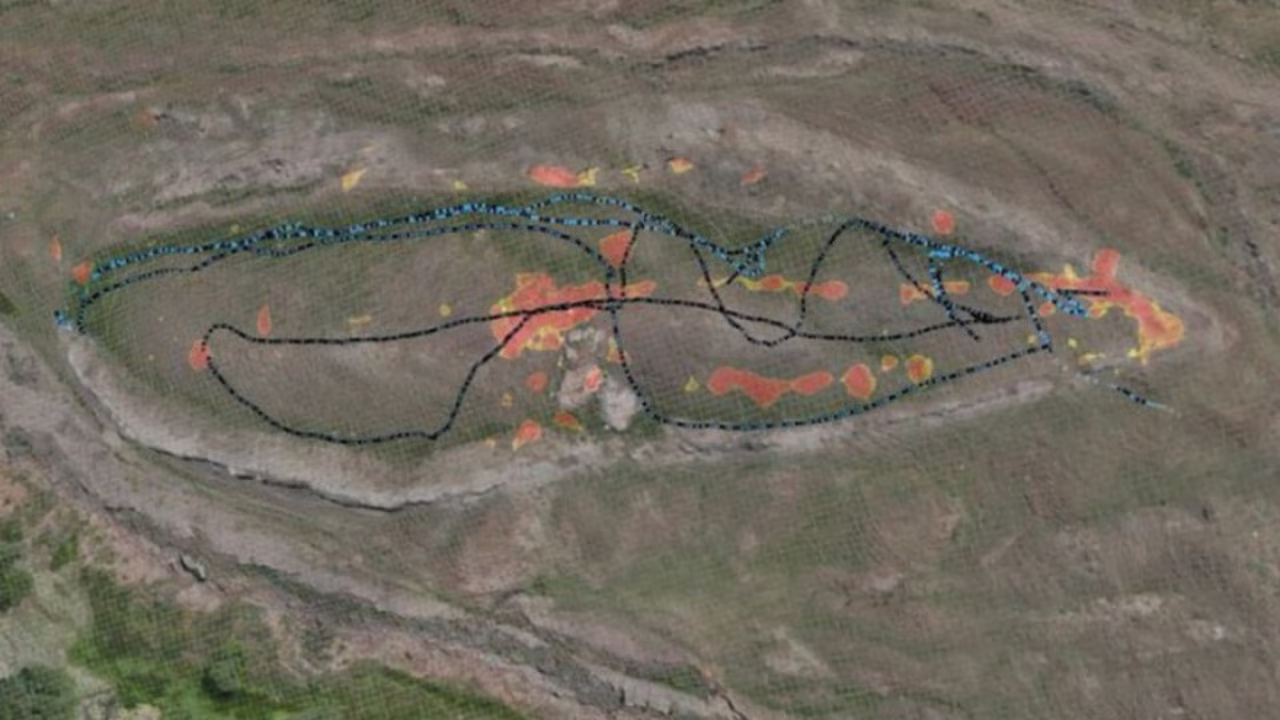
“We were looking for cavities, wooden remnants, or remains that could form a ship’s shape underground,” Prof Atila said of his ongoing ground-penetrating radar work last week.
“We noticed many anomalies on the Durupınar formation. These are gaps. The presence of anomalies intersecting at right angles raised the question of ‘was there a ship here’? Could these be the gaps of that ship?”
He also points to efforts to gather 1000 soil samples from the site and its surroundings. Initial results suggest the rock cavity contains 40 per cent more carbon than the surrounding soil.
“This raises the idea that there may be organic material or remains of wood,” Prof Atila speculates.
Mr Jones is jubilant, claiming vindication for similar results in 2014, 2019 and 2021.
But Prof Atila is more hesitant: “We will receive the definitive results in two months.”
Sivas Cumhuriyet University says it will publish a comprehensive report in 2027.
Answers in Genesis?
Finding Noah’s ark is regarded as the holy grail of biblical archaeology.
It could be held up as proof that the Old Testament’s tales are literal truth.
And that Charles Darwin’s theory of evolution and astrophysicist Georges Lemaître’s Big Bang theory of the universe’s origins are wrong.
“Your support today helps us make the evidence of Noah’s ark irrefutable,” promises a call for donations on the Noah’s ark Scan Facebook page.
The problem is: Which one?
The biblical account in Genesis 6-9 is confused and self-contradictory.
Genesis 7:4, 12, and 17 state that the cataclysmic worldwide flood lasted “40 days and 40 nights”.
Genesis 7:24 and 8:3 state it was 150 days.
It’s also unclear how many animals were brought into the Ark.
“And of every living thing of all flesh, two of every sort shalt thou bring into the Ark, to keep them alive with thee; they shall be male and female.
“Of fowls after their kind, and of cattle after their kind, of every creeping thing of the earth after his kind, two of every sort shall come unto thee, to keep them alive.”
That’s Genesis 6:19-20.
Then there’s Genesis 7:2-3
“Of every clean beast thou shalt take to thee by sevens, the male and his female: and of beasts that are not clean by two, the male and his female.
“Of fowls also of the air by sevens, the male and the female; to keep seed alive upon the face of all the earth.”
Biblical scholars see this as evidence that ancient Jewish theologians had to reconcile (and appease) two separate biblical flood traditions circulating in their communities.
That’s not surprising.
Both are remarkably similar to much older Mesopotamian stories, preserved in Sumerian and Babylonian on nine ancient cuneiform tablets.
One set of tales, the Atrahasis Epic, dates from around 1750BC.
Here, the later role of Noah is played by Atrahasis, and the Babylonian pantheon fills the role of angry (or sympathetic) gods.
The Sumerian Flood story is a separate narrative.
The oldest surviving example dates from about 1600BC. Here, the immortal King Ziusudra is given the task of building and captaining the Ark.
Then, because King Ziusudra had safeguarded the animals and the seed of mankind, they settled him in a land overseas, in the land of Dilmun, where the sun rises.
Another surviving flood tradition has been found on tablets inscribed some 1000 years later. Dubbed The Epic of Gilgamesh, its Noah-hero is named as Utnapishti the Shuruppakean.
Jewish theologians will have been in close contact with these disparate accounts during the Assyrian Exile of the 8th Century BC, and again during the Babylonian Exile of the 6th Century BC.
Efforts to consolidate Hebrew traditions into a standardised scriptural text began between the 8th and 6th Centuries BC. The Talmud (core Rabbinic Judaism text) itself was not fixed until well after the Babylonian exile.
It was a controversial process.
The bible itself says as much.
The Prophet Jeremiah, who lived through the Babylonian destruction of Jerusalem, was damning in his criticism: “How can you say, ‘We are wise, and the law of the Lord is with us’? But behold, the lying pen of the scribes has made it into a lie.” (Jeremiah 8:8)
The Noah Code
Genesis 8 reports Noah’s ark coming to rest in the “mountains of Ararat”.
Its exact location has been the source of fascination ever since.
The oldest Mesopotamian accounts, dating to 1800BC or so, are vague in their descriptions. It’s hinted to have been a mountain beyond a world-encircling ocean.
The famous Imago Mundi cuneiform tablet, whose 7th Century BC creator claimed it was a reproduction of an even older map, defines eight enormous mythical mountains (nagÿs) as compass points.
One, the fourth “nagÿ”, has been linked by eminent Babylonian historian Irving Finkel to the Ark tales as its caption mentions enormous timber “ribs”. It’s also in the general direction of Türkiye from Mesopotamia.
Only one surviving Mesopotamian Ark tablet specifically details where the Ark came to rest. It’s a 7th-century BC version of the Gilgamesh story that details Utnapishti’s voyage.
I scanned the horizon in every direction:
In twelve [var. fourteen] places emerged a nagÿ.
On Mount Niæir the boat ran aground.
Mount Niæir held the boat fast and did not let it move …
Mount Niæir is generally believed to be part of the Zagros Mountains in modern-day Iraqi Kurdistan.
But Biblical scholars associate the “Ararat” mentioned in Genesis with the home of Türkiye’s highest mountain, Mount Ağrı (Mount Ararat).
The site creating so much excitement can be found some 29km to its south.
It was first spotted by Turkish army officer İlhan Durupınar in 1959 as a stark hull-like shape among aerial survey photos. That’s why the distinctive rock formation now bears his name.
On the surface, it fits the bill.
The Ark’s size is surprisingly consistent across ancient texts.
All surviving accounts consistently put it at between 14,400 and 15,000 cubits.
But the ship’s shape is another matter.
The old Mesopotamian accounts are split.
One tradition describes the Ark as a “magurgur”, a long but thin reed river boat.
Another depicts it as being an enormous version of a circular “coracle”, made of woven rope sealed with bitumen.
The later Gilgamesh tradition details a simple timber cube, with walls of equal length and height.
Only the Noah’s ark of Genesis gets close to the oblong wooden hull shown in children’s books, and the “reconstructed” Ark museum built by creationist advocacy group Answers in Genesis.
But that’s what the researchers say they have found.
Mr Jones has pre-empted Prof Atila’s peer-reviewed scientific study by telling Fox News that ground-penetrating radar has exposed parallel lines and angular structures at depths of 2.5m to 6m. He says these form a 4m passageway and three distinct underground strata that match the Genesis description of the Ark with three main decks.
“[This] suggests an internal complexity that is difficult to attribute to natural geological processes. We really believe that this layout … would suggest that it’s a man-made object and not just a natural formation,” he said.
Jamie Seidel is a freelance writer