
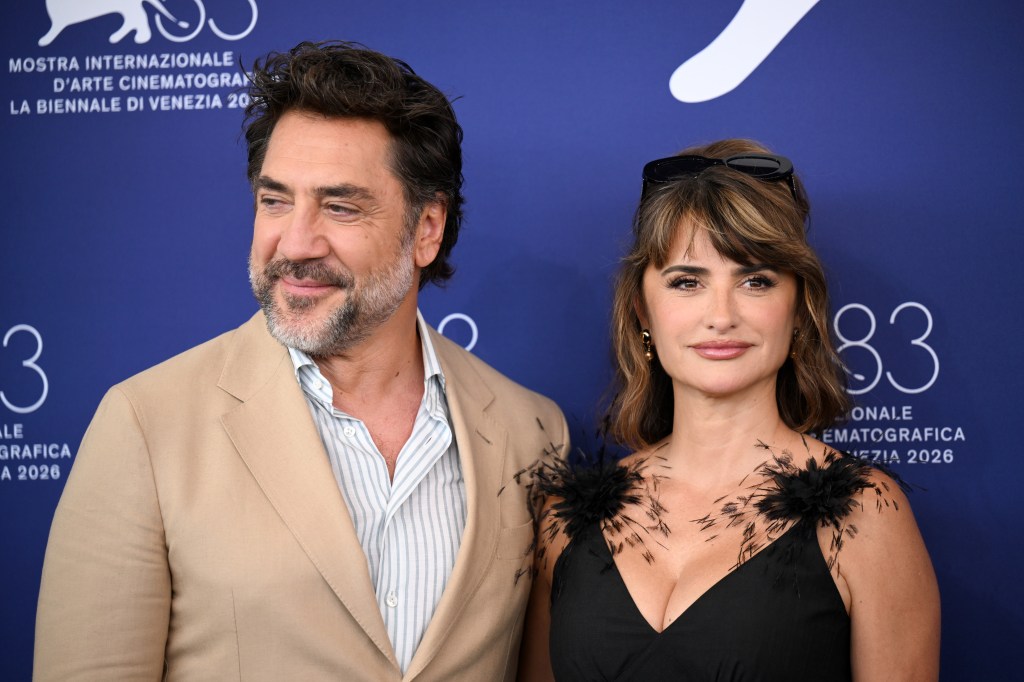
A-list couple Penélope Cruz and Javier Bardem touched down at the Venice Film Festival on Tuesday for the competition world premiere of Oscar-winning French director Florian Zeller’s highly anticipated thriller Bunker.
Bardem plays an architect who takes on an ethically questionable project to build a survivalist bunker for a tech billionaire, in a move that will lead his wife of seventeen years (Cruz) to question their relationship.
It marks the first time the stars who wed in 2010, and share two children together, have shared the big screen together in the role of a fictitious married couple.
The couple were asked at the press conference for the film whether they had put any of their real-life marriage into the roles, and if they sometimes argued about work.
“We are very good at really creating fiction and reality; otherwise, we won’t survive in this job,” replied Bardem.
Cruz said it would be unimaginable that they had never argued once over the course of their 30-year relationship but that they rarely got heated over work.
“We both really love this profession, but it’s true that there is a good balance in terms of how much you are speaking about work,” she said.
“Obviously, if you are preparing a movie together, obviously that is going to be very present in the conversations. But we haven’t done this very often… it has appeared like every five years because all the things that we were offered, we didn’t think they were for us, or for us at that specific moment.”
“But with this, there was no question because it was with Florian. When we had the first meeting with him about it, because we both loved the script, we knew that we were going to be protected.”
Cruz suggested Zeller had a way of getting an actor to bring their life experiences to their performances, without bringing in their personal life.
“Having somebody like him in the middle, you feel safer because you know there are going to be days that are more tricky, big arguments in the movie… emotional scenes… and I’m very grateful to Florian because he was always watching us, always feeling and seeing everything, without invading, he was a real protection for us in that way, and it was really beautiful to have that.”
Bunker is Zeller’s second film to play in competition at Venice after The Son in 2022, while his Oscar-winning first feature The Father premiered in Sundance.
The director said he had approached the couple for the film simply because he “adored them” but also admitted he was intrigued as to how the fact they are a real couple would impact the film.
“They are among the greatest actor actors working today, and so obviously it was an honor for me to work with them,” he said.
“But I have to say that from the very beginning, I was also interested in having them together on screen, because I thought it would be a unique way to capture something special as a real couple, to give layers to all the scenes of this film, to blur the line, between reality and fiction, but to try to approach something that I’m interested in, which is the burning authenticity of the truth, and to do that for actors, you have to be very bold, you have to be very fearless and ambitious, and this is what they are, and that’s why they are such great artists.”
Authenticity in the film also comes from the way the couple speak their native language Spanish at home, and English in the outside world.
“It’s amazing how much that has changed. Because even if you look back 10, 15 years, it was always so challenging to get financiers to accept something like that. It has really changed over the last three decades that we’ve been working and sometimes really struggling, trying to convince producers or sometimes even directors to try to do things that way,” said Cruz.
“The audience was always ready for that, but there was a fear… This is what kids grow up used to now, seeing original films with people speaking the language they are supposed to speak, and multilingual films, which is the way the world more and more becomes, and it has to be reflected in film.”
Zeller revealed inspiration for the film had come from an article he had read about an underground survivalist bunker being built in secret by a “famous tech billionaire [Mark Zuckerberg].
“It was a secret project, meaning that everyone involved in this project had to sign an NDA… and for some reason, the information went public, and I thought it was like a fascinating paradox because this man who was who made a fortune based on the idea of connecting people together was working on a plan B to isolate himself from the rest of the world, and I thought a lot about that,” he explained.
“The more I was thinking about it, the more I realized that all of us, to some degrees, we are all tempted to live in a bunker-not a real bunker, but an invisible bunker. The lifestyle that we are embracing more and more, without questioning it, the lifestyle that is basically the one these billionaires are promoting, is a world of illusion where you believe that somehow you don’t really need the others anymore.”
Bardem and Cruz acknowledged that Zeller’s intent with the film chimed with their own sense of political responsibility.
‘Bunker’ stars Javier Bardem and Penélope Cruz on the importance and responsibility of talking politics as artists: “It would be very contradictory to be a part of a movie like this… and then say ‘I don’t talk about politics.’”
‘Bunker’ tells the story of an architect who… pic.twitter.com/7t8OI4Lot2
— Deadline (@DEADLINE) September 8, 2026
“As an artist, you have a responsibility to make a story happen and to tell the story that the director, the author wants. And then you as an individual, it doesn’t matter if you’re an artist, an actor, a plumber, or a taxi driver. You have the right to expose your truth or what you think is important,” said Bardem, who is known for his outspoken support of Palestinian rights.
“Obviously, I have more resources to do it than a taxi driver because I have this thing and I have you guys listening to me. So the responsibility is a different one, and that’s what I think is important to have a responsibility toward the world that we live in aand that I don’t take it for granted… This movie speaks about that. Speaks about how how much we are willing to see, feel, welcome the other, or… how much are we going to isolate ourselves and criminalize and dehumanize the other?”