
Introduction by Croakey: Australians’ need for emergency food relief is expected to continue increasing, amid cost of living pressures and food price spikes driven by the volatile global context.
Meanwhile, Victorians heading to the polls have good reason to carefully scrutinise the policies being put forward by politicians speaking loudly about cost of living pressures, reports Marie McInerney.
Her report draws upon a Victorian election webinar convened this week by Sustain: The Australian Food Network, as well as discussions at the 11th Global Conference of the Alliance for Healthy Cities, held recently in Sydney.
Marie McInerney writes
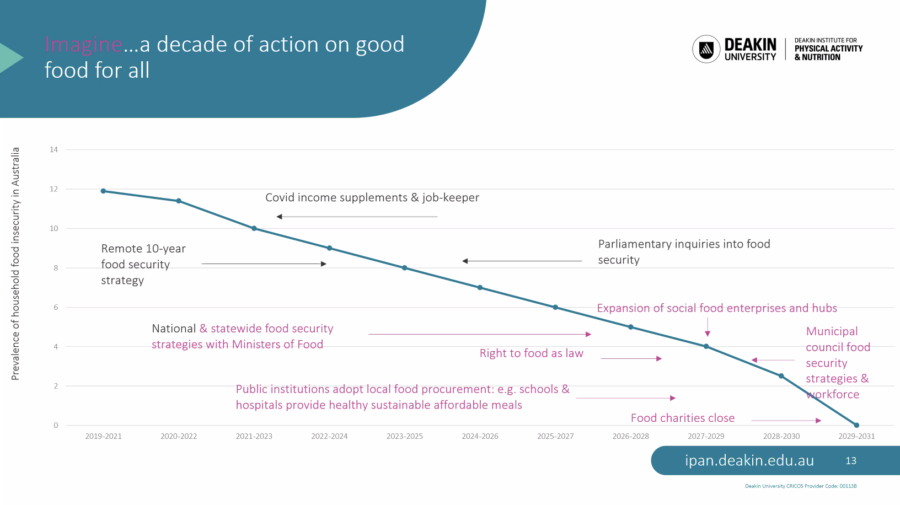
One in eight Australian households, around 13 percent, currently have inadequate access to healthy and affordable food, which leads to stress, skipping meals, juggling bills and rent and, for some, resorting to theft or emergency food relief, says Deakin University food security researcher Dr Rebecca Lindberg.
Australians are almost twice as likely as people from other high income nations to be in this situation – a worrying result for a wealthy, food producing and exporting country, Lindberg told Victorian election webinar this week.
Household comparisons are not exact, she said, but according to the United Nation’s Food and Agriculture Organisation’s 2023-25 hunger map, Australia has 15 percent of houses experiencing food insecurity compared to an eight percent average of other high income countries.
Lindberg, who is a Senior Lecturer at Deakin’s Institute for Physical Activity and Nutrition, said the volume of food now moving through the food relief sector in Australia has tripled since 2008.
Such demand shows Australia has “got a really substantial challenge on our hands and what we have been doing so far is not working”, she said.
Tackling food insecurity means addressing its root causes, including “institutionalised racism, discrimination, poverty, social and cultural marginalisation, and dysfunctioning food systems,” she said.

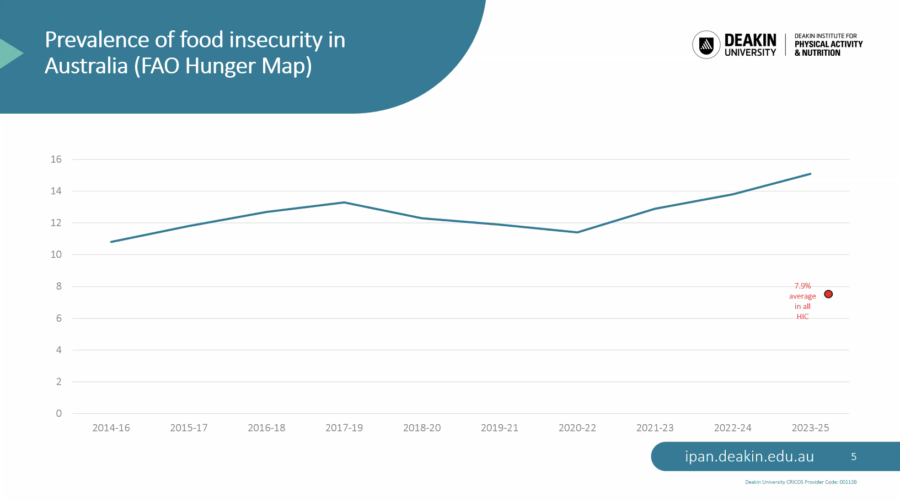 Slide presented by Dr Rebecca Lindberg
Broken food system
Lindberg was speaking at the official launch of Vote for Food Victoria 2026, a campaign by Sustain: The Australian Food Network, which is calling for “political courage and action on the cost of living crisis and our broken food system” in the lead up to the 28 November state election.
Nick Rose, Sustain’s co-founder and executive director, told the webinar that the need for action on food security is “grounded in the reality that is confronting us right now, today, in Victoria, in Australia and globally, which is one of converging and escalating crisis from multiple directions”.
He outlined the “accelerating climate change context with the Super El Nino and the ongoing, and indeed worsening, conflict in the Middle East, which is causing major disruptions to crude oil, but also to finished products, in particular diesel fuel and fertiliser”.
“All this together is setting the scenario for a deepening crisis,” he said.
Rose’s warning was underscored by a Climate Council report this week that predicted significant agricultural damage among $855 billion in economic losses projected Australia-wide by the end of the century.
Yet, Croakey notes that the same politicians – in particular, the Liberal National parties and One Nation – who talk constantly about cost of living concerns have repeatedly voted against lifting income support payments and minimum wages.
One Nation also boasts it is the “only political party to question climate science”, despite climate change having profound impacts on food production and costs in Australia and globally, as well as rising numbers of refugees in the Pacific and beyond.
Sustain’s Victorian Election Scorecard assesses the major parties’ commitments across ten priority areas for a fairer, healthier and more resilient food system. These include food system governance, First Nations leadership, food security, sustainable agriculture, school food programs, local food production and workforce development.
In almost all priority areas, One Nation and the Liberal Party had made no commitments.
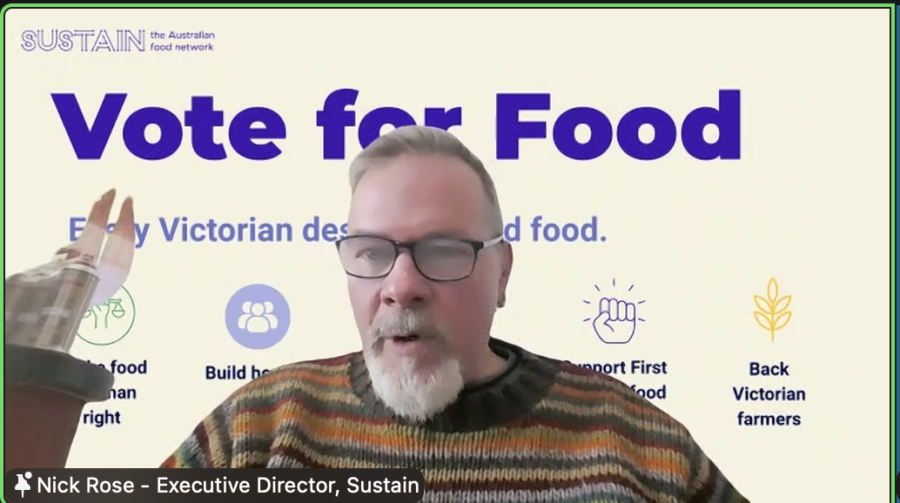 Nick Rose leads discussions at the webinar
Local pain
Sustain’s #VoteforFood campaign says Australia produces enough food to feed 90 million people, yet prices are soaring, farmers are struggling, and food insecurity is rising.
“Currently, food policy is fragmented across government departments, causing contradictions, inefficiencies and missed opportunities,” it says. “Our food system faces many threats, including climate change, the supermarket duopoly, loss of fertile farmland due to urban sprawl and geopolitical instability threatening supply chains”.
People attending the webinar shared local examples of the crisis, including that Waminda Community House in regional Benalla has reported a 92 percent increase in the number of local people who presented in person for food relief between September 2025 and June 2026.
“Waminda provided food relief to 2,405 adults (~20% pop’n) and uncounted children between July 2025 and June 2026, while attendance at its free Thursday lunches increased by 104 percent over the same period — for a region of 12,300,” a webinar participant posted in the chat.
A representative of Bass Coast Shire Council, south east of Naarm/Melbourne, reported similar concerns.
“We have five food relief locations in Bass Coast and all of them have seen a striking increase in weekly numbers of people access their emergency food relief service and/or community meals,“ the representative said.
Sustain says these hardships have to be seen as a failure of public policy rather than an ‘unfortunate’ consequence of economic hardship.
This week has delivered further such examples of harmful policies , including a warning from the Melbourne-based Asylum Seekers Resource Centre (ASRC) that it may have to raise up to $1 million a week “just to provide basic food in Victoria if thousands more people seeking asylum are stripped of their right to work”.
A separate report from the Australian Council of Social Service and UNSW found an alarming number of refugees already spend their first decade in Australia in poverty. The first year for those entering the country on a humanitarian visa – which means they have usually fled conflict or persecution – is particularly grim.
On average, around three in five (59 percent) live in households with $400 or less a week, while 73 percent live in households with $500 or less a week. Some still live with that meagre, insufficient household income ten years later, at huge risk to health and wellbeing, and longevity, the report said.
That’s also the case for people living on other income support. An analysis by the Australian Institute of Health and Welfare of mortality outcomes between 2012 and 2022 shows ‘the close relationship between socioeconomic disadvantage and health outcomes in Australia”.
It found, for example, the average morality rate of people receiving unemployment payments was 270 deaths per 100,000 person-years — four times as high as the rate for people not receiving income support.
No fry zones
Sustain said a rights-based approach to food calls for a systemic, structural approach, asking: What conditions must government create so that everyone can access adequate, nutritious and culturally appropriate food with dignity?”
That doesn’t mean having government supply everyone’s food, it said, but “accepting public responsibility for progressively creating the social, economic and physical conditions in which the right can be realised,” it said.
That would mean governments have to consider food access when developing other policies, including housing and planning, agriculture and public food procurement (including potentially school meals) and to assess whether laws and budgets are improving or undermining access.
Similar issues were top of mind at last week’s 11th Global Conference of the Alliance for Healthy Cities (AFHC2026) in Sydney. In one political sesson, NSW Planning Minister Paul Scully was upbeat about a Performance and Wellbeing Framework introduced by the State Government and plans for a state planning framework for tackling climate risks.
But he drew the line at specific efforts to address a concentration of fast food and takeaway outlets, particularly around town centres, schools, and disadvantaged areas, which health experts say are creating “obesogenic environments”.
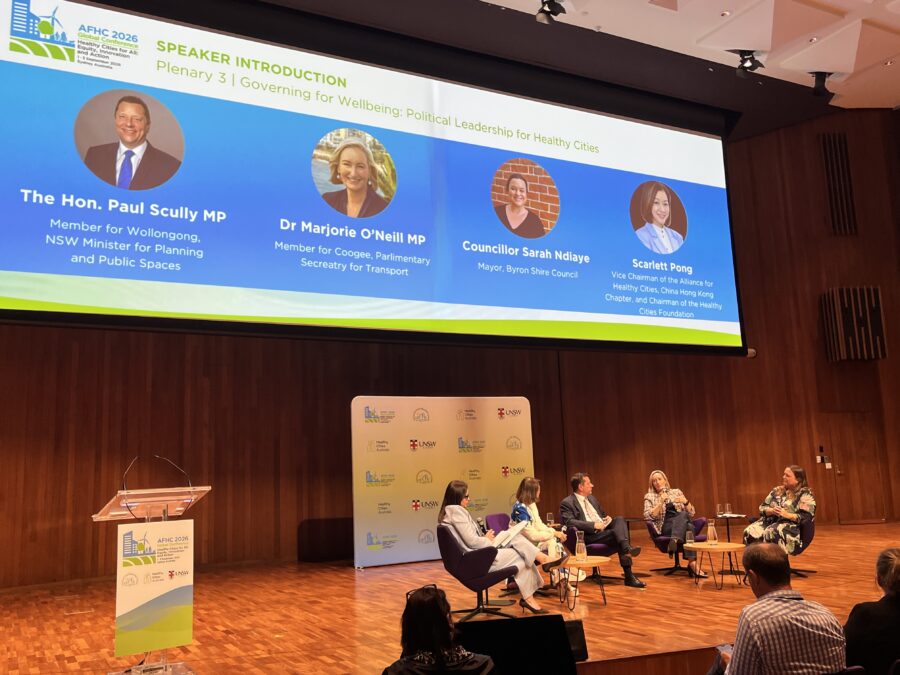 NSW Planning Minister Paul Scully, centre, at the global cities conference. Photo by Marie McInerney
Many jurisdictions around the world have taken tougher action on fast food and food security, including areas in the UK and Ireland that have introduced ‘no fry zones’ around schools.
New York’s popular Mayor Zohran Mamdani is also leading the way with plans to build five city-owned grocery stores, one in each borough and starting in Harlem and the Bronx.
Under his model, the City will own the land and cover overhead costs like rent and construction. A private operator, selected through a request for proposals, will manage daily operations and be required to pass savings directly to customers on a core basket of everyday staples.
The city stores will not offer cigarettes, alcohol, lottery tickets or hot foods.
“When corporations control every part of the food supply chain, prices go up, basic necessities become luxuries and workers and customers both lose,” Mamdani said in a statement.
“A public option allows us to intervene where the market has failed. We cannot accept a status quo where even the most fundamental needs — putting food on the table — feel out of reach.”
Competing interests
But, unsurprisingly, Mamdani is facing significant kick-back to his plan, including from small businesses.
Dr Dori Patay, a senior research fellow with Sydney’s Leeder Centre for Health Policy, Economics and Data, has written that food system governance “is fraught with competing interests, policy incoherence and power asymmetries”.
She told the Sustain webinar that getting healthy change is difficult when “certain actors are more powerful than others”, and where some departments, communities and stakeholders are regularly excluded.
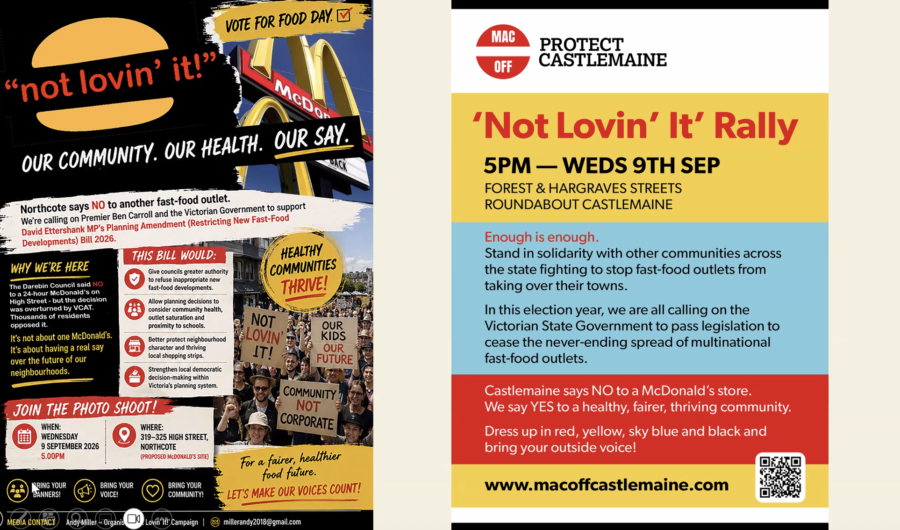
Sustain, which has warned that local planning regimes that are ‘putting corporate hunger first’, is highlighting local actions in Victoria that are aiming to give local government greater powers.
A number of communities, including regional Castlemaine, Philip Island and Bendigo, are trying to use or strengthen state planning laws to stop the approval of fast food outlets and ensure supply and access to healthy foods at affordable prices.
The most high profile case is playing out now in Melbourne’s inner north, where a new McDonald’s is set to open in Northcote — just 50 metres from the local primary school.
Advocates are drawing hope from a question put to Parliament last month by the Northcote MP Kat Theophanous, a member of the Victorian Labor Government, who asked how the state’s new planning framework, which posits health and wellbeing as a core objective, might help “moderate the proliferation of fast-food outlets like the McDonald’s slated for Northcote”.
She said it’s well known that “multinational fast-food outlets have a disproportionate influence on food environments and everyday nutritional choices”.
National issues
While Sustain has its focus right now on Victoria, food security, quality, access and affordability are growing national issues.
The Federal Government is due to publish its Feeding Australia national food security strategy in mid-2027 and will need to address its commitment to a “zero hunger target” by 2030 as a signatory to the United Nation’s Sustainable Development Agenda.
But Lindberg said Australia is unlikely to see demand for emergency food drop in the near future, amid cost of living pressures and food price spikes driven by the volatile global context.
She said a “constellation of synergistic programmes and policies, or a jigsaw effect” is needed to address the underlying causes, as well as support people in a time of crisis.
Lindberg told the webinar she became involved in food security research and analysis after working for a food charity 15 years ago.
“My CEO said our unofficial job was to put ourselves out of business and that’s what I’ve made my career goal,” she said.
See Croakey’s archive of articles on food security