
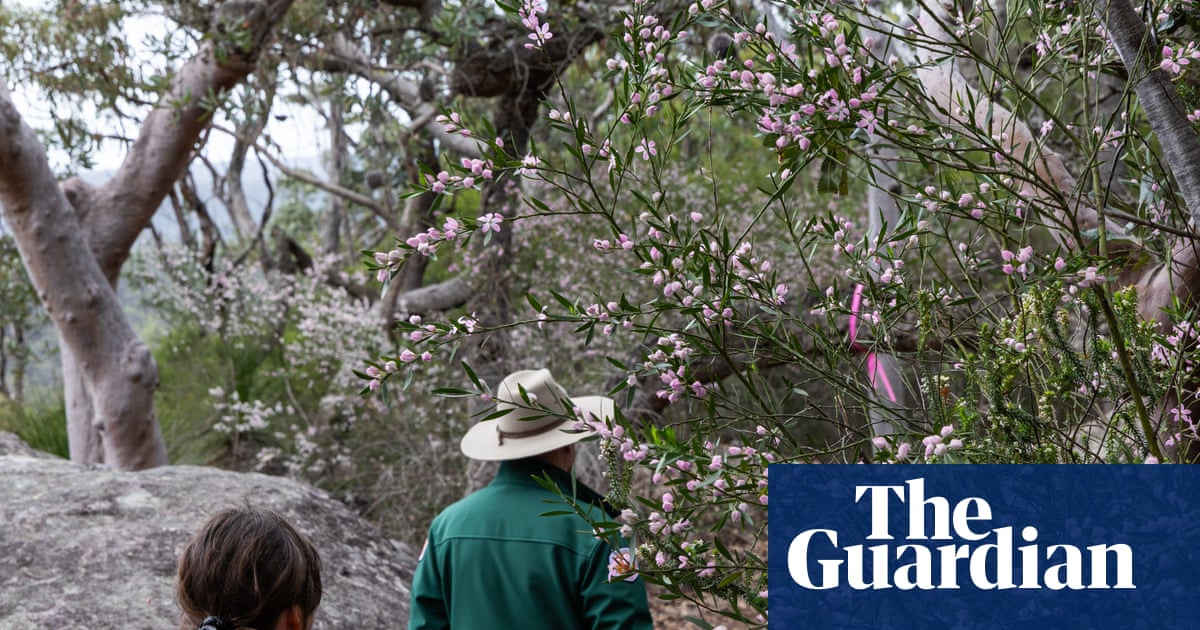
On a cloudy Spring morning, a group of 20 nature enthusiasts gather at the entrance to a nature park on the northern edge of Sydney. “Good to see nobody is wearing thongs,” our volunteer tour leader, Helen Logie, says to chuckles.
We are among just under 5,000 people lucky enough to visit Muogamarra nature reserve during the six weeks a year it is open to the public, coinciding with wildflower season. This year, tickets – which provide access to a limited number of guided and self-directed walks – sold out in less than a week.
On the windy drive in, cars slowed to marvel at waratahs, now in full bloom – one of the threatened species that people flock here year after year to witness.
A NSW waratah (Telopea Speciosissima) in the Muogamarra nature reserve, NSW, Australia Photograph: Blake Sharp-Wiggins/The Guardian
The fully native nature reserve, encompassing 2,300 hectares on the edge of the Hawkesbury River, has been protected for almost a century and inhabited by traditional owners for at least 20,000 years.
Its fragile ecosystem and Aboriginal cultural heritage cuts it off to public access for most of the year, providing a unique experience.
The park was a prominent Aboriginal meeting place and is littered with shell middens and sacred sites, some of which remain inaccessible to the public. In the 1930s, the conservationist and engineer John Duncan Tipper took a lease of about 800 hectares of the land.
Helen Logie, a volunteer tour guide, speaks to the group during a walk through the reserve. Photograph: Blake Sharp-Wiggins/The GuardianA beetle hides in a large wedge-pea (Gompholobium grandiflorum). Photograph: Blake Sharp-Wiggins/The Guardian
Tipper was concerned about continuing damage to Sydney’s national parks in what was a period of great species collapse in Australia. Koalas were being shot by the thousands, and great swathes of wildflowers were being cut down and sold in the city.
We are heading out on two walks this morning, including Tipper Loop and a 2km trek to the western lookout. There are 900 plant species here, 14 mammals and more than 100 varieties of birds, but it’s the wildflowers that are the drawcard.
Logie points out a huge Gymea lily, which producers clusters of trumpet-shaped red flowers, and smoke bush, which has intricate white flowers that – viewed close up – look like lace.
An intricate-looking smoke bush (Conospermum longifolium). Photograph: Blake Sharp-Wiggins/The GuardianA Gymea lily (Doryanthes excelsa). Photograph: Blake Sharp-Wiggins/The Guardian
As we inspect a woody pear, the sound of a fan-tailed cuckoo rings out in the distance. The trees here are hundreds of years old, the perfect habitat for native avian life. Logie says sometimes they spot wedge-tailed eagles and lyrebirds. There are even rumours of koalas – though nobody sees one.
The soil here is sandstone, common to the steep ridge tops of the Hawkesbury, and volcanic. In these harsh conditions, native species have managed to thrive – sometimes due to, not in spite of, the poor ground quality.
We pass a purple sun orchid that has only recently come into bloom, and lobelia, which emerges only after fire. Back-burning has recently been completed in preparation for summer, and green shoots are already bursting on top of blackened gum.
skip past newsletter promotion
Sign up to Five Great Reads
Each week our editors select five of the most interesting, entertaining and thoughtful reads published by Guardian Australia and our international colleagues. Sign up to receive it in your inbox every Saturday morning

after newsletter promotion
An eastern yellow robin (Eopsaltria australis). Photograph: Blake Sharp-Wiggins/The Guardian
It’s been an unseasonably warm, wet winter, Logie explains, and many of the species have been flowering and dying off early. It’s hard, if not impossible, to control the environment so that everything is in bloom during the six-week window when the park is open.
That’s what makes Muogamarra different to botanical gardens or tulip festivals – nothing is curated, everything is transient. Logie is excited by a lady’s finger flower she hadn’t seen last time she was here.
I find my mind start to calm as I scan the landscape for pops of colour, the usual traffic sounds of the city replaced by bird song and the crunching of leaves. As we approach the western lookout, we suddenly reach an expanse of pink wax flowers, dog rose and boronias, hugging the track like a native Barbie wonderland.
Then the view appears: in front of us, Pete’s Crater and Pete’s Bite, a volcanic diatreme and dyke system, the mangroves of Bar island and the Hawkesbury River, and, to our left, the Blue Mountains and national park.
Greg Kirby, a national parks area manager, says there are not many parts of NSW left with ‘such little human intervention’. Photograph: Blake Sharp-Wiggins/The GuardianSome pink wax flowers (Eriostemon australasius). Photograph: Blake Sharp-Wiggins/The Guardian
The sheer scale of it takes my breath away. There is something profoundly peaceful about disconnecting into nature, to be able to witness the landscape as it used to be before western intervention.
Greg Kirby, the manager of north western Sydney’s National Parks & Wildlife Service, says there are not many parts of New South Wales with “such little human interaction”.
“The longstanding protection means it’s pristine,” he says. “And in spring, it’s just this cacophony of colour. You’re surrounded by it.”
As we return to the reality of the highway, I gaze out at farmland and strings of introduced tree species with a new suspicion. Perhaps my herb patch could use an upgrade.