
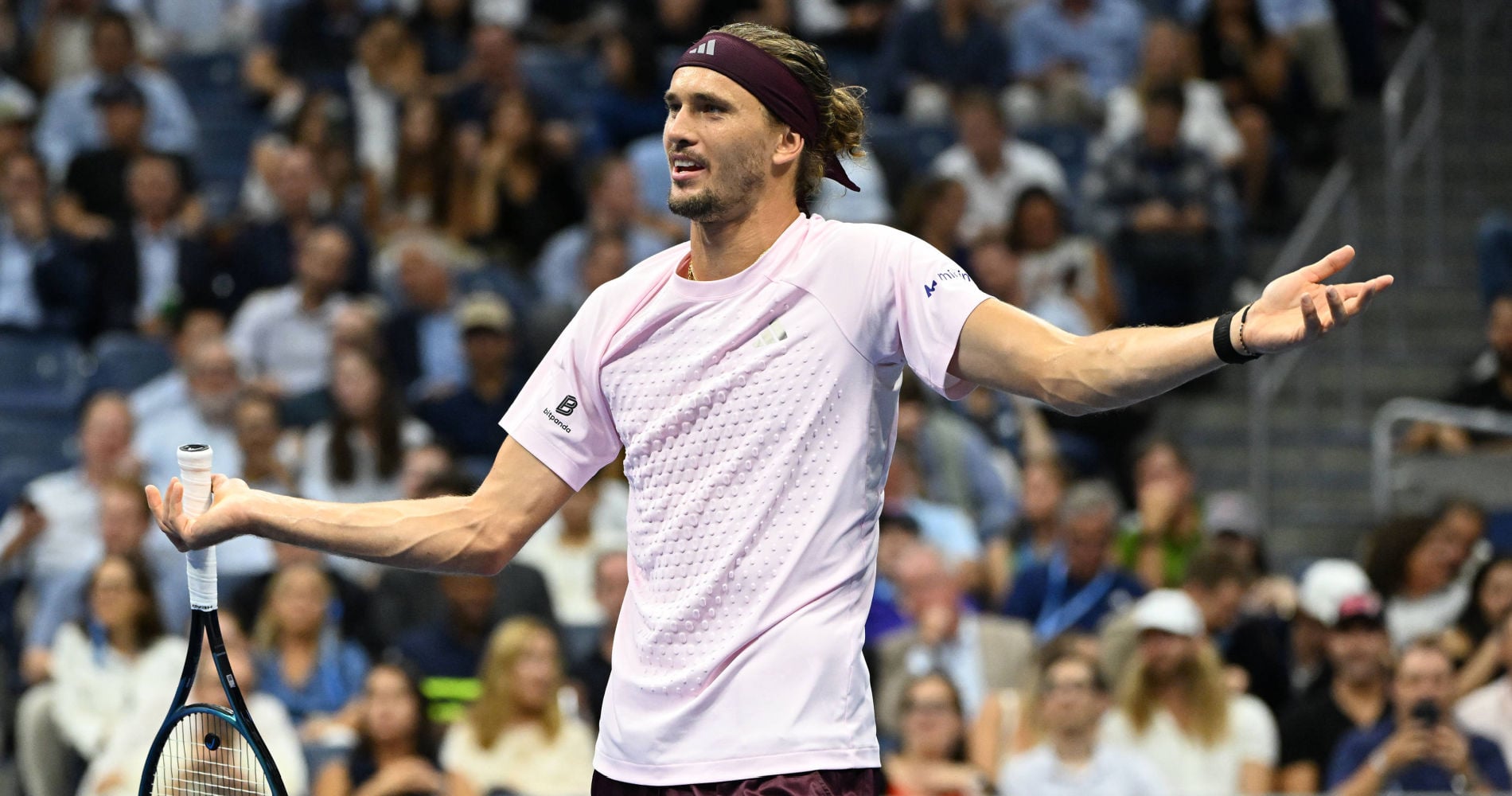
He then declined to make it a grievance. “At the end of the day, if it’s within the rules with the time between points, I cannot say anything against that, because it’s within the rules. If he extends the time, then gets time violation, so it’s pretty simple as that.”
Told that the shot clock had reached zero on several occasions while the bouncing continued, Khachanov put the responsibility with the chair rather than the opponent, and admitted he has been on the receiving end of the same complaint himself.
“I’m not the guy who would ask umpire to look at it. I don’t like to do that. I don’t like when opponents are, I think in some situations they mention to me even that I am honestly averaging 12 seconds or 15 seconds every point. I think it’s a job of umpire to notice and to be more aware and actually take the action. So it’s up to him, not to me.”
A fortnight of counting
The routine has been one of the running subjects of this tournament on social media, where the bounces have been counted match by match and clipped point by point. The most circulated figure is 12,040 pre-serve bounces across Zverev’s first five matches here, which comes from a fan count rather than an audited tournament statistic and is best treated as an approximation.
The range reported across outlets is 18 or 19 bounces before a typical serve, rising to around 25 on some points.
I saw the stat. Like, I bounced it 12,000 times or something like that. That’s quite funny.
Zverev has seen the numbers and cannot account for them “I have no idea why,” the German top seed said after reaching the final. “I’m not doing it on purpose. I saw the stat. Like, I bounced it 12,000 times or something like that. That’s quite funny.”
He is not, he says, working to a target. “I’m not counting in my head. I’m not getting a certain number or anything like that. I don’t know why it increased so much. I think today it decreased again, because I saw it before the semifinal, so I was, like, okay, it’s got to go less. Then I forget about it every once in a while, and then it goes up to I don’t know what number it is.”
Asked what finally makes him stop and serve, he was no closer to an answer. “No clue. Really, honestly, no idea.”
The rule
The 2026 Grand Slam Rule Book allows a maximum of 25 seconds from the moment the ball goes out of play at the end of a point until the ball is struck for the first serve of the next one. It says nothing whatever about how many times the ball may be bounced inside that window, and it sets no clock at all between a first serve and a second, requiring only that the second be struck “without delay”.
A first offence brings a time violation warning. After that, a server who exceeds the limit loses a first serve and a receiver concedes a point. The same section also lets an umpire call a violation before the 25 seconds have elapsed if the receiver is delaying the server’s reasonable pace, which is the provision Khachanov says opponents have raised about him.
Zverev plays Ben Shelton in the final on Sunday.