
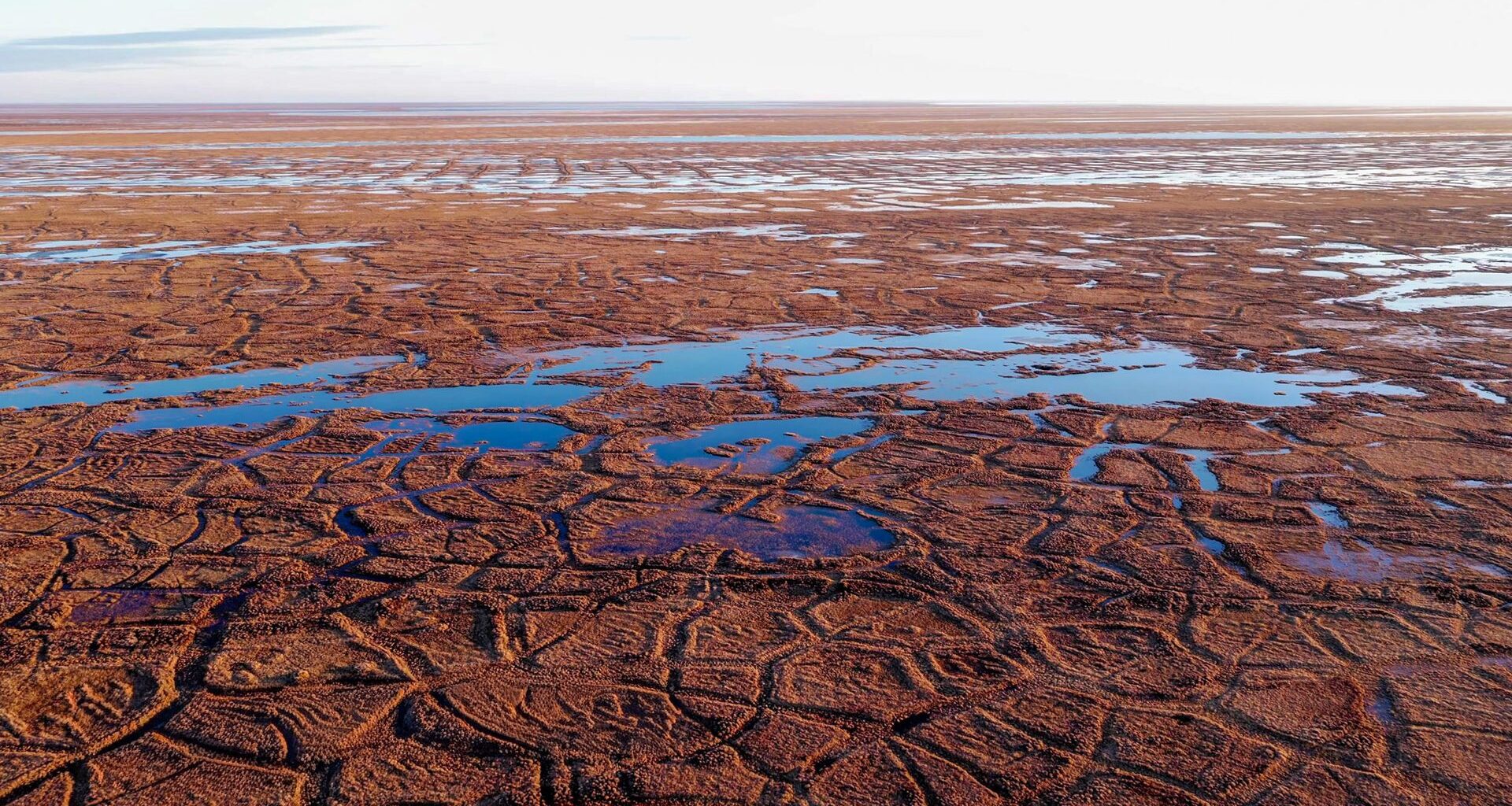
Warming-induced emissions from permafrost, wetlands, and wildfires could add up to 0.7°F by 2100, and most climate models leave them out.
Forecasts of how hot this century will get start with how much coal, oil, and gas people burn. But as frozen ground thaws, wetlands warm up and forests burn, the planet releases greenhouse gas of its own. A new model estimates that this extra gas could add 0.4°F to 0.7°F (0.2°C to 0.4°C) by 2100 on top of the warming people cause.
That would amplify the warming projected for the rest of this century by a fifth to a third, and most of the models behind today’s forecasts don’t include that feedback. It’s a model’s calculation, not a measurement, and the uncertainty is as wide as the number itself.
Dr. Sam Abernethy, a research scientist at Spark Climate Solutions, a nonprofit, led the work with colleagues at Woodwell Climate Research Center, Stanford University and the Environmental Defense Fund.
“What surprised us was the size of the feedback: we found that natural systems could amplify global warming by 20 to 30 percent,” Abernethy said. “This hidden multiplier is missing from the models guiding climate policy, so those models are likely underestimating how much warming is coming – and overestimating how much carbon we can still afford to emit.”
Most climate models skip this feedback
Some of warming’s effects cause more warming. Warmer air holds more water vapor, for one, and the big Earth system models behind the IPCC‘s reports have included that for decades. What most of them don’t include is the gas that comes out of the ground, the wetlands and the burning forests as the temperature climbs.
The authors call that gas warming-induced emissions. The IPCC’s last major report used 11 of those models to study feedbacks. None of them covered extra methane from wetlands or from lakes and rivers, only two had thawing permafrost, and five had fire.
Because of that gap, the authors wrote, today’s projections are likely to show less warming than will actually happen. They also allow a bigger remaining carbon budget than really exists.
Four natural sources were added to one model
Abernethy’s team took four sources: permafrost, wildfires, wetlands, and lakes and rivers. For each one, an earlier study had already projected how much carbon dioxide or methane it would release as the world warmed.
The team converted those projections into simple rules: so much extra gas for every degree of warming. Then it tested the rules across three futures, from strong climate action to one where warming keeps climbing through 2100.
In all three futures, the methane rule came out the same. Together, the four sources release about 107 million tons (97 million metric tons) more methane a year for every 1.8°F (1°C) of warming.
Then the team fed the added gas into a stripped-down climate model called MAGICC. It runs fast enough to be repeated 600 times with different settings for how sensitive the climate is.
Permafrost carbon adds the most warming
By 2100, the extra methane could reach 55 to 210 million tons (50 to 190 million metric tons) a year, depending on the future. That’s more than all the human-caused methane North America emits today at the low end, and more than Asia’s at the high end.
The added carbon dioxide, from thawing ground and fire, could reach between 5% and 40% of what fossil fuels emit today.
In the climate model, that gas adds about 0.4°F (0.2°C) by 2100 in the strong-action future, 0.5°F (0.3°C) in the middle one and 0.7°F (0.4°C) in the higher-emissions one. Carbon dioxide and methane contribute about equally, and carbon dioxide from thawing permafrost is the single largest piece.
Christina Schädel, a senior research scientist at Woodwell and a co-author, led the earlier study whose permafrost projections this one builds on.
“Permafrost scientists have long warned that thawing soils would become a significant emissions source as the planet warms,” Schädel said. “This paper shows that permafrost thaw accounts for half of the anticipated warming-induced emissions.”
Cutting emissions shrinks the feedback too
The rules scale with temperature, so the less people warm the planet, the less the planet adds on its own. Abernethy told Earth.com that this is the finding he wanted to highlight.
“They directly respond to the warming that we cause, so this is yet another argument about the necessity of cutting emissions from fossil fuels, agriculture, and other human activities,” he said.
There is a catch. Even in the strong-action future, the feedback’s warming keeps rising through 2100. Carbon dioxide builds up in the air, and an emission takes six to ten years to reach its full effect.
So cutting emissions shrinks the future feedback, the authors wrote, but it can’t undo the warming from gas already released.
Earth.com also asked about the remaining carbon budget, the carbon dioxide the world can still emit and stay under the Paris limits of 2.7°F (1.5°C) and 3.6°F (2°C). It shrinks, Abernethy said, by an amount that depends on the path taken.
The IPCC already trims its budgets by one fixed number for permafrost carbon dioxide. In the team’s runs, the adjustment to the carbon budget more than doubled between the strong-action and higher-emissions futures.
“Just having one correction term isn’t enough because the source strengths can vary so much depending on the scenario,” he said.
The uncertainty is as big as the estimate
Every rule rests on a single earlier study, and where two estimates exist for the same source, they disagree. For wetlands, a second model estimates a methane response nearly twice as large as the one the team used.
“All four of these feedbacks are highly uncertain – I wouldn’t yet say there’s one that the scientific community is confident about,” Abernethy said. “Permafrost is likely the most uncertain, both in its magnitude and timing, partially because it is the largest source.”
Before 2050 the uncertainty is bigger than the estimate itself. Only by 2100 does the whole range stay above zero in all three futures.
The authors also list what they left out, and some of it would raise the estimate while some would lower it. Methane from rice paddies, carbon dioxide from dying forests and nitrous oxide are all missing. Permafrost that thaws into new wetland doesn’t add wetland methane in the model, either.
These emissions also cause warming that triggers more emissions. Counting that loop would raise the projection by about 18% by 2100.
On the other side, the model skips the plants that grow back after thaw and fire and take carbon up again. It also skips feedbacks involving aerosols and plant vapors that are so uncertain that even their direction isn’t settled.
Are these feedbacks already showing up?
Asked whether the feedbacks are already visible in the atmosphere, Abernethy said they are, with a caveat. The evidence comes from the chemical makeup of methane in air samples, which differs by source.
“Yes, although it’s a noisy signal with high year-to-year variability,” he said. “There is some evidence in particular that tropical wetland methane emissions have already increased, based on isotopic atmospheric measurements. And forest fire emissions are increasing in the boreal regions, which impacts the climate as well as air quality.”
Still missing is a side-by-side comparison of several models of these feedbacks. The big climate models are compared that way before every IPCC report, and Spark is convening one now. The authors also want the next IPCC assessment to correct its carbon budgets in a way that changes with the emissions path.
Abernethy also said greenhouse gas monitoring networks need improving. They would give early warning of these feedbacks, and more data for the models.
Until then, the size of the planet’s own contribution rests on one earlier study per source. And the rules were tested only up to 5.9°F (3.3°C) of warming; past that, the authors wrote, the relationship between temperature and emissions could change.
The full study was published in the journal Environmental Research Letters.
—–
Like what you read? Subscribe to our newsletter for engaging articles, exclusive content, and the latest updates.
Check us out on EarthSnap, a free app brought to you by Eric Ralls and Earth.com.
—–