
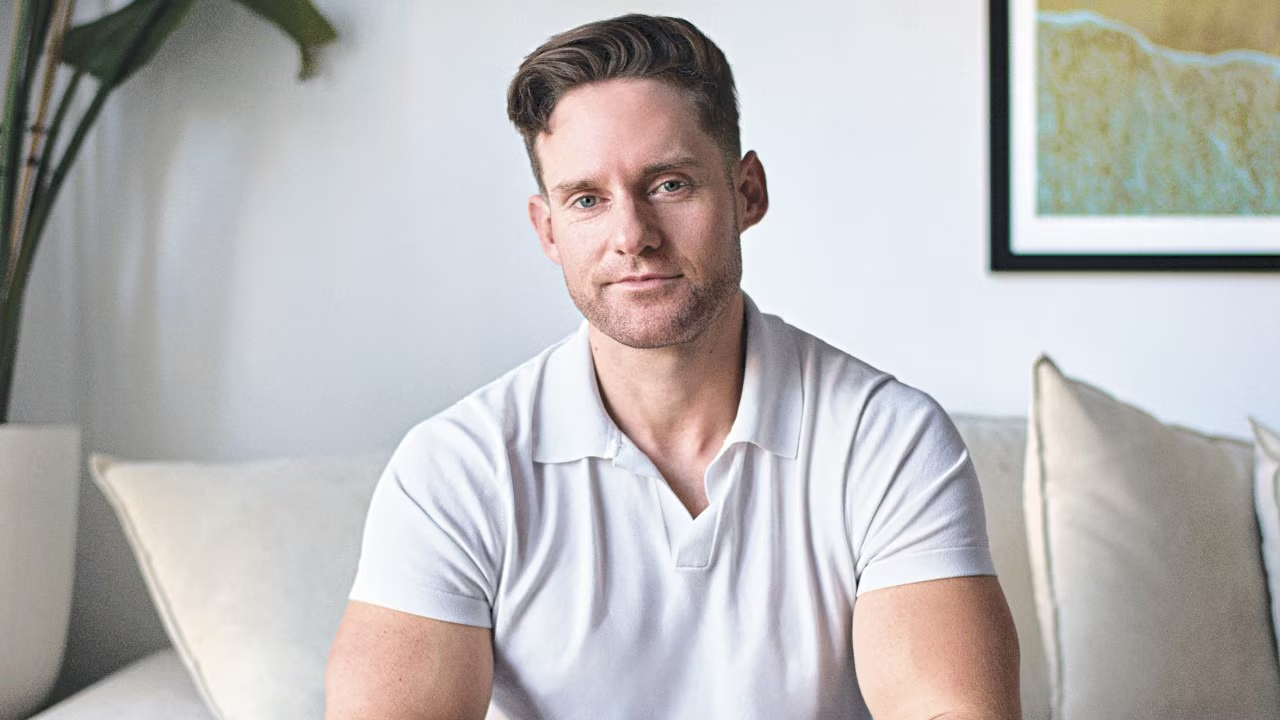
The author, consultant psychiatrist, and ADHD specialist tells all.
You have a new book out, This Explains Everything: A psychiatrist’s guide to navigating adult ADHD. What inspired you to journey into the world of adult ADHD for your latest book? And tell me about your choice for the title: ‘This Explains Everything’.
Yeah, I love that as a place to start and it’s interesting because I think both of those questions almost come together because the kind of light bulb to write the book, and then the real inspiration behind it, was that sense of meeting adults and then seeing them for ADHD assessment and having this huge moment for them when they’re where they like ‘Oh my god, this explains everything’ or ‘this explains so much’. Every week I was meeting men and women where that was the sort of underlying feeling that was bringing them to me. But then if we confirmed ADHD was there, that’s usually the front runner emotion or feeling behind it. And so it was like trying to box that into a concept for a book, to encapsulate that feeling for people to read and to feel seen and heard, and then give some some really great – hopefully great – evidenced information about what adult ADHD actually is, because there’s a lot of misinformation and confusion around it. This Explains Everything [as a title] just felt perfect because that’s the feeling that so many patients get, which is hopefully what the book kind of leaves people feeling as well.

I think the masking element is one of the biggest. Masking for adult ADHD, what that really means and looks like, is really just working so incredibly hard under the surface to scaffold, twist, mask, contain, hide ADHD symptoms so that people don’t see them on the outside. I meet so many adults who are really hyperactive and restless and fidgety and want to interrupt everyone on the inside, but people would never see that because they’re working so hard all the time to just hold themselves or stop or bite their tongue. And then I also meet so many people in super successful prominent positions that are doing really well on the outside but they’re exhausted and burnt out because on the inside they’re doing all this masking to have 20 different calendars so that they don’t forget things or double check everything, even triple check everything because they’re used to rushing it and making mistakes and missing details. So I think the biggest misconception for adult ADHD is that someone has to look like a bit of a hot mess on the outside. I think that’s the stereotypical, really unfortunate stigmatising view of ADHD, is that someone is just all over the place, they’re disorganised, the house is a bomb site, they’re struggling to hold down a job. That’s not what adult ADHD looks like for so many people I meet. And I think that misconception around what ADHD looks like on the surface compared to underneath, that’s the biggest thing that I kind of want to push through. And especially with the book, I wanted to let people know what it actually can feel like, even if that’s just on the inside.
Something you explore in your book is ‘the must-knows for women with ADHD’. Why was it important to you to highlight this area specifically and what are some of your key ‘must-knows’?
We know that historically women and girls have been significantly under-diagnosed when it comes to ADHD, and there’s some really interesting things around that. So we know that girls and women are more likely to have inattentive symptoms – so they’re less likely to be hyperactive, loud, impulsive, but they’re more likely to struggle on the inside with focus, distractibility, forgetfulness, maybe internalised hyperactivity that no one sees. And then I think because girls and women unfortunately still get a lot of gender pressures pushed onto them, there’s really interesting research showing that that means girls and women are more likely to mask and internalise and cover up their symptoms compared to boys. So for decades, if not centuries, girls and women just literally got missed, and even the older diagnostic criteria for ADHD, they really disadvantaged women being diagnosed because you literally had to have some of those more overt hyperactive men/boy typical symptoms to be diagnosed, whereas that’s changed now so the criteria are more inclusive so that women are thankfully finally getting recognised.
There’s a lot out there about, ‘are we over-diagnosing’ or ‘are too many women now getting diagnosed with ADHD’ and I want to push back on that. That’s just all absolute rubbish and I think part of the problem is that that’s even out there. We still know that women are under-diagnosed when it comes to ADHD, and if we think that two to six percent of the adult population have ADHD, of that two to six percent, so many are still undiagnosed and more women than men are undiagnosed. It kind of hits home that this is just such an important area that we need to be getting more information out there for women.
What are some lesser-known diagnostic symptoms of adult ADHD that you think more people should be aware of?
Some lesser known symptoms that are actually really common for adults can be things like holding in and containing the urge to finish someone’s sentence, or interrupt, even if we’re not doing it on the outside. Another one is not just struggling to focus for tasks and activities to actually complete things, but struggling to focus and be present when someone is talking or when we’re listening to other people. I talk to so many adults who say they’re constantly getting into little fights with their partner, or they’re getting in trouble at work, because they just cannot stay focused when that person is telling them something, giving them instructions, talking to them about their day. It can make people feel really guilty. Other people can interpret it as rude, or you just don’t care, but struggling to listen to others and take in information is a really common symptom.
You also cover what friends and family members can do to support others with ADHD. If you were to share one piece of advice for people who want to support an adult they know with ADHD, what would it be?
I think the biggest thing I would want friends, family and loved ones of someone with ADHD to understand is that some of these things that are impacting work and relationships, or that we might be seeing or feeling from that loved one with ADHD – that’s nothing to do with an actual choice. It’s not down to their motivation, their intelligence, their drive. It’s not because of rudeness. I think if friends and family have a little bit more openness to understanding where some of these things are coming from, it can just help everyone. It helps the person with ADHD and it helps the friend or family or support person on the other side know that this isn’t an active choice, it’s nothing intentional or malicious, and that can kind of really just improve the whole family system or relationship when it comes to moving through things.
If someone wants to learn more about ADHD, or feels they can relate to any of the symptoms or experiences you describe in your book, where should they go to get more information and support?
Your GP is such a good place to start. GPs are just amazing in terms of their breadth of knowledge, what they know about local access, they will have links to psychiatrists they’ve worked with before or psychologists, so I think starting with your GP is a really good place to start. I think if that question mark is there, and even if it doesn’t turn out to be ADHD, it’s always just asking the question.
There are also some really good resources. There’s the ADHD Foundation Australia which has heaps of really good information for people [with ADHD], but then also family members, parents, partners, and it has some really great info now about adult ADHD as well.
You have degrees in psychology, human physiology and medicine, as well as specialist training as a Consultant Psychiatrist. What led you to become an ADHD specialist?
I’m just so interested in people and I love (probably too much) talking to people and hearing about their experiences and goals and heartbreaks. So when I started seeing people for ADHD, because I fell into a role where I started seeing more people for ADHD symptoms and then did some further training and expertise in that area specifically, I was just fascinated by the differences in people’s experiences and how our minds work. I love understanding how someone else’s brain works differently to mine, and there’s so many strengths with neurodiversity and ADHD and autism as well. So it’s just a really fascinating, rewarding area to just literally talk to people all day about how they focus, how they chase goals, how their relationship goes. So I just find it fascinating.

Exercise is a non-negotiable for me. A workout, a jog, even going for a walk – it’s a non-negotiable to keep stress, mental health, sleep just flowing for me. And then, I’m not perfect at it, but I also think just some protected time to try and clock off – my partner is good at trying to make me do that. Just some time to put the laptop away, put my phone on silent – even if it’s an hour. Trying to get some time in the day to just chill or do something I enjoy. That’s not always possible but I think protecting even a tiny bit of time, that’s also a key thing that I try and advocate for, for mental health, because otherwise we can literally get to the end of the week and we can realise we’ve literally had no time for just our own thoughts or time because the world is just constantly bombarding us.
You are a doctor and very healthy person – but do you have any surprisingly unhealthy habits people might be surprised about?
I’m like, really bad for wanting to watch a movie on the couch and just chill, but then also having my laptop open, and being on my phone, and like getting up to make food. So again, I guess it comes back to that switching off thing ironically, I’m probably not the best at that at times. I’ve definitely got a sweet tooth as well. So as much as I love to look after my health and I go to the gym a lot, I am an absolute sucker for a bowl of ice cream or chocolate.
Rapid Fire Round
Can’t start my morning without: Coffee
Currently listening to: I’m re-listening to The OC season 1 soundtrack
Currently watching: The OC season 1!
Currently reading: I’m re-reading Ikigai: The Japanese Secret to a Long and Happy Life by Francesc Miralles and Hector Garcia
Person you’d love to meet: Doctor Mike (American family physician)
Dream holiday destination: Anywhere in Italy (even if I’ve already been)
Favourite hobby: Going to the gym
Something you wish you were better at: Playing the piano
Current obsession: Chicken from Chargrill Charlies